
[Paper Review] TripoSR: Fast 3D Object Reconstruction from a Single Image
TripoSR is a fast feed-forward transformer-based model that reconstructs high-quality textured 3D meshes from a single image in under 0.5 seconds on an A100 GPU, achieving state-of-the-art results among open-source methods.
This technical report introduces TripoSR, a 3D reconstruction model leveraging transformer architecture for fast feed-forward 3D generation, producing 3D mesh from a single image in under 0.5 seconds. Building upon the LRM network architecture, TripoSR integrates substantial improvements in data processing, model design, and training techniques. Evaluations on public datasets show that TripoSR exhibits superior performance, both quantitatively and qualitatively, compared to other open-source alternatives. Released under the MIT license, TripoSR is intended to empower researchers, developers, and creatives with the latest advancements in 3D generative AI.
Motivation & Objective
- Motivate fast, accurate 3D reconstruction from a single image for research and application deployment.
- Enhance data quality and diversity to improve generalization to in-the-wild images.
- Develop a memory-efficient, high-fidelity triplane-NeRF framework with robust training strategies.
- Provide open-source access to model, code, and demo under MIT license.
Proposed method
- Build on the LRM architecture with a transformer-based image encoder and a triplane-NeRF decoder.
- Use an image encoder initialized from DINOv1 to project RGB input into latent vectors for 3D reconstruction.
- Introduce a triplane-based NeRF with 40 channels to balance quality and memory.
- Incorporate a mask loss to reduce floaters and improve reconstruction fidelity.
- Train with high-resolution rendering patches (128x128 crops from 512x512 images) and importance sampling to emphasize foreground details.
- Condition the triplane projection with learned camera parameters (instead of fixed camera conditioning) to improve robustness to real-world inputs.
Experimental results
Research questions
- RQ1Can a fast, feed-forward transformer-based model produce high-fidelity 3D meshes from a single image?
- RQ2Does enhancing data curation and rendering, along with targeted architectural and training tweaks, yield state-of-the-art reconstructions among open-source methods?
- RQ3How does TripoSR perform in terms of shape accuracy and texture quality compared with existing baselines on standard benchmarks?
Key findings
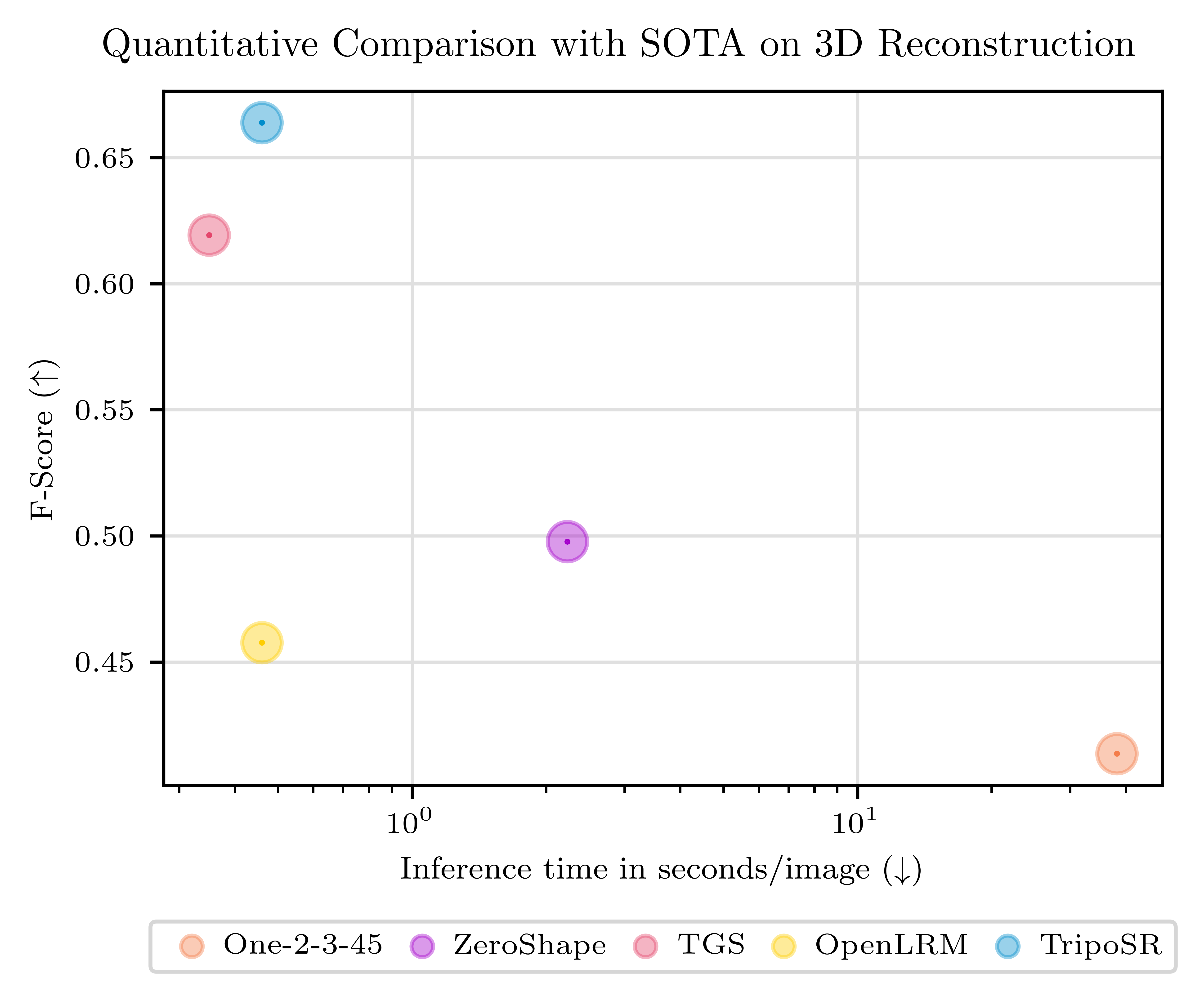
- Achieves state-of-the-art quantitative performance (CD and F-score) on GSO and OmniObject3D among feed-forward single-image 3D reconstruction methods.
- Infers a 3D mesh from a single image in about 0.5 seconds on an NVIDIA A100 GPU.
- Outperforms baselines such as One-2-3-45, ZeroShape, TGS, and OpenLRM on both datasets in Chamfer Distance and F-score metrics.
- Introduces data and training enhancements (data curation from Objaverse, diverse rendering, triplane channel optimization, mask loss, and patch-based high-resolution supervision) that collectively improve reconstruction quality and efficiency.
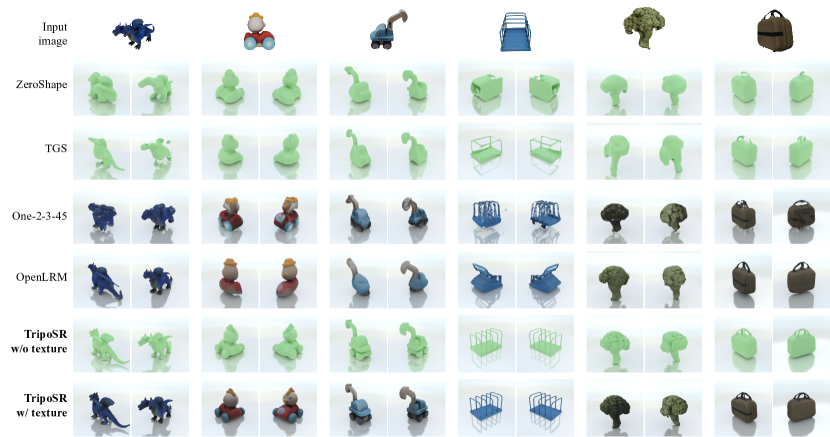
- Produces textured meshes, with qualitative results showing better detail alignment and texture fidelity compared to competing methods.
Read this paper
Open the full text in the Nubint reader and ask about any passage as you read.
Read this paper on NubintThis review was generated by AI from the original paper. Please check the paper before citing it.