
[论文解读] Ultraviolet Compactness of High-Redshift Galaxies as a Tracer of Early-Stage Gas Infall, Bursty Star Formation, and Offset from the Fundamental Metallicity Relation
本研究利用 JWST NIRSpec/NIRCam 数据探查紧凑性与局部 FMR 金属丰度偏移在 z>3 星系中的关系,发现 FMR 稍微演化以及紧凑性与金属缺乏之间的联系,支持随机且自内向外的早期恒星形成。
The empirical anti-correlation between gas-phase metallicity and star formation rate (SFR) at a fixed stellar mass, known as the fundamental metallicity relation (FMR), is commonly interpreted as an equilibrium state in the interplay between gas infall, enrichment, and gas removal. JWST/NIRSpec spectroscopy has shown a $z>3$ deviation from the local-universe FMR calibrations, suggesting that these galaxies are potentially caught out of equilibrium. To investigate this, we inferred the stellar population, nebular, and morphological properties of 427 galaxies at $310^9M_{\odot}$ galaxies exhibit negligible redshift evolution. We also confirm the redshift evolution of the FMR: $z>3$ galaxies appear metal-deficient compared to expectations for their stellar mass and SFR according to the local-universe FMR. This offset grows with redshift. Metal deficiency is correlated with compactness: galaxies most offset from the average mass-size relation are also the most metal-poor for their stellar mass and SFR. We interpret this as a product of bursty star formation: compact galaxies exhibit elevated SFR surface densities, indicating that they are observed during burst episodes triggered by gas infall. While accretion of metal-poor gas has reduced their gas-phase metallicity by diluting the interstellar medium, they are observed prior to chemical yield release by newly formed massive stars. Simply, they are chemically out of equilibrium compared to the equilibrium state known as the FMR.
研究动机与目标
- 解释超出 z≈3 的质量-金属丰度关系的红shift演化并测试高红移时 FMR 的适用性。
- 探究更紧凑的高红移星系是否更缺少金属并在局部 FMR 标定中有偏移。
- 测量 z>4 星系的 rest-UV 尺寸与质量-尺寸关系并评估其随红移的演化。
- 评估紧凑性是否与 FMR 偏移相关,以推断早期气体吸积和随机星形成模式。
提出的方法
- 汇编一个包含 427 颗 z>3 星系的样本,这些星系同时具备 NIRSpec 棱镜光谱和 NIRCam 光度测量(334 颗来自公开计划 + 93 颗来自 JADES)。
- 使用 galight 结合 WebbPSF 的点扩展函数(PSF)测量 rest-UV 尺寸,以确保整个样本的一致性。
- 通过 SED 拟合(prospector/FSPS)和发射线分析(pPXF 与 MILES 库)推断恒星质量、SFR 与金属丰度。
- 使用 R23 和 O32 诊断,结合 EW(Hβ) 作为 ISM 电离性的代理,推导气相金属丰度并解析金属丰度的简并性。
- 通过 Andrews & Martini (2013) 的标定(翻译为 Chabrier IMF,见 Nakajima 等 2023)将恒星质量和 SFR 预测的金属丰度,用来评估 FMR 的红shift 演化。
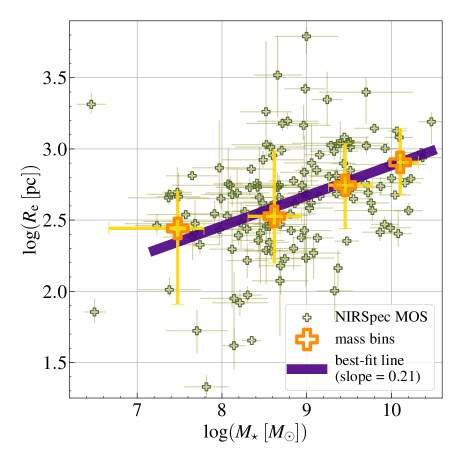
- 以 κ log(M*) − log(Re) 来量化星系紧凑性,κ 固定为发现的质量-半径斜率(0.21)。
实验结果
研究问题
- RQ1在 z>4 时,基本金属丰度关系是否存在温和演化,以及高红移金属丰度与 FMR 预测相比如何?
- RQ2在 z>3 时,星系紧凑性与气相金属丰度之间是否存在稳健的负相关,指示早期气体吸积?
- RQ3z=4–10 星系的质量-尺寸关系的红移演化是什么,且这种演化如何依赖于恒星质量?
- RQ4紧凑、低金属丰度、高 SFR 的系统是否支持 earliest 星系的内向外、随机星形成场景?
主要发现
- 使用局部 FMR 标定时,z>3 星系的基本金属丰度关系偏移存在温和的红shift 演化。
- z=4–10 的质量-尺寸关系的最佳拟合幂律斜率为 0.21 ± 0.04。
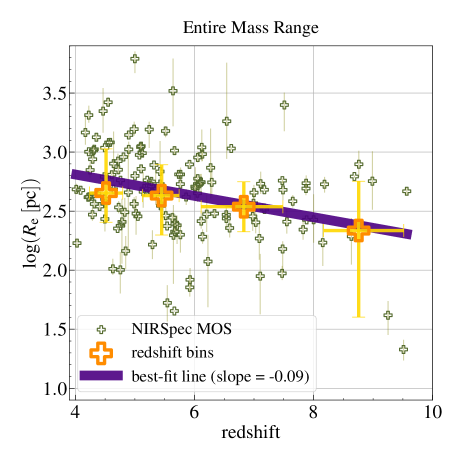
- 在固定恒星质量时,星系在更高红移时变得更紧凑,尺寸-红shift 关系斜率为 −0.090 ± 0.02。
- 在固定质量下,更紧凑的星系往往金属不足且更偏离局部 FMR 标定,呈现线性 FMR 偏移对紧凑性的关系,斜率 −0.35 ± 0.11,截距 −0.56 ± 0.09。
- 该分析支持 earliest 星系的内向外、爆发式星形成图景,快速的中心吸积驱动紧凑、低金属丰度的核心。
更好的研究,从现在开始
从论文设计到论文写作,大幅缩短您的研究时间。
无需绑定信用卡
本解读由 AI 生成,并经人工编辑审核。