
[Paper Review] Unconventional phonon spectra and obstructed edge phonon modes
This paper introduces unconventional phonon spectra in topologically trivial materials, where phonon band representations (eBR) do not align with atomic vibration band representations (aBR), identifying two types: type I (on empty sites) and type II (on atoms with non-atomic orbitals). Black phosphorus exhibits type-I unconventionality, while 1H-MoSe₂ shows type-II; both host obstructed edge phonon modes, suggesting enhanced electron-phonon coupling at boundaries.
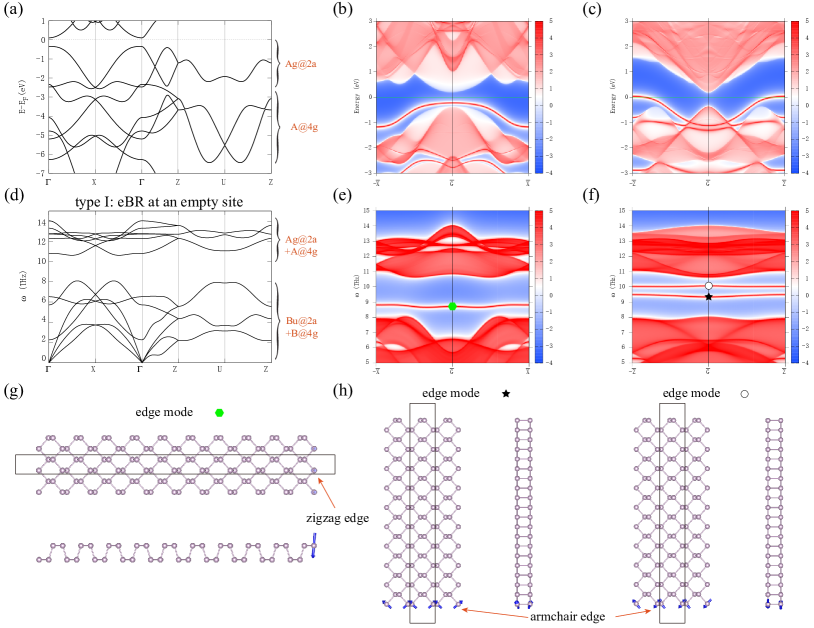
Based on the elementary band representations (EBR), some topologically trivial materials are classified as unconventional ones (obstructed atomic limit), where the EBR decomposition of electronic states is not consistent with the atomic valence-electron band representations. In the work, we identify that the unconventional nature can also exist in phonon spectra, where the EBR decomposition of the phonon modes is not consistent with atomic vibration band representations (ABR). The unconventionality has two types: type I is on an empty site; type II is on an atom site with non-atomic vibration orbitals. Our detailed calculations show that black phosphorus (BP) and 1H-MoSe2 have unconventional both phonon spectra and electronic band structures. The BP has the type-I unconventional phonon spectrum, while 1H-MoSe2 has the type-II one. The obstructed phonon modes are obtained for two types of unconventional phonon spectra.
Motivation & Objective
- To extend the concept of obstructed atomic limits from electronic to phononic systems using elementary band representations (eBR).
- To identify and classify unconventional phonon spectra in materials where eBR decomposition does not match atomic vibration band representations (aBR).
- To investigate the coexistence of unconventional electronic and phononic band structures in materials like black phosphorus and 1H-MoSe₂.
- To demonstrate the emergence of obstructed edge phonon modes in frequency gaps, analogous to obstructed electronic states.
- To explore the implications of phonon unconventionality for electron-phonon coupling and surface properties in 2D materials.
Proposed method
- First-principles density functional theory (DFT) calculations using the Quantum ESPRESSO package with PBE-GGA exchange-correlation functional.
- Projector augmented-wave (PAW) method for electronic structure and phonon calculations with a vacuum layer >15 Å to avoid interlayer coupling.
- Phonon band structures computed and irreducible representations extracted using the ir2ph code.
- eBR and aBR decomposition of phonon modes performed via the UnconvMat website using tqc.data files from DFT outputs.
- Analysis of band representations based on space group symmetry and Wyckoff positions to identify eBR-aBR mismatch.
- Edge phonon modes computed and visualized to confirm obstructed character and topological-like behavior in frequency gaps.
Experimental results
Research questions
- RQ1Can the concept of obstructed atomic limits, originally applied to electronic bands, be extended to phonon spectra?
- RQ2What are the distinct types of phonon unconventionality, and how do they differ in their origin (empty site vs. non-atomic orbital sites) hề?
- RQ3Do materials with unconventional electronic band structures also exhibit unconventional phonon spectra?
- RQ4Can obstructed edge phonon modes emerge in frequency gaps, and what is their physical origin?
- RQ5What is the role of symmetry and Wyckoff positions in determining the eBR-aBR mismatch in phonon bands?
Key findings
- Black phosphorus (BP) exhibits a type-I unconventional phonon spectrum, where the eBR decomposition of phonon bands does not match the atomic vibration band representations (aBR), due to occupied eBRs at empty Wyckoff positions (4g and 2a).
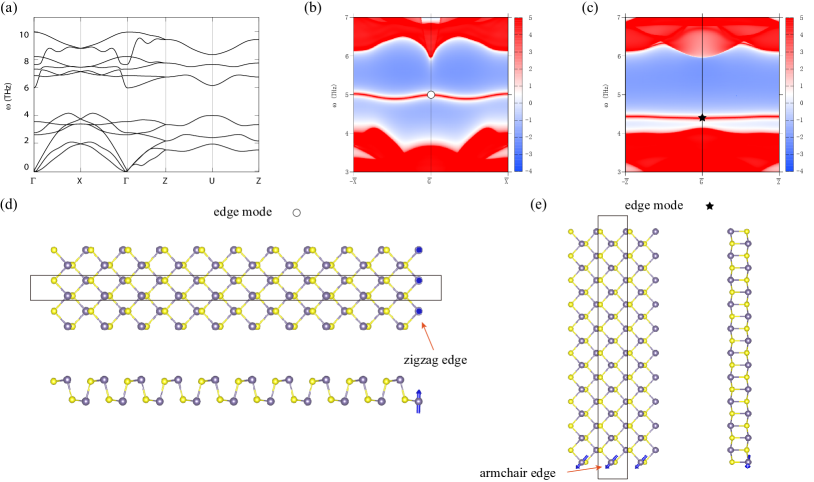
- 1H-MoSe₂ displays a type-II unconventional phonon spectrum, with eBRs centered on Mo atoms (1c site) but involving non-atomic p-orbital-like vibrations, indicating a mismatch with aBRs.
- The phonon band structure of BP splits into two well-separated parts, with the lower six bands belonging to $B@4g + B_u@2a$ eBRs, while the upper six belong to $A@4g + A_g@2a$ eBRs.
- In 1H-MoSe₂, the nine phonon bands split into three parts: $A_2''@1c + E'@1c$, $A_1'@1c + E''@1c$, and $A_2''@1c + E@1c$, with the middle part not matching aBRs of Mo atoms.
- Obstructed edge phonon modes are observed in both BP and 1H-MoSe₂, localized at zigzag and armchair edges, with distinct vibrational patterns confirmed via visualization.
- Janus 1H-MoSSe, a derivative of 1H-MoSe₂, retains electronic unconventionality (type I) but fails to support full phonon unconventionality due to reduced symmetry, though edge phonon modes persist.
Better researchstarts right now
From reading papers to final review, dramatically reduce your research time.
No credit card · Free plan available
This review was created by AI and reviewed by human editors.