
[Paper Review] UniTime: A Language-Empowered Unified Model for Cross-Domain Time Series Forecasting
UniTime proposes a unified, language-empowered Transformer model for cross-domain multivariate time series forecasting that overcomes domain-specific data characteristics, domain confusion, and convergence speed imbalances through domain instructions, a Language-TS Transformer, and adaptive masking. It achieves state-of-the-art performance and strong zero-shot generalization across diverse domains like energy, weather, and economics.
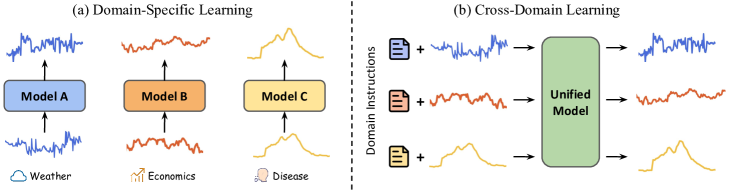
Multivariate time series forecasting plays a pivotal role in contemporary web technologies. In contrast to conventional methods that involve creating dedicated models for specific time series application domains, this research advocates for a unified model paradigm that transcends domain boundaries. However, learning an effective cross-domain model presents the following challenges. First, various domains exhibit disparities in data characteristics, e.g., the number of variables, posing hurdles for existing models that impose inflexible constraints on these factors. Second, the model may encounter difficulties in distinguishing data from various domains, leading to suboptimal performance in our assessments. Third, the diverse convergence rates of time series domains can also result in compromised empirical performance. To address these issues, we propose UniTime for effective cross-domain time series learning. Concretely, UniTime can flexibly adapt to data with varying characteristics. It also uses domain instructions and a Language-TS Transformer to offer identification information and align two modalities. In addition, UniTime employs masking to alleviate domain convergence speed imbalance issues. Our extensive experiments demonstrate the effectiveness of UniTime in advancing state-of-the-art forecasting performance and zero-shot transferability.
Motivation & Objective
- To develop a unified time series forecasting model that generalizes across diverse application domains without requiring dedicated models per domain.
- To address the challenge of varying data characteristics (e.g., number of variables, sequence lengths) across domains.
- To mitigate domain confusion by enabling the model to distinguish between different time series distributions using natural language instructions.
- To alleviate domain convergence speed imbalance through a masking strategy that stabilizes training across domains with different dynamics.
- To enable effective zero-shot transfer learning by leveraging instruction-based generalization across unseen domains.
Proposed method
- UniTime employs a Language-TS Transformer that jointly encodes time series tokens and natural language domain instructions to align modality representations.
- It uses domain-specific instructions as input context to guide the model in distinguishing between different time series domains and improving feature alignment.
- A masking strategy is applied during training to stabilize convergence across domains with varying temporal dynamics and learning speeds.
- The model leverages pretrained GPT-2 weights for the language encoder, enabling strong inductive bias for instruction understanding.
- An instruction selection protocol is used at inference time, selecting the most suitable instruction from training data based on performance on a small subset of test samples.
- The architecture supports flexible input dimensions, allowing adaptation to time series with varying numbers of channels and sequence lengths.
Experimental results
Research questions
- RQ1Can a unified time series forecasting model effectively generalize across diverse domains with varying data characteristics?
- RQ2How does incorporating natural language instructions improve model performance and domain discrimination in cross-domain time series forecasting?
- RQ3To what extent does masking help balance convergence speeds across domains with different temporal dynamics?
- RQ4Can a unified model achieve strong zero-shot transfer performance on unseen domains without fine-tuning?
- RQ5How do different fine-tuning strategies for the pretrained language model affect overall forecasting performance?
Key findings
- UniTime consistently outperforms strong baselines across multiple datasets, including Electricity, ETTh1, ETTh2, and Weather, demonstrating state-of-the-art performance in cross-domain forecasting.
- The model achieves superior zero-shot generalization, with the instruction selection protocol successfully identifying the best-performing instruction (from ETTh1) for unseen datasets like Electricity and Weather.
- Freezing the entire pretrained language model still yields strong performance, indicating that the PLM’s self-attention mechanism inherently captures useful representations for time series tokens.
- Fine-tuning the full language model yields the best results, followed by the FPT (frozen parameters except positional embeddings and normalization) strategy, which offers a good trade-off between performance and efficiency.
- The model’s performance is significantly degraded when the input order is reversed (time series before instructions), confirming the importance of attention flow from instructions to time series tokens.
- The use of pretrained language model weights leads to substantially better performance than random initialization, highlighting the value of pretraining on large-scale text corpora.
Read this paper
Open the full text in the Nubint reader and ask about any passage as you read.
Read this paper on NubintThis review was generated by AI from the original paper. Please check the paper before citing it.