
[论文解读] Updates to ALMA Site Properties: using the ESO-Allegro Phase RMS database -- ALMA Memo 624
本文利用来自 ALMA 第3至第7周期的超过17,000次 ALMA 观测数据,结合 ESO-Allegro 相位均方根(RMS)数据库,对 ALMA 台址的大气相位稳定性进行了全面且长期的分析,量化了基线长度(500–10,000 米)和 timescales(30–240 秒)下的相位均方根(RMS)。研究结果表明,智利冬季(6月至8月)提供了最佳观测条件,相位均方根和水汽柱总量(PWV)均较低,且证实快速切换相位参考技术可有效缓解高频、长基线观测中的相位变化。
We present a long-term overview of the atmospheric phase stability at the Atacama Large Millimeter/submillimeter Array (ALMA) site, using >5 years of data, that acts as the successor to the studies summarized two decades ago by Evans et al 2003. Importantly, we explore the atmospheric variations, the `phase RMS', and associated metadata of over 17000 accrued ALMA observations taken since Cycle 3 (2015) by using the Bandpass calibrator source scans. We indicate the temporal phase RMS trends for average baseline lengths of 500, 1000, 5000, and 10000m, in contrast to the old stability studies that used a single 300m baseline phase monitor system. At the ALMA site, on the Chajnantor plateau, we report the diurnal variations and monthly changes in the phase RMS on ALMA relevant baselines lengths, measured directly from data, and we reaffirm such trends in atmospheric transmission (via Precipitable Water Vapour - PWV). We confirm that day observations have respectively higher phase RMS and PWV in contrast to night, while the monthly variations show Chilean winter (June - August) providing the best, high-frequency and long-baseline observing conditions - low (stable) phase RMS and low PWV. Yet, not all good phase stability condition occur when the PWV is low. Measurements of the phase RMS as a function of short timescales, 30 to 240s, that tie with typical target source scan times, and as a function of baseline length indicate that phase variations are smaller for short timescales and baselines and larger for longer timescales and baselines. We illustrate that fast-switching phase-referencing techniques, that allow short target scan times, could work well in reducing the phase RMS to suitable levels specifically for high-frequencies (Band 8, 9 and 10), long-baselines, and the two combined.
研究动机与目标
- 提供 ALMA 台址大气相位稳定性的长期、系统性评估,填补自 Evans(2003)开创性研究以来的空白。
- 利用真实观测数据,量化不同基线长度(500–10,000 米)和 timescales(30–240 秒)下的相位均方根(RMS)变化。
- 将相位稳定性与气象参数(如水汽柱总量(PWV)、风速和温度)相关联,以识别最佳观测条件。
- 开发并发布一个公开可访问的相位均方根(RMS)数据库,附带辅助脚本,以支持未来 ALMA 观测规划与科学优化。
- 评估快速切换相位参考技术在缓解高频、长基线观测中大气相位波动方面的有效性。
提出的方法
- 利用来自超过17,000个 ALMA 执行块(EBs)的通带校准源扫描数据,覆盖第3至第7周期(2015–2019年),并持续整合2020–2021年的数据。
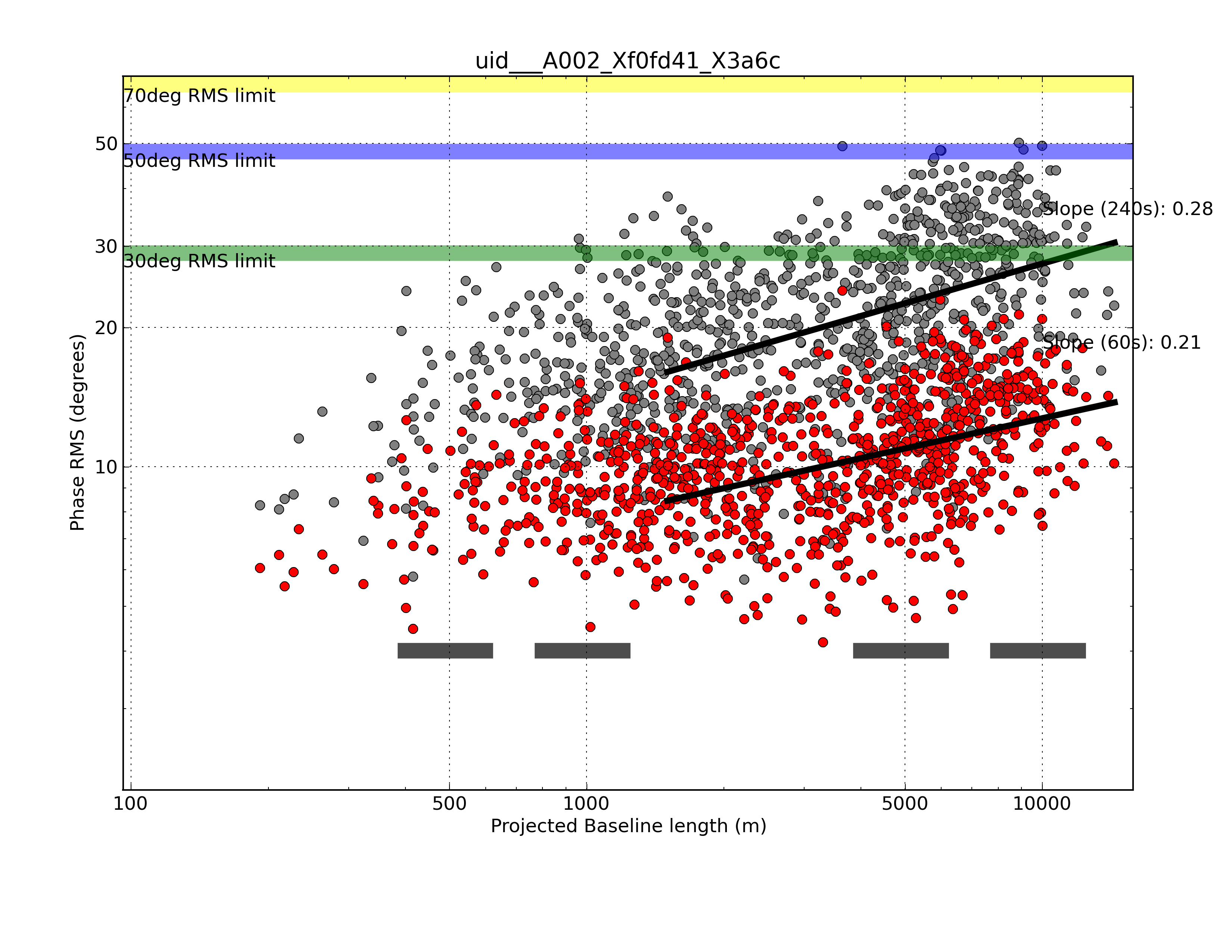
- 基于短 timescales(30–240 秒)内的相位解算结果,将相位均方根(RMS)计算为路径长度变化的微米(µm)单位,代表典型目标扫描持续时间。
- 将相位均方根(RMS)测量标准化为四种基线长度:500 米、1,000 米、5,000 米和 10,000 米,以支持对比分析。
- 构建结构化 SQL 数据库,包含多个表格:Overview、Source、Summary、Baseline、ResidualSummary、ResidualBaseline、DphaseSummary 和 DphaseBaseline,用于存储相位均方根(RMS)和残差相位数据。
- 采用 gaintable 基校准方法,通过使用定期(如每30秒)的相位解作为参考点,提取残差相位变化,然后计算残差的均方根(RMS)。
- 使用伪 D-phase 值(相位解之间差异的中位数)进行稳健性检查,尤其在长时间尺度下解算点较少时更具优势。
实验结果
研究问题
- RQ1在 ALMA 台址,大气相位稳定性(相位均方根(RMS))在5年以上的时段内,如何随不同基线长度(500–10,000 米)而变化?
- RQ2相位均方根(RMS)和水汽柱总量(PWV)的日变化与月变化趋势如何?它们与观测条件有何关联?
- RQ3低水汽柱总量(PWV)条件是否能保证低相位均方根(RMS)?是否存在尽管 PWV 较低但相位稳定性仍差的情况?
- RQ4快速切换相位参考技术在缓解高频(波段8–10)和长基线观测中的相位均方根(RMS)方面效果如何?
- RQ5相位均方根(RMS)数据库能否用于改进观测策略并最大化 ALMA 的科学产出?
主要发现
- 智利冬季(6月至8月)提供了最佳观测条件,相位均方根(RMS)最低,水汽柱总量(PWV)最低,尤其有利于高频和长基线观测。
- 白天观测的相位均方根(RMS)和水汽柱总量(PWV)显著高于夜间,表明日间大气变化影响了相位稳定性。
- 相位均方根(RMS)随基线长度和积分 timescales 的增加而上升,从30秒增至240秒时数值升高,证实更长 timescales 会放大大气波动。
- 在短 timescales(如30–60 秒)和短基线条件下,相位变化较小,表明快速切换相位参考技术可有效降低相位噪声。
- 相位均方根(RMS)数据库已包含超过17,000次数据摄入(截至2021年底完成度达87%),现可通过 ALMA 科学门户公开访问,并附带社区可用的辅助脚本。
- 残差相位均方根(RMS)和 D-phase 测量结果表明,相位稳定性在长时间尺度(>120 秒)下最易受损,此时每条扫描的相位解算点数量极少。
更好的研究,从现在开始
从阅读论文到最终审阅,大幅缩短您的研究时间。
无需绑定信用卡
本解读由 AI 生成,并经人工编辑审核。