
[论文解读] Updating the $^{56}$Ni Problem in Core-collapse Supernova Explosion
本研究通过一维拉格朗日流体动力学模型结合光球灯近似下的中微子加热,探究了大质量恒星超新星中的⁵⁶Ni问题。结果表明,尽管⁵⁶Ni合成范围对爆发能量增长速率($ olimits\dot{E}_{\text{expl}}$)不敏感,但⁵⁶Ni的抛射质量强烈依赖于最内层物质是否逃逸。因此,慢速爆发($ olimits\dot{E}_{\text{expl}} \lesssim 1$ 贝特每秒)无法重现贫氢包层超新星中观测到的⁵⁶Ni质量,后者需要更快的早期爆发阶段($ olimits\dot{E}_{\text{expl}} \gtrsim 2$ 贝特每秒)。
Details of the core-collapse supernova (CCSN) explosion mechanism still need to be fully understood. There is an increasing number of successful examples of reproducing explosions in multidimensional hydrodynamic simulations, but subsequent studies pointed out that the growth rates of the explosion energy $\dot{E}_\mathrm{expl}$ of these simulations are insufficient to produce enough $^{56}$Ni to match observations. This issue is known as the `$^{56}$Ni problem' in CCSNe. Recently, however, some studies have suggested that this $^{56}$Ni problem is derived from the simplicity of the explosion model. In response, we investigate the effect of the explosion energy growth rate $\dot{E}_\mathrm{expl}$ on the behavior of nucleosynthesis in CCSNe in a more realistic model. We employ the 1D Lagrangian hydrodynamic code, in which we take neutrino heating and cooling terms into account with the light-bulb approximation. We reiterate that, consistent with previous rebuttal studies, there is the $^{56}$Ni problem: Although $^{56}$Ni is synthesized to almost the same mass coordinate independent of $\dot{E}_\mathrm{expl}$, some of the innermost material in the low-$\dot{E}_\mathrm{expl}$ model failed to escape, leading to a shift in the innermost mass coordinate of the ejecta to the outer positions. Comparing our results with observations, we find that while modern slow explosions can, in principle, reproduce observations of standard Type II SNe, this is not possible with stripped-envelope SNe. Our finding places a strong constraint on the explosion mechanism. There are significant differences in the progenitor structures and the explosion mechanism between Type II and stripped-envelope SNe.
研究动机与目标
- 为解决长期存在的核心坍缩超新星中⁵⁶Ni问题,即慢速爆发能量增长速率的模拟无法产生观测到的⁵⁶Ni质量。
- 研究爆发能量增长速率($\dot{E}_{\text{expl}}$)在包含中微子加热的一维流体动力学模型中对核合成与抛射质量的影响。
- 比较现代慢速爆发模型在标准II型超新星与贫氢包层超新星观测中的可行性。
- 确定⁵⁶Ni问题是否源于模型简化,还是爆炸动力学中的基本限制。
- 评估前身星结构差异或爆发机制变化是否可解释II型与贫氢包层超新星之间⁵⁶Ni产量的差异。
提出的方法
- 采用光球灯近似建模中微子加热与冷却项的一维拉格朗日流体动力学代码。
- 通过从0.1至5贝特每秒的初始爆发能量增长速率($\dot{E}_{\text{expl}}$)变化,实现自洽的爆发建模。
- 利用包含640种核素的核反应网络进行后处理核合成,计算⁵⁶Ni产量。
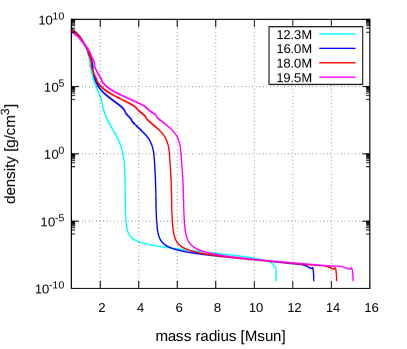
- 对初始质量为12.3、16.0、18.0和19.5 M$_\odot$的前身星在零时主序阶段进行模拟,涵盖不同的致密性与中微子光度。
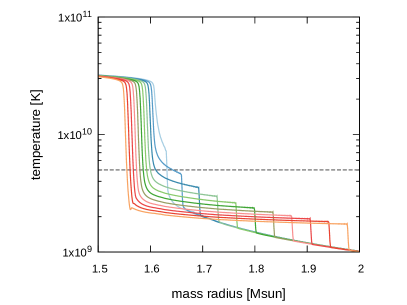
- 追踪激波、原生中子星(PNS)及⁵⁶Ni富集区域的质量坐标,以评估抛射物组成与逃逸条件。
- 将模拟得到的⁵⁶Ni质量与II型及贫氢包层超新星光曲线观测值进行比较。
实验结果
研究问题
- RQ1在自洽的中微子加热流体动力学模型中,核心坍缩超新星的⁵⁶Ni产量是否依赖于爆发能量增长速率($\dot{E}_{\text{expl}}$)?
- RQ2为何现代慢速爆发模拟($\dot{E}_{\text{expl}} \lesssim 1$ 贝特每秒)无法重现贫氢包层超新星中观测到的⁵⁶Ni质量?
- RQ3⁵⁶Ni产量与$\dot{E}_{\text{expl}}$之间的负相关性是否为先前模型中缺失初始坍缩所导致的数值伪影?
- RQ4慢速爆发能否再现标准II型超新星中观测到的⁵⁶Ni质量,还是必须依赖更快的爆发阶段?
- RQ5前身星结构或爆发机制的哪些物理差异可解释贫氢包层超新星中⁵⁶Ni质量高于II型超新星的原因?
主要发现
- ⁵⁶Ni合成范围(至何质量坐标)几乎与$\dot{E}_{\text{expl}}$无关,表明核合成对爆发速率不敏感。
- 在低$\dot{E}_{\text{expl}}$模型中,最内层物质无法逃逸,导致最内层抛射物质量坐标外移,从而减少总⁵⁶Ni质量。
- 尽管⁵⁶Ni合成量相似,但其抛射质量对最内层PNS表面区域是否达到逃逸速度极为敏感。
- 现代慢速爆发($\dot{E}_{\text{expl}} \lesssim 1$ 贝特每秒)可再现标准II型超新星中的观测⁵⁶Ni质量($M_{\text{Ni}} \approx 0.03 M_\odot$)。
- 然而,这些模型无法再现贫氢包层超新星中更高的⁵⁶Ni质量($M_{\text{Ni}} \approx 0.07 M_\odot$),后者要求$\dot{E}_{\text{expl}} \gtrsim 2$ 贝特每秒。
- 结果表明,II型与贫氢包层超新星之间在前身星结构或爆发机制上存在显著差异,后者更倾向于快速的早期爆发阶段。
更好的研究,从现在开始
从阅读论文到最终审阅,大幅缩短您的研究时间。
无需绑定信用卡
本解读由 AI 生成,并经人工编辑审核。