
[Paper Review] Using the IBM Analog In-Memory Hardware Acceleration Kit for Neural Network Training and Inference
This paper presents the IBM AIHWKit, a Python-based simulation toolkit that enables accurate modeling of analog in-memory computing (AIMC) hardware for deep neural network (DNN) training and inference. It integrates device nonidealities like noise and variability into PyTorch-like workflows, allowing researchers to train and evaluate DNNs under realistic AIMC conditions, with key contributions including hardware-aware training, customizable simulation components, and integration with a managed cloud platform (Analog AI Cloud Composer).
Analog In-Memory Computing (AIMC) is a promising approach to reduce the latency and energy consumption of Deep Neural Network (DNN) inference and training. However, the noisy and non-linear device characteristics, and the non-ideal peripheral circuitry in AIMC chips, require adapting DNNs to be deployed on such hardware to achieve equivalent accuracy to digital computing. In this tutorial, we provide a deep dive into how such adaptations can be achieved and evaluated using the recently released IBM Analog Hardware Acceleration Kit (AIHWKit), freely available at https://github.com/IBM/aihwkit. The AIHWKit is a Python library that simulates inference and training of DNNs using AIMC. We present an in-depth description of the AIHWKit design, functionality, and best practices to properly perform inference and training. We also present an overview of the Analog AI Cloud Composer, a platform that provides the benefits of using the AIHWKit simulation in a fully managed cloud setting along with physical AIMC hardware access, freely available at https://aihw-composer.draco.res.ibm.com. Finally, we show examples on how users can expand and customize AIHWKit for their own needs. This tutorial is accompanied by comprehensive Jupyter Notebook code examples that can be run using AIHWKit, which can be downloaded from https://github.com/IBM/aihwkit/tree/master/notebooks/tutorial.
Motivation & Objective
- Address the challenge of deploying DNNs on analog in-memory computing (AIMC) hardware, which suffers from device noise, nonlinearity, and circuit nonidealities.
- Provide a software toolkit that bridges high-level deep learning frameworks with accurate physical models of AIMC devices and peripheral circuits.
- Enable researchers to simulate and optimize DNNs for AIMC hardware without requiring access to physical chips or low-level circuit simulators.
- Facilitate the development of hardware-aware training algorithms by offering customizable simulation components and integration with cloud-based physical hardware access.
- Promote community-driven development by encouraging contributions to a well-maintained open-source toolkit to reduce tool fragmentation in the AIMC research space.
Proposed method
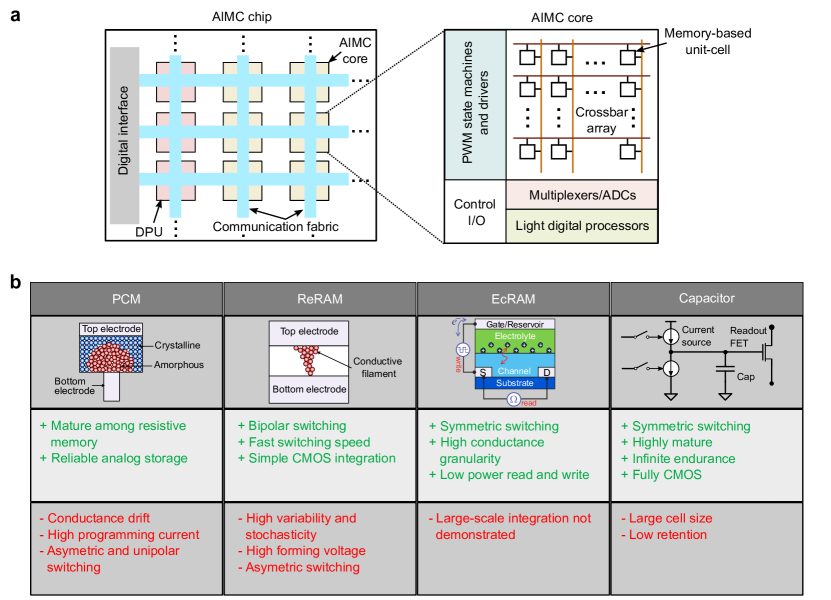
- Implement a simulation framework within the AIHWKit that models the physical behavior of non-volatile memory (NVM) devices such as PCM, ReRAM, and MRAM in crossbar arrays.
- Integrate device-level nonidealities including device-to-device variation, cycle-to-cycle variation, random telegraph noise (RTN), and conductance nonlinearity into the simulation pipeline.
- Support mixed-precision training and inference by modeling analog-to-digital (ADC) and digital-to-analog (DAC) conversion with configurable resolution and nonidealities.
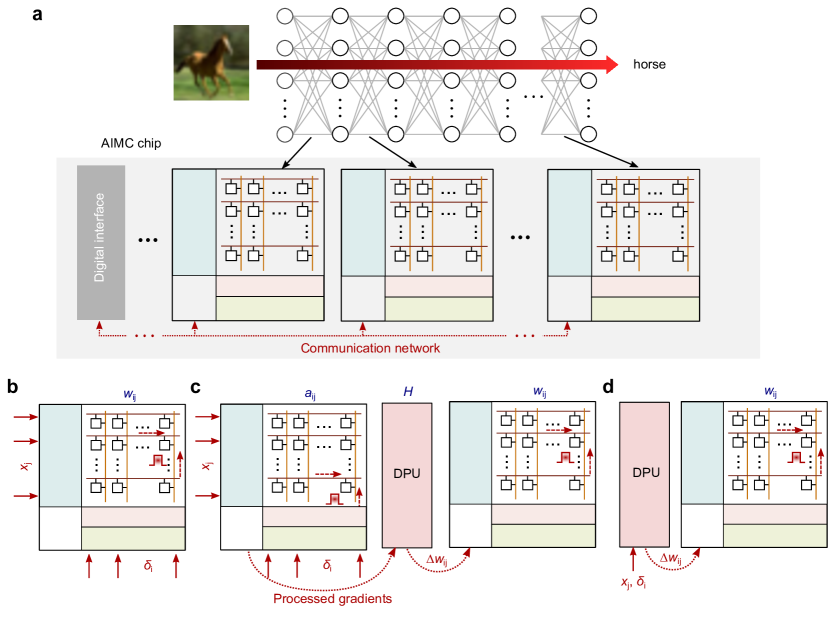
- Enable hardware-aware training (HWA) through analog gradient accumulation with dynamic reference (AGAD) and support for stochastic gradient descent (SGD) with analog weight updates.
- Provide a modular software architecture allowing users to extend functionality by overriding core components like AnalogTile or InferenceTile, and to integrate custom peripheral logic.
- Integrate with the Analog AI Cloud Composer, a managed cloud platform offering access to both simulated and physical AIMC hardware for end-to-end evaluation.
Experimental results
Research questions
- RQ1How can deep neural networks be effectively trained and inferred on analog in-memory computing hardware while accounting for device and circuit nonidealities?
- RQ2What are the key hardware-aware training strategies that can maintain DNN accuracy under the noisy and nonlinear characteristics of resistive memory devices?
- RQ3How can simulation toolkits like AIHWKit be architected to support both high-level DNN framework integration and low-level hardware modeling without requiring SPICE-level simulation?
- RQ4What are the performance and accuracy trade-offs of different precision and quantization schemes (e.g., bit slicing, mixed-precision) in AIMC-based inference?
- RQ5How can community-driven open-source development of simulation toolkits reduce fragmentation and accelerate progress in analog AI hardware research?
Key findings
- The AIHWKit enables accurate simulation of DNN inference and training on AIMC hardware with realistic device nonidealities, including RTN, conductance nonlinearity, and ADC/DAC quantization.
- Hardware-aware training using analog gradient accumulation (AGAD) and dynamic reference scaling maintains DNN accuracy comparable to digital training, even under significant device variability.
- The toolkit supports mixed-precision inference and training, with configurable ADC/DAC resolution, allowing researchers to evaluate the impact of low-precision arithmetic on model performance.
- The Analog AI Cloud Composer provides seamless access to both simulated and physical AIMC hardware, enabling end-to-end evaluation of DNNs in a cloud-based environment.
- Custom extensions to the AIHWKit—such as new peripheral operations or optimizer implementations—can be contributed via pull requests, ensuring long-term maintainability and community adoption.
- The toolkit has been successfully used to simulate and evaluate DNNs across various architectures and device parameters, with results published in multiple studies (e.g., [75, 76, 61, 22]).
Read this paper
Open the full text in the Nubint reader and ask about any passage as you read.
Read this paper on NubintThis review was generated by AI from the original paper. Please check the paper before citing it.