
[Paper Review] Vision-based Multi-future Trajectory Prediction: A Survey
A comprehensive survey of multimodal trajectory prediction (MTP), detailing taxonomies of frameworks, datasets, evaluation metrics, and future directions. It covers noise-based, anchor-conditioned, grid-based, and distribution-focused approaches, plus evaluation challenges.
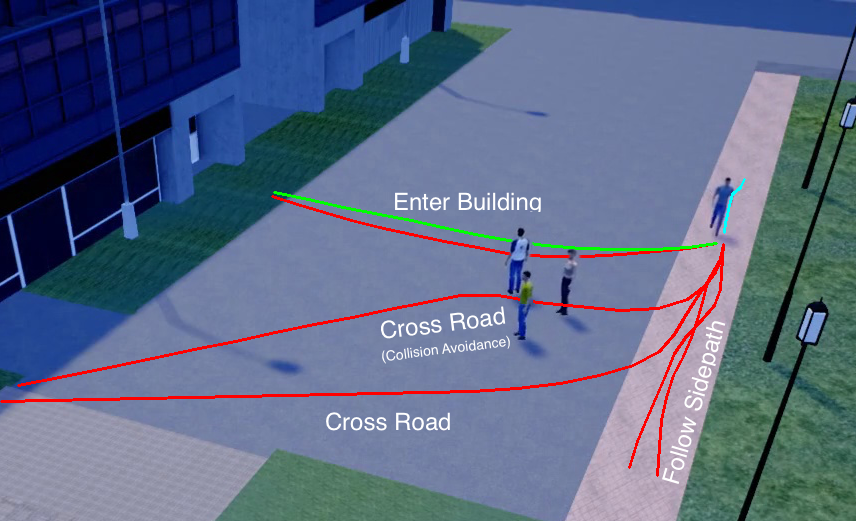
Vision-based trajectory prediction is an important task that supports safe and intelligent behaviours in autonomous systems. Many advanced approaches have been proposed over the years with improved spatial and temporal feature extraction. However, human behaviour is naturally diverse and uncertain. Given the past trajectory and surrounding environment information, an agent can have multiple plausible trajectories in the future. To tackle this problem, an essential task named multi-future trajectory prediction (MTP) has recently been studied. This task aims to generate a diverse, acceptable and explainable distribution of future predictions for each agent. In this paper, we present the first survey for MTP with our unique taxonomies and a comprehensive analysis of frameworks, datasets and evaluation metrics. We also compare models on existing MTP datasets and conduct experiments on the ForkingPath dataset. Finally, we discuss multiple future directions that can help researchers develop novel multi-future trajectory prediction systems and other diverse learning tasks similar to MTP.
Motivation & Objective
- Introduce the multimodal trajectory prediction (MTP) problem and its importance for autonomous systems.
- Present a taxonomy of MTP frameworks and analyze their strengths and limitations.
- Review datasets, benchmarks, and evaluation metrics used in MTP research.
- Identify current challenges, gaps, and promising directions for future MTP research.
- Connect MTP with downstream tasks like motion planning and explainability considerations.
Proposed method
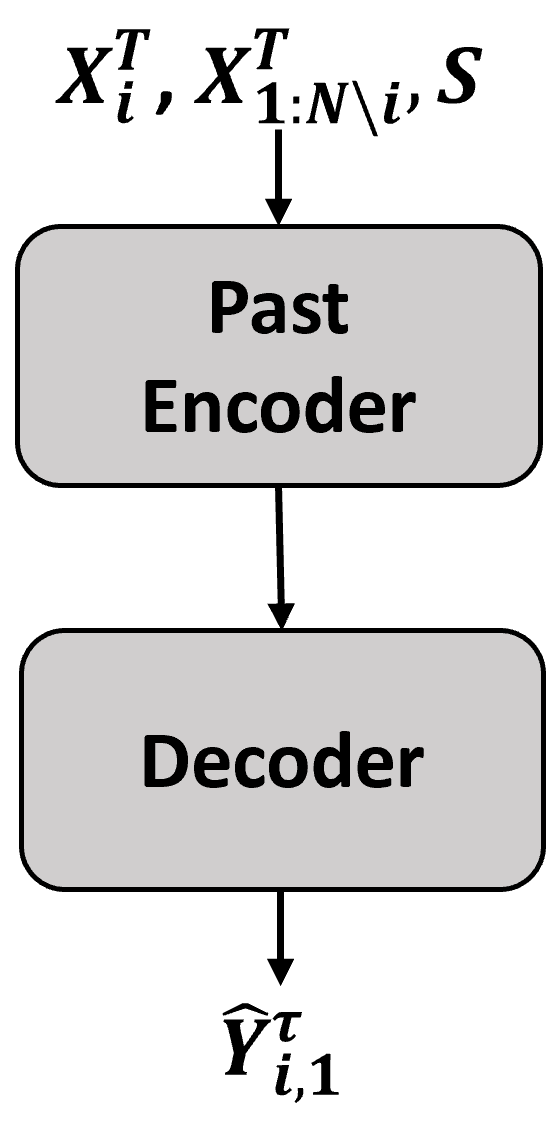
- Survey and taxonomy development of MTP frameworks, including Noise-based, Anchor Conditioned, Grid-based, and output representations (Gaussian, etc.).
- Discussion of training objectives and loss functions (e.g., variety loss, adversarial loss, CVAE evidence lower-bound).
- Analysis of evaluation metrics across lower-bound, probability-aware, and distribution-aware categories.
- Review of datasets and benchmarks (ETH/UCY, NuScenes, Argoverse, Waymo) and synthetic toy datasets (ForkingPath).
- Synthesis of future directions: metrics, motion planning integration, language-guided explainability, lightweight frameworks, OOD handling, and urban-wide prediction.
Experimental results
Research questions
- RQ1What are the primary framework families used for multimodal trajectory prediction and how do they differ?
- RQ2What datasets and evaluation metrics are used to assess MTP models, and what are the limitations of these metrics?
- RQ3How can MTP be integrated with downstream tasks like motion planning and explainability?
- RQ4What directions can address current shortcomings such as modality coverage, computation, and OOD generalization?
Key findings
- MTP frameworks are categorized into Noise-based, Anchor Conditioned, Grid-based, and various output representations (e.g., Gaussian, normalizing flows, DDPM).
- Evaluation metrics for MTP are divided into lower-bound, probability-aware, and distribution-aware, each with distinct limitations and challenges.
- ForkingPath provides multiple ground-truth trajectories to better evaluate distribution coverage in MTP models.
- Datasets like ETH/UCY, Stanford Drone, NuScenes, Argoverse, and Waymo are standard benchmarks, with synthetic toy datasets used to study mode collapse and social acceptance.
- There is a recognized need for better metrics, integration with motion planning, and language-guided explainable MTP as future directions.
Read this paper
Open the full text in the Nubint reader and ask about any passage as you read.
Read this paper on NubintThis review was generated by AI from the original paper. Please check the paper before citing it.