
[Paper Review] Voice Transformer Network: Sequence-to-Sequence Voice Conversion Using Transformer with Text-to-Speech Pretraining
The paper introduces a Voice Transformer Network (VTN) that uses a Transformer-based seq2seq voice conversion model with a two-stage Text-to-Speech pretraining strategy to improve data efficiency and speech quality, outperforming an RNN-based baseline.
We introduce a novel sequence-to-sequence (seq2seq) voice conversion (VC) model based on the Transformer architecture with text-to-speech (TTS) pretraining. Seq2seq VC models are attractive owing to their ability to convert prosody. While seq2seq models based on recurrent neural networks (RNNs) and convolutional neural networks (CNNs) have been successfully applied to VC, the use of the Transformer network, which has shown promising results in various speech processing tasks, has not yet been investigated. Nonetheless, their data-hungry property and the mispronunciation of converted speech make seq2seq models far from practical. To this end, we propose a simple yet effective pretraining technique to transfer knowledge from learned TTS models, which benefit from large-scale, easily accessible TTS corpora. VC models initialized with such pretrained model parameters are able to generate effective hidden representations for high-fidelity, highly intelligible converted speech. Experimental results show that such a pretraining scheme can facilitate data-efficient training and outperform an RNN-based seq2seq VC model in terms of intelligibility, naturalness, and similarity.
Motivation & Objective
- Motivate seq2seq voice conversion (VC) to capture prosody and duration changes.
- Leverage Transformer architectures for VC to replace RNN/CNN-based models.
- Introduce a two-stage TTS-based pretraining to improve data efficiency and reduce mispronunciations.
- Demonstrate that TTS-pretrained VC yields high-quality, intelligible speech even with limited VC data.
Proposed method
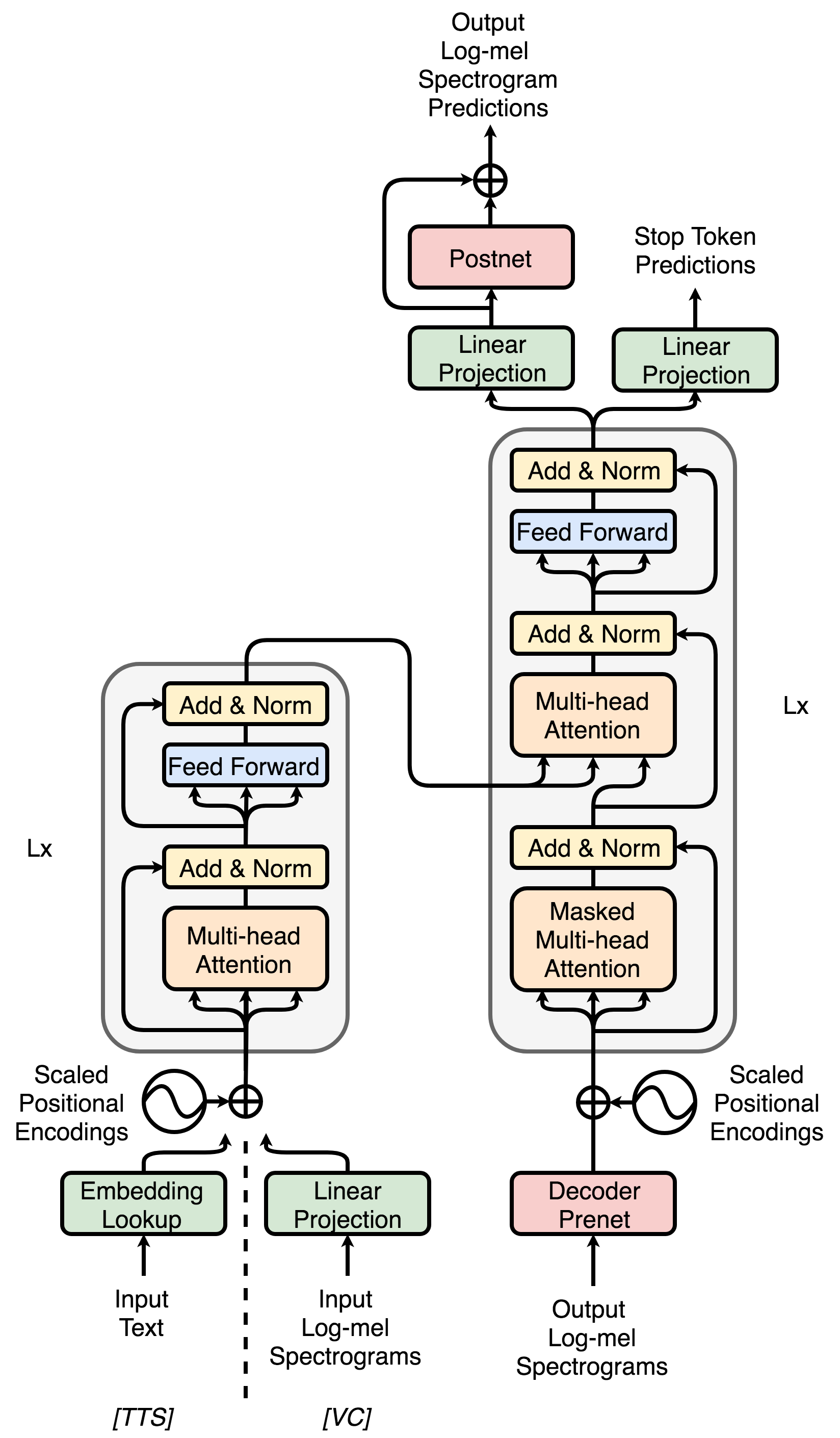
- Adapts Transformer-TTS architecture for VC by replacing the encoder input embedding with a linear projection.
- Introduces encoder reduction factor to stack frames and stabilize attention during training.
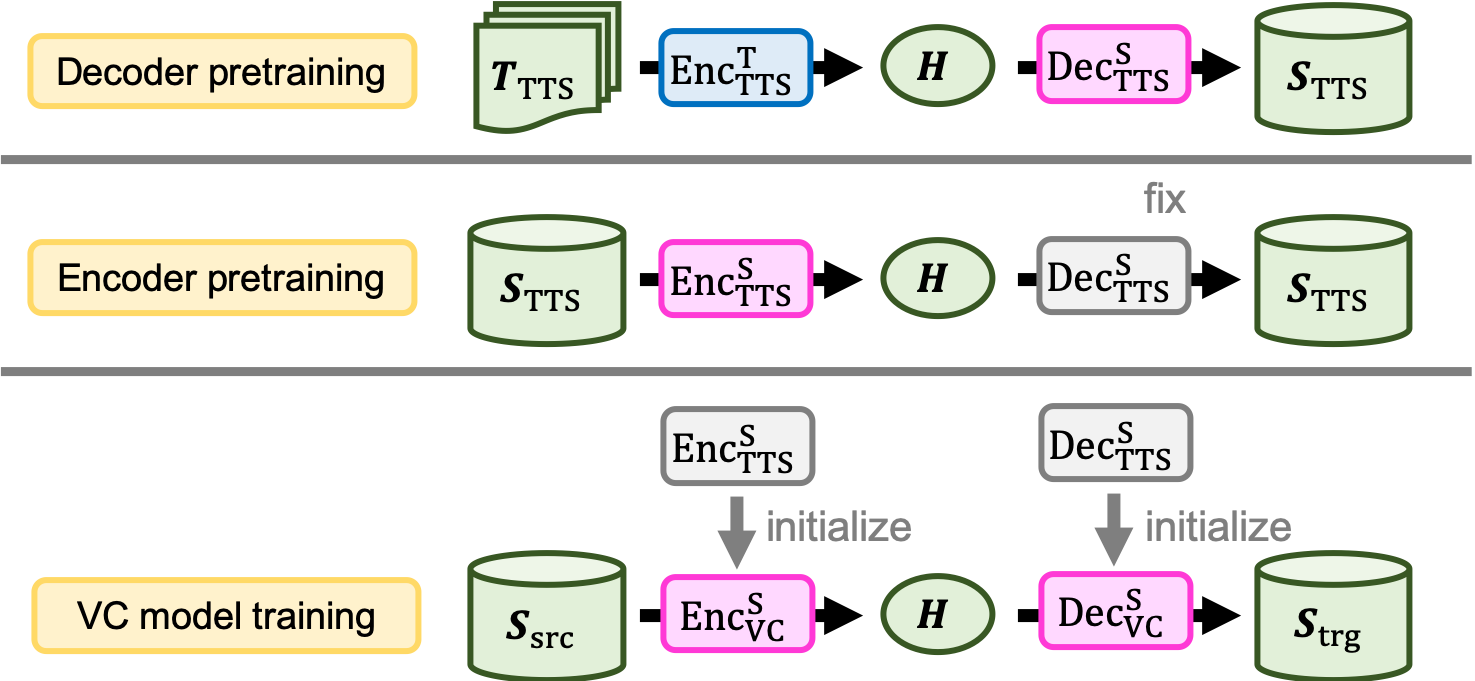
- Proposes a two-stage pretraining: decoder pretrained on large-scale TTS data; encoder pretrained via autoencoder using the fixed pretrained decoder.
- Uses multi-speaker, nonparallel TTS and VC data, with a two-stage training to transfer fine-grained representations from TTS to VC.
- Evaluates with MCD, CER, WER, and MOS-style subjective tests to assess spectral fidelity and intelligibility.
Experimental results
Research questions
- RQ1Can a Transformer-based seq2seq VC model achieve better intelligibility and naturalness than RNN-based seq2seq VC models?
- RQ2Does pretraining VC components with large-scale TTS data improve data efficiency and robustness on small VC datasets?
- RQ3How does the proposed VC system perform in terms of spectral distortion, ASR compatibility, and perceptual naturalness and similarity?
Key findings
- VTN with TTS pretraining consistently outperforms the baseline ATTS2S on objective metrics when trained with the same data.
- Encoder pretraining combined with decoder pretraining yields robust gains, particularly as VC data size decreases.
- With full training data, VTN significantly improves naturalness and similarity over the baseline in subjective tests.
- Even with very limited VC data (e.g., 80 utterances), VTN remains superior to the baseline, indicating strong data efficiency.
- Compared to TTS adaptation alone, VTN with pretraining can achieve higher naturalness and similarity due to better prosody preservation and linguistic representations.
Read this paper
Open the full text in the Nubint reader and ask about any passage as you read.
Read this paper on NubintThis review was generated by AI from the original paper. Please check the paper before citing it.