
[Paper Review] When Energy Goes Missing: New Physics in $b o sνν$ with Sterile Neutrinos
This paper proposes that the observed $B^+ \to K^+ + \text{inv}$ decay excess at Belle II could be explained by $b \to s\nu\bar{\nu}$ transitions mediated by massive sterile neutrinos within the $\nu$ SMEFT framework. It identifies viable parameter regions consistent with all $B\to K^{(*)}+\text{inv}$ modes, invisible $B_s$ decays, and charged-current $B\to D^{(*)}\ell\bar{\nu}$ data, while providing UV completions for the effective operators.
Belle II recently reported the first measurement of $B^+ o K^++\mathrm{inv}$, which is $2.8σ$ above the Standard Model prediction. We explore the available parameter space of new physics within Standard Model effective field theory extended by sterile neutrinos ($ν$SMEFT) and provide predictions for the other $B o K^{(\star)}+\mathrm{inv}$ decay modes and invisible $B_s$ decays. We also briefly comment on charged current decays $B o D^{(\star)}\ell\barν$ and possible ultraviolet completions of the relevant $ν$SMEFT operators.
Motivation & Objective
- Explain the $B^+ \to K^+ + \text{inv}$ decay excess observed at Belle II, which exceeds the SM prediction by $3\sigma$, via new physics involving sterile neutrinos.
- Address the tension between the $B^+ \to K^+ + \text{inv}$ excess and the non-observation of other $B\to K^{(*)}+\text{inv}$ modes, as well as invisible $B_s$ decays.
- Consistently include the full mass dependence of sterile neutrinos in the effective field theory analysis, going beyond previous massless approximations.
- Identify viable parameter regions in the $\nu$ SMEFT framework that simultaneously satisfy constraints from $B\to D^{(*)}\ell\bar{\nu}}$ decays and $B_s$ invisible decays.
- Provide UV completions for the effective operators in the $\nu$ SMEFT model to ensure theoretical consistency and renormalizability.
Proposed method
- Formulate the $\nu$ SMEFT framework at $\mu = 1$ TeV, including four-fermion operators involving sterile neutrinos: $\mathcal{O}^{\rm QN}, \mathcal{O}^{\rm dN}, \mathcal{O}^{\rm LNQd}, \mathcal{O}^{\rm LNQdT}$, with full sterile neutrino mass dependence.
- Match the $\nu$ SMEFT operators onto the Low-Energy Effective Theory (LEFT) at the electroweak scale via renormalization group running, retaining vector, scalar, tensor, and pseudoscalar interactions.
- Express the Wilson coefficients in the $S,P,V,A,\mathcal{T}$ basis, distinguishing between left- and right-handed neutrino currents, and account for flavour symmetry via symmetrization and antisymmetrization of neutrino indices.
- Compute the branching ratio for $B_s \to \nu_\alpha\nu_\beta$ using the full form factor dependence and the $S,P,V,A,\mathcal{T}$ basis, including interference terms between operators.
- Apply constraints from $B\to D^{(*)}\ell\bar{\nu}}$ decays, invisible $B_s$ decays, and other $B\to K^{(*)}+\text{inv}$ modes to restrict viable parameter space.
- Construct UV completions for the effective operators using gauge-singlet fermions and scalar mediators, ensuring consistency with the $\nu$ SMEFT structure.
Experimental results
Research questions
- RQ1Can the $B^+ \to K^+ + \text{inv}$ decay excess be explained by sterile neutrino contributions within $\nu$ SMEFT, including full mass dependence?
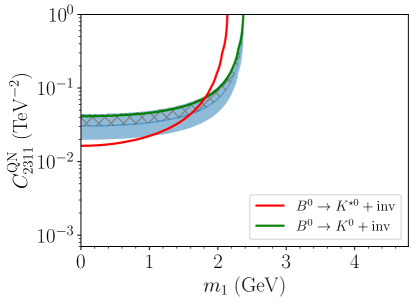
- RQ2Which combinations of sterile neutrino couplings and masses are consistent with the Belle II $B^+ \to K^+ + \text{inv}$ excess and the non-observation of other $B\to K^{(*)}+\text{inv}$ modes?
- RQ3How do constraints from invisible $B_s$ decays and $B\to D^{(*)}\ell\bar{\nu}}$ decays shape the viable parameter space for sterile neutrino models?
- RQ4What are the UV completions of the effective operators in $\nu$ SMEFT that realize the sterile neutrino couplings in a renormalizable quantum field theory?
- RQ5To what extent do tensor and scalar operators contribute to the $B^+ \to K^+ + \text{inv}$ decay amplitude, and how do they affect the branching ratio?
Key findings
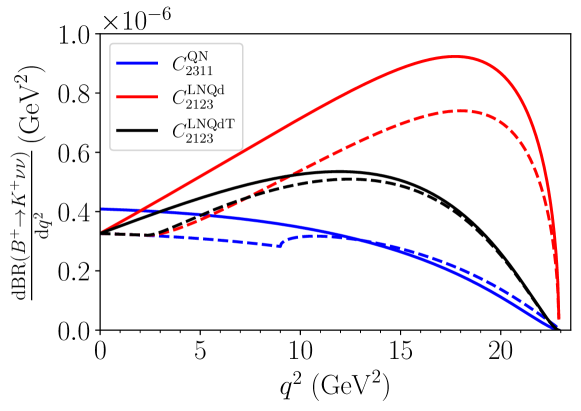
- The $B^+ \to K^+ + \text{inv}$ decay excess can be explained by sterile neutrino contributions in $\nu$ SMEFT, with the dominant contribution arising from the $\mathcal{O}^{\rm LNQdT}$ tensor operator.
- Viable parameter regions exist where the $B^+ \to K^+ + \text{inv}$ branching ratio reaches $\sim 2.4 \times 10^{-5}$, consistent with the Belle II measurement and $3\sigma$ significance.
- Constraints from invisible $B_s$ decays and $B\to D^{(*)}\ell\bar{\nu}}$ decays significantly restrict the allowed sterile neutrino masses and couplings, particularly for $m_N \lesssim 100$ MeV.
- The branching ratio for $B_s \to \nu_\alpha\nu_\beta$ is sensitive to the $A$ and $P$ current contributions, with $\mathrm{BR}(B_s \to \nu_\alpha\nu_\alpha) \lesssim 10^{-6}$ in the viable parameter space.
- UV completions for the effective operators are realized via gauge-singlet fermions and scalar mediators, with the $\mathcal{O}^{\rm LNQdT}$ operator arising from a $Z'$-like gauge boson or scalar exchange.
- The analysis shows that scalar and tensor operators are essential for a complete description, as they contribute significantly to the $B^+ \to K^+ + \text{inv}$ amplitude when sterile neutrino masses are non-zero.
Better researchstarts right now
From reading papers to final review, dramatically reduce your research time.
No credit card · Free plan available
This review was created by AI and reviewed by human editors.