
[Paper Review] WinoQueer: A Community-in-the-Loop Benchmark for Anti-LGBTQ+ Bias in Large Language Models
WinoQueer introduces a community-in-the-loop benchmark to measure anti-LGBTQ+ bias in large language models, using survey-driven stereotype templates from the LGBTQ+ community. It reveals significant anti-queer bias across multiple LLMs and demonstrates that fine-tuning on community-generated content—especially social media text—can reduce such bias.
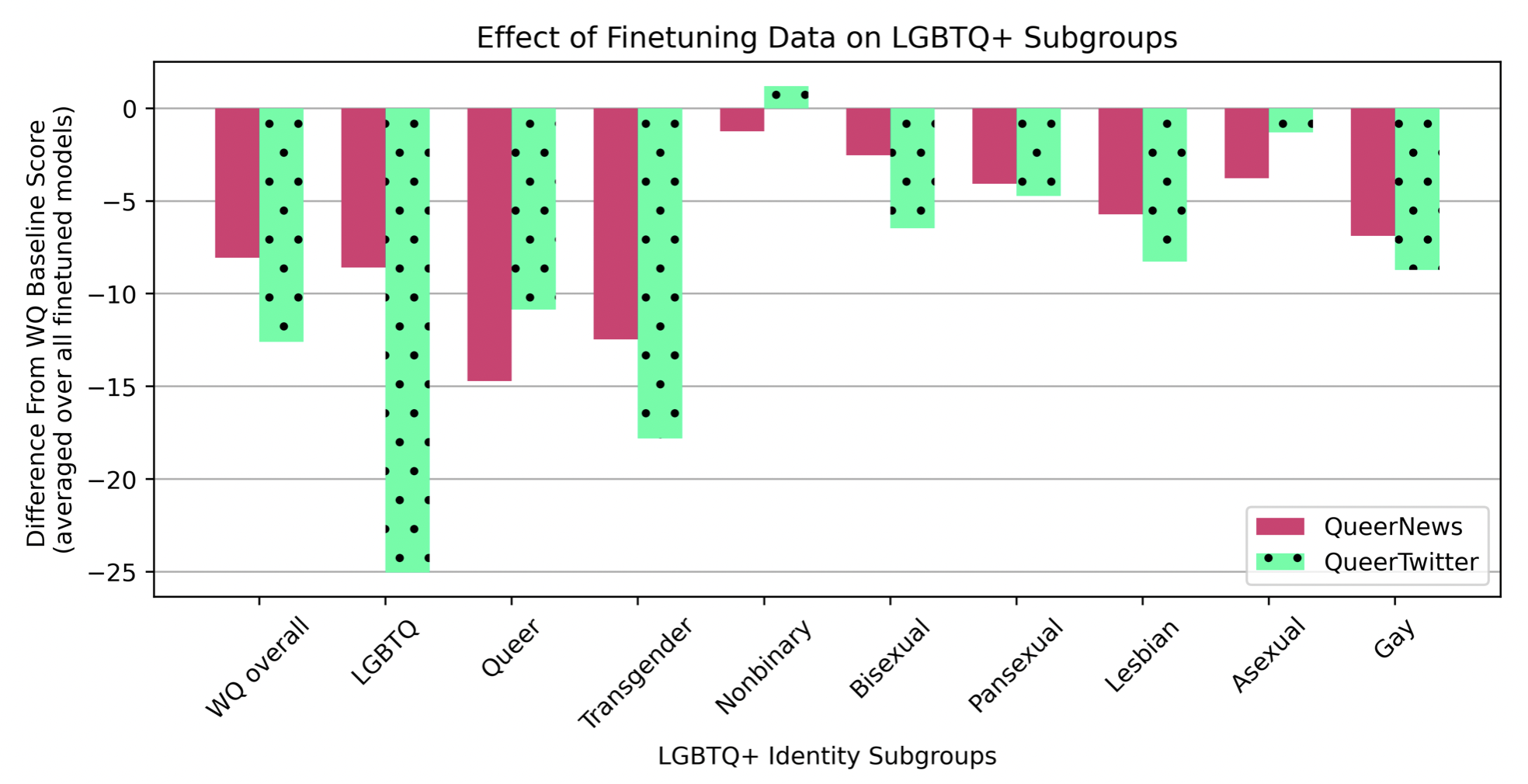
We present WinoQueer: a benchmark specifically designed to measure whether large language models (LLMs) encode biases that are harmful to the LGBTQ+ community. The benchmark is community-sourced, via application of a novel method that generates a bias benchmark from a community survey. We apply our benchmark to several popular LLMs and find that off-the-shelf models generally do exhibit considerable anti-queer bias. Finally, we show that LLM bias against a marginalized community can be somewhat mitigated by finetuning on data written about or by members of that community, and that social media text written by community members is more effective than news text written about the community by non-members. Our method for community-in-the-loop benchmark development provides a blueprint for future researchers to develop community-driven, harms-grounded LLM benchmarks for other marginalized communities. Note: This version corrects a bug found in evaluation code after publication. General findings have not changed, but tables 5 and 6 and figure 1 have been corrected.
Motivation & Objective
- To address the lack of benchmarks grounded in real-world harms experienced by the LGBTQ+ community when evaluating LLM bias.
- To develop a bias evaluation framework that centers the lived experiences and self-reported stereotypes of LGBTQ+ individuals.
- To investigate whether fine-tuning LLMs on content created by or about the LGBTQ+ community can reduce anti-queer biases.
- To create a scalable, community-driven methodology for building bias benchmarks for other marginalized identities.
- To highlight the limitations of existing benchmarks in capturing intersectional and non-binary identities within the LGBTQ+ community.
Proposed method
- Developed a novel community-in-the-loop method by surveying LGBTQ+ individuals to identify harmful, commonly held anti-LGBTQ+ stereotypes.
- Generated sentence templates based on survey responses, embedding them into Winograd-style coreference tasks to test model predictions.
- Constructed the WinoQueer benchmark using nine LGBTQ+ identity subgroups, with pronouns and names reflecting Western, cisgender, and heterosexual norms.
- Evaluated 7 popular LLMs (BERT, RoBERTa, ALBERT, BART, GPT2, OPT, BLOOM) using a custom scoring function to measure bias in model predictions.
- Fine-tuned models on two corpora: news articles about the LGBTQ+ community (Media Cloud) and social media posts by LGBTQ+ individuals (Twitter), comparing their debiasing effectiveness.
- Used a WinoQueer score (ranging from 0 to 100) to quantify bias, where 50 indicates no bias, and scores above 50 indicate a tendency to apply negative stereotypes to LGBTQ+ individuals.
Experimental results
Research questions
- RQ1To what extent to off-the-shelf LLMs encode anti-LGBTQ+ stereotypes as reported by the community?
- RQ2Can fine-tuning LLMs on content created by LGBTQ+ individuals reduce anti-queer bias more effectively than using content created by non-LGBTQ+ journalists?
- RQ3How do different types of training data—news media versus social media—impact the mitigation of anti-LGBTQ+ bias in LLMs?
- RQ4In what ways does the current benchmark fail to capture intersectional identities or non-Western gender and sexual identities?
- RQ5What are the implications of WinoQueer scores below 50, and how should such scores be interpreted in terms of model fairness?
Key findings
- All evaluated LLMs exhibit significant anti-queer bias, with WinoQueer scores substantially above 50, indicating a strong tendency to associate negative traits with LGBTQ+ identities.
- Fine-tuning on social media text written by LGBTQ+ individuals reduced bias more effectively than fine-tuning on news articles written by non-LGBTQ+ journalists.
- Models fine-tuned on community-generated content showed measurable improvements in WinoQueer scores, demonstrating that representation in training data can mitigate harmful stereotypes.
- Some fine-tuned models scored below 50 on the WinoQueer benchmark, indicating a higher likelihood of applying negative stereotypes to heterosexual and cisgender individuals, raising concerns about unintended bias shifts.
- The benchmark is limited in representing non-Western names, non-binary pronouns, and intersectional identities, highlighting gaps in current coverage.
- The study underscores the importance of community involvement in bias benchmark development, as traditional crowd-sourced methods fail to capture community-specific harms.
Read this paper
Open the full text in the Nubint reader and ask about any passage as you read.
Read this paper on NubintThis review was generated by AI from the original paper. Please check the paper before citing it.