
[Paper Review] Y-net: Multi-scale feature aggregation network with wavelet structure similarity loss function for single image dehazing
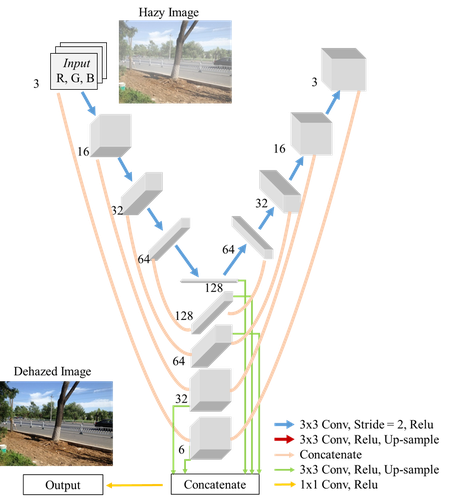
This paper proposes Y-Net, a multi-scale feature aggregation U-Net variant for single image dehazing that outperforms state-of-the-art methods by combining 1×1 convolutions to fuse multi-scale features and introducing a Wavelet Structure Similarity (W-SSIM) loss function. The W-SSIM loss enhances perceptual quality by applying SSIM across multi-scale wavelet subbands, improving detail preservation and reducing artifacts.
Single image dehazing is the ill-posed two-dimensional signal reconstruction problem. Recently, deep convolutional neural networks (CNN) have been successfully used in many computer vision problems. In this paper, we propose a Y-net that is named for its structure. This network reconstructs clear images by aggregating multi-scale features maps. Additionally, we propose a Wavelet Structure SIMilarity (W-SSIM) loss function in the training step. In the proposed loss function, discrete wavelet transforms are applied repeatedly to divide the image into differently sized patches with different frequencies and scales. The proposed loss function is the accumulation of SSIM loss of various patches with respective ratios. Extensive experimental results demonstrate that the proposed Y-net with the W-SSIM loss function restores high-quality clear images and outperforms state-of-the-art algorithms. Code and models are available at https://github.com/dectrfov/Y-net.
Motivation & Objective
- Address the ill-posed nature of single image dehazing by learning end-to-end without explicit priors on atmospheric light or transmission.
- Improve image restoration quality by aggregating multi-scale features from different layers of a CNN encoder-decoder.
- Enhance perceptual quality and reduce artifacts by designing a novel loss function based on discrete wavelet transforms and SSIM.
- Demonstrate superior performance on synthetic datasets compared to prior-based and deep learning-based dehazing methods.
Proposed method
- Proposes a Y-shaped network architecture that aggregates multi-scale feature maps from encoder and decoder paths using 1×1 convolutions to form the final output.
- Uses strided convolutions and max-pooling for down-sampling and transposed convolutions for up-sampling, similar to U-Net, but replaces final skip connection with multi-scale fusion.
- Introduces the Wavelet SSIM (W-SSIM) loss function that applies discrete wavelet transform (DWT) recursively to decompose images into subbands of varying scales and frequencies.
- Computes SSIM on high-frequency subbands (LH, HL, HH) and low-frequency subband (LL), with adjustable weights to prioritize high-frequency details and suppress halo artifacts.
- Employs a recursive DWT process with three iterations and uses Haar wavelets, accumulating SSIM losses with adaptive ratios (x = r², y = r(1−r), z = (1−r)²) for multi-scale consistency.
- Trains the network using Adam optimizer with a batch size of 32, input resolution 480×480, and a learning rate of 0.0001 on the RESIDE dataset.
Experimental results
Research questions
- RQ1Can multi-scale feature aggregation in a U-Net-like architecture significantly improve dehazing performance compared to standard skip connections?
- RQ2Does a wavelet-based SSIM loss function lead to better perceptual quality and reduced artifacts than standard L2 or SSIM losses in image dehazing?
- RQ3Can the proposed W-SSIM loss function enhance feature learning across multiple frequency bands without requiring explicit depth or transmission priors?
- RQ4How does the combination of W-SSIM and L2 loss compare to individual losses in terms of PSNR and SSIM on dehazed images?
Key findings
- The proposed Y-Net achieves a PSNR of 26.61 and SSIM of 0.947 on the RESIDE synthetic dataset, outperforming all compared methods including AOD-Net, MBE, and W-U-Net.
- The W-SSIM loss alone improves PSNR by 0.30 and SSIM by 0.012 over standard L2 loss, and further increases PSNR to 26.61 and SSIM to 0.947 when combined with L2 loss.
- On the FADE perceptual evaluation metric, the proposed method achieves scores of 1.77 (River), 2.37 (People), and 0.592 (Willow), outperforming all baselines in perceptual quality.
- Visual results show that only the proposed method effectively removes haze from river surfaces without introducing noise or artifacts, while other methods like MBE produce speckle noise.
- The W-SSIM loss function successfully preserves high-frequency details and suppresses halo effects, as evidenced by improved SSIM and perceptual scores across all test images.
- The ablation study confirms that W-SSIM loss is more effective than L2 or standard SSIM loss, indicating its ability to guide the network toward perceptually superior reconstructions.

Read this paper
Open the full text in the Nubint reader and ask about any passage as you read.
Read this paper on NubintThis review was generated by AI from the original paper. Please check the paper before citing it.