
[Paper Review] Yamdb: easily accessible thermophysical properties of liquid metals and molten salts
Yamdb provides an open, extensible database of thermophysical properties for liquid metals and molten salts, storing temperature-dependent property correlations as reusable equations and coefficients in human- and machine-readable YAML format. It enables easy integration into Python and Go workflows, offering rapid, accurate access to experimental data with long-term maintainability and extensibility through standardized, version-controlled data files.
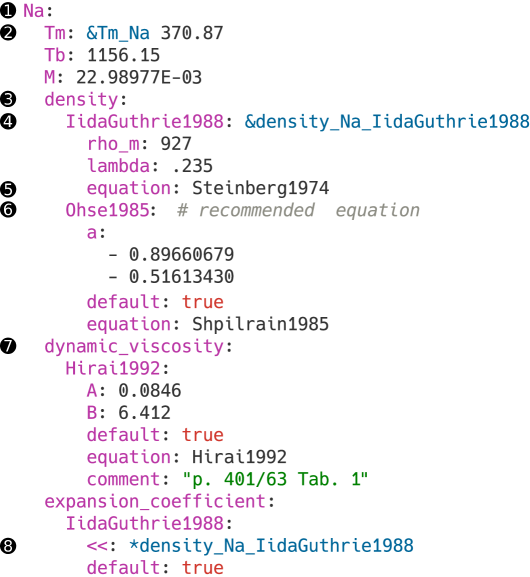
Yamdb (Yet another materials data base) addresses the need to provide thermophysical properties of liquid metals and molten salts in an easily accessible manner. Mathematical relations describing material properties - usually determined by experiment - are taken from the literature. Equations and their coefficients are stored separately. The former can be implemented in any programming language (Python and Go in this case) and the latter are kept in YAML files together with additional information (source, temperature range, composition, accuracy if available, etc).
Motivation & Objective
- Address the scarcity and inaccessibility of reliable thermophysical property data for liquid metals and molten salts in high-temperature applications.
- Provide a lightweight, extensible database that separates mathematical equations from their coefficients for long-term maintainability and reuse.
- Enable seamless integration of thermophysical property data into scientific computing workflows using widely supported programming languages like Python and Go.
- Facilitate error reduction and data validation by centralizing coefficients from peer-reviewed literature in a structured, version-controlled format.
- Support the scientific community by offering a freely available, MIT-licensed database that can be extended and contributed to by researchers.
Proposed method
- Store thermophysical property correlations (e.g., density, viscosity, conductivity) as mathematical functions derived from experimental data in the literature.
- Separate the equations (implemented in Python and Go) from their coefficients, which are stored in human-readable, machine-parsable YAML files.
- Use YAML as the data format for coefficients due to its readability, flexibility, widespread adoption, and support in major programming ecosystems.
- Implement a modular software architecture where new properties are added by creating new modules (e.g., density.py) and registering them in a central dictionary.
- Ensure reproducibility and ease of use by providing clear documentation, example code, and a standardized interface for property retrieval.
- Enable cross-language interoperability by relying on standard YAML parsers available in most programming languages, including Crystal and Ruby.
Experimental results
Research questions
- RQ1How can thermophysical property data for liquid metals and molten salts be made more accessible and reusable in scientific simulations?
- RQ2What data format and software architecture best balance human readability, machine processability, and long-term maintainability for experimental thermophysical data?
- RQ3To what extent can a lightweight, open-source database reduce errors and improve reproducibility in high-temperature materials modeling?
- RQ4How can researchers easily extend the database with new materials, properties, or correlation equations without deep software engineering expertise?
- RQ5What is the impact of separating equations from coefficients on the longevity and reusability of thermophysical property data?
Key findings
- Yamdb successfully provides a curated, open-access database of thermophysical properties for liquid metals and molten salts using a modular, extensible design.
- The separation of equations and coefficients in YAML format enables long-term data preservation and reduces the risk of errors during implementation.
- The database is natively compatible with Python and Go, and can be easily adapted to other languages via standard YAML parsers.
- The software is released under the MIT license, ensuring broad reuse and contribution potential in both academic and industrial research.
- The project supports extensibility through a documented contribution workflow, including pull requests and issue tracking via public repositories on Codebase.Helmholtz.
- The database has been published with persistent DOIs (10.14278/rodare.2549 and 10.14278/rodare.2547), ensuring citability and long-term digital persistence.

Better researchstarts right now
From reading papers to final review, dramatically reduce your research time.
No credit card · Free plan available
This review was created by AI and reviewed by human editors.