
[论文解读] Excitation and Abundance of C3 in star forming cores:Herschel/HIFI observations of the sight-lines to W31C and W49N
本研究利用赫歇尔/HIFI的观测数据,分析了星体形成核 W31C 和 W49N 中 C3 的激发状态与丰度。辐射转移模型显示,振转跃迁受到红外辐射的强烈泵浦,导致吸收特征;推导出的 C3 垂直柱密度约为 1.5 × 10¹⁵ cm⁻²,对应丰度约为 10⁻⁸,与暖化化学模型一致,且显著高于弥散云中的值。
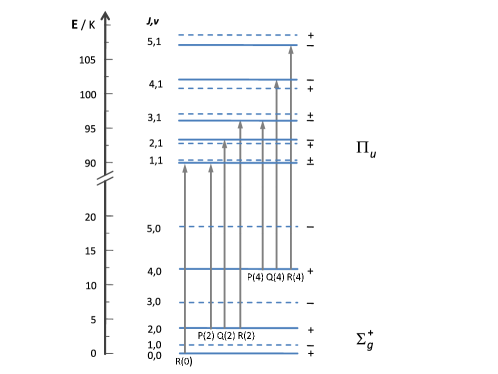
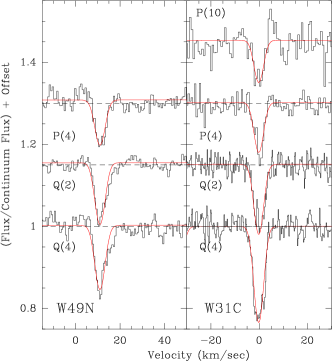
We present spectrally resolved observations of triatomic carbon (C3) in several ro-vibrational transitions between the vibrational ground state and the low-energy nu2 bending mode at frequencies between 1654-1897 GHz along the sight-lines to the submillimeter continuum sources W31C and W49N, using Herschel's HIFI instrument. We detect C3 in absorption arising from the warm envelope surrounding the hot core, as indicated by the velocity peak position and shape of the line profile. The sensitivity does not allow to detect C3 absorption due to diffuse foreground clouds. From the column densities of the rotational levels in the vibrational ground state probed by the absorption we derive a rotation temperature (T_rot) of ~50--70 K, which is a good measure of the kinetic temperature of the absorbing gas, as radiative transitions within the vibrational ground state are forbidden. It is also in good agreement with the dust temperatures for W31C and W49N. Applying the partition function correction based on the derived T_rot, we get column densities N(C3) ~7-9x10^{14} cm^{-2} and abundance x(C3)~10^{-8} with respect to H2. For W31C, using a radiative transfer model including far-infrared pumping by the dust continuum and a temperature gradient within the source along the line of sight we find that a model with x(C3)=10^{-8}, T_kin=30-50 K, N(C3)=1.5 10^{15} cm^{-2} fits the observations reasonably well and provides parameters in very good agreement with the simple excitation analysis.
研究动机与目标
- 利用高分辨率亚毫米波观测,确定致密星体形成核中 C3 的激发条件与柱密度。
- 评估红外泵浦在填充 C3 的振转能级(特别是 ν₂ = 1–0 跃迁)中的作用。
- 将观测到的吸收轮廓与辐射转移模型进行比较,以推导出准确的 C3 丰度,并检验简化双层模型中的假设。
- 评估动能温度、光学厚度和尘埃温度对观测谱线轮廓与激发温度的影响。
提出的方法
- 利用赫歇尔/HIFI 仪器对 W31C 和 W49N 星体形成核进行 C3 转动与振转跃迁的高分辨率光谱观测。
- 采用辐射转移模型模拟谱线轮廓,综合考虑碰撞激发、红外泵浦及尘埃连续辐射。
- 模型考虑了不同的动能温度(Tkin)、柱密度与光学厚度,特别关注 ν₂ = 1–0 跃迁。
- 计算了基态振动态中转动能级与第一激发振动态(ν₂ = 1)的激发温度,同时考虑碰撞与辐射泵浦。
- 使用双层模型进行对比,假设源填充因子为 1,并假设与尘埃温度热平衡。
- 通过与观测到的光学厚度和谱线形状对比,测试模型性能,并对碰撞速率与密度变化进行敏感度分析。
实验结果
研究问题
- RQ1在星体形成核中,C3 在基态与第一激发振动态中的主要激发机制是什么?
- RQ2推导出的 C3 柱密度与丰度与暖化化学模型的预测相比如何?
- RQ3碰撞速率、动能温度与光学厚度的不确定性在多大程度上影响对激发状态与丰度的推断?
- RQ4为何在 W31C 与 W49N 的明亮连续谱背景上观测到 C3 吸收线?这与转动能级阶梯的激发温度有何关联?
- RQ5红外泵浦在多大程度上影响观测到的光学厚度与 ν₂ = 1–0 跃迁的表观激发温度?
主要发现
- C3 的 ν₂ = 1–0 跃迁主要由红外泵浦激发,导致在 W31C 与 W49N 的明亮连续谱上产生强烈的吸收特征。
- 在基态振动态中,低 J 能级的转动能级温度为 35–37 K,内层云中高 J 能级约为 20 K,外层则降至 10–20 K。
- 辐射转移模型在 30 K 动能温度下推导出 W31C 的 C3 柱密度为 1.5 × 10¹⁵ cm⁻²,高于双层模型的估计值,原因在于连续谱光学厚度部分填充了吸收深度。
- 在 W31C 与 W49N 中推导出的 C3 丰度约为 10⁻⁸,与暖化化学模型预测一致,模型参数为 n(H₂) ≈ 2 × 10⁵ cm⁻³ 与 A_V ≈ 10。
- 这些核中 C3 的柱密度约为弥散云与半透明云的 100 倍,后者的柱密度通常为 10¹²–10¹³ cm⁻²,解释了在前导弥散气体中未检测到 C3 的原因。
- 由于双层模型中的假设(如填充因子为 1 且 T_ex ≪ T_c)导致激发温度被低估,因此柱密度为下限值,从而低估了真实柱密度。
阅读本论文
在 Nubint 阅读器中打开原文,边读边就任意段落提问。
在 Nubint 中阅读本论文本解读由 AI 根据论文原文生成,引用前请核对原文。