
[论文解读] GaMeS: Mesh-Based Adapting and Modification of Gaussian Splatting
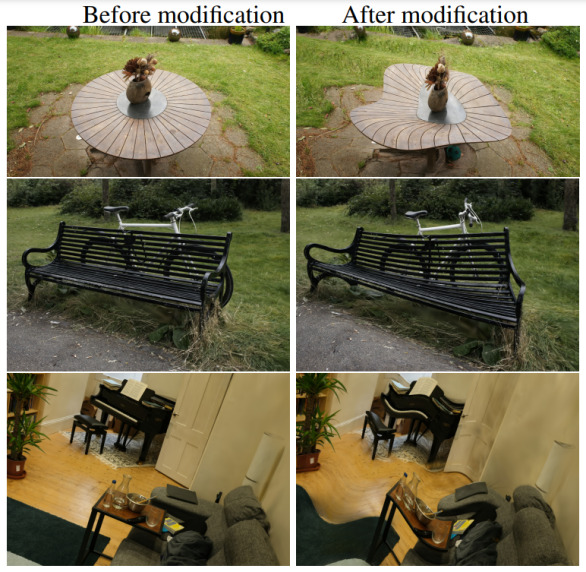
GaMeS 将高斯点绘绑定到网格面上,以实现网格变化时对高斯分量的自动适应和实时编辑,从而实现对三维场景的可编辑、实时渲染。
Gaussian Splatting (GS) is a novel, state-of-the-art technique for rendering points in a 3D scene by approximating their contribution to image pixels through Gaussian distributions, warranting fast training and real-time rendering. The main drawback of GS is the absence of a well-defined approach for its conditioning due to the necessity of conditioning several hundred thousand Gaussian components. To solve this, we introduce the Gaussian Mesh Splatting (GaMeS) model, which allows modification of Gaussian components in a similar way as meshes. We parameterize each Gaussian component by the vertices of the mesh face. Furthermore, our model needs mesh initialization on input or estimated mesh during training. We also define Gaussian splats solely based on their location on the mesh, allowing for automatic adjustments in position, scale, and rotation during animation. As a result, we obtain a real-time rendering of editable GS.
研究动机与目标
- 推动相较于神经辐射场(NeRFs)的更快、可编辑的3D场景渲染。
- 引入一种基于网格的高斯点绘(GaMeS)表示,能够通过网格变化实现对高斯的实时修改和动画。
- 展示 GaMeS 可以在有无明确输入网格的情况下工作;可从伪网格或基于 FLAME 的网格进行初始化。
- 在多个数据集上展示具有竞争力的渲染质量,同时实现高效的一阶段训练和编辑。
提出的方法
- 将每个高斯量参数化为网格面顶点,由此将高斯放置在网格表面。
- 使用一个导向,使高斯的均值成为面顶点的凸组合,从而保持与面中心的对齐。
- 将高斯协方差表示为分解形式 Sigma = R^T S R,其中 R 是与面对齐的旋转,S 是对角缩放;将第一个缩放分量固定为一个小的 epsilon 以贴合在表面上。
- 允许基于网格和伪网格的 GaMeS;当缺少网格时,通过将高斯按分量重新参数化到估计的面上来推断伪网格。
- 提供单阶段训练方案,在其中网格和高斯参数共同优化,使网格被编辑时能够实现实时调整。
- 可选地使用 FLAME 初始化网格以进行人脸实验,并训练 GaMeS 以实现可编辑、动画化的结果。
实验结果
研究问题
- RQ1GaMeS 能否在实现可编辑、网格绑定的高斯分量的同时,达到与最先进的 Gaussian Splatting (GS) 方法相当的渲染质量?
- RQ2将高斯绑定到网格面是否能够在训练和推理过程中实现网格编辑对高斯参数(均值和协方差)的自动传播?
- RQ3GaMeS 对现有网格和训练过程中生成的伪网格都有效吗?初始化(包括 FLAME)如何影响性能?
- RQ4每个网格面上的高斯数量和网格面细分对渲染质量和训练时间有什么影响?
- RQ5与静态 GS 相比,GaMeS 在动画化或动态编辑场景中的表现如何?
主要发现
- 与基线相比,GaMeS 在 NeRF-Synthetic 和 Mip-NeRF360 数据集上取得了具有竞争力的 PSNR 结果。
- GaMeS 实现实时编辑,网格修改会自动传播到高斯均值和协方差,在变换过程中维持高渲染质量。
- GaMeS 支持存在现有网格、伪网格初始化和基于 FLAME 的人脸初始化,展示了在对象和场景上的灵活性。
- 使用伪网格(每个高斯一个面)允许编辑高斯而无需昂贵的预处理,结果接近 GS 变体。
- 对大网格面进行细分在经历显著网格变形时提升鲁棒性和渲染质量。
- 推理和编辑可以达到与静态 GS 渲染相当的速度,训练时间取决于场景复杂度,从几分钟到不到一个小时不等。
阅读本论文
在 Nubint 阅读器中打开原文,边读边就任意段落提问。
在 Nubint 中阅读本论文本解读由 AI 根据论文原文生成,引用前请核对原文。