
[论文解读] Jellyfish galaxies with the IllustrisTNG simulations -- When, where, and for how long does ram pressure stripping of cold gas occur?
本研究利用TNG50宇宙学模拟分析了535个水母星系中的激波压力剥离(RPS),发现RPS作用时间跨度较长(15–80亿年),峰值剥离发生在落入后约10亿年内,且在0.2–2 R_200c范围内持续时间不超过20亿年。尽管剥离过程持续时间长,星系在损失约98%的冷气体前仍持续形成恒星,且其向星系晕中沉积的冷气体量超过当前存在的量——表明它们是星系周围气体库的重要贡献者。
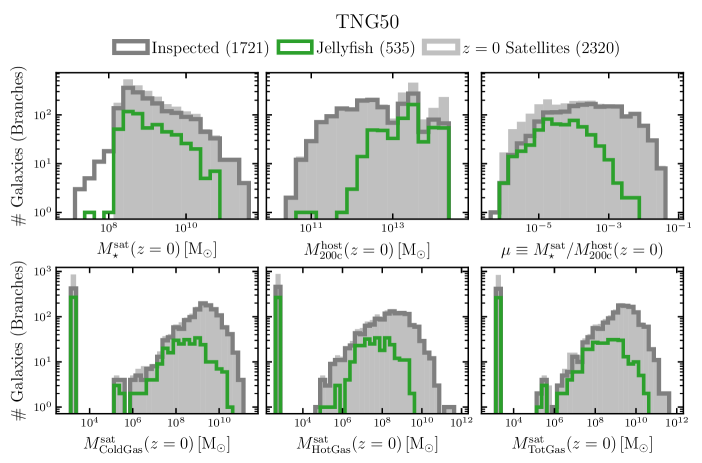
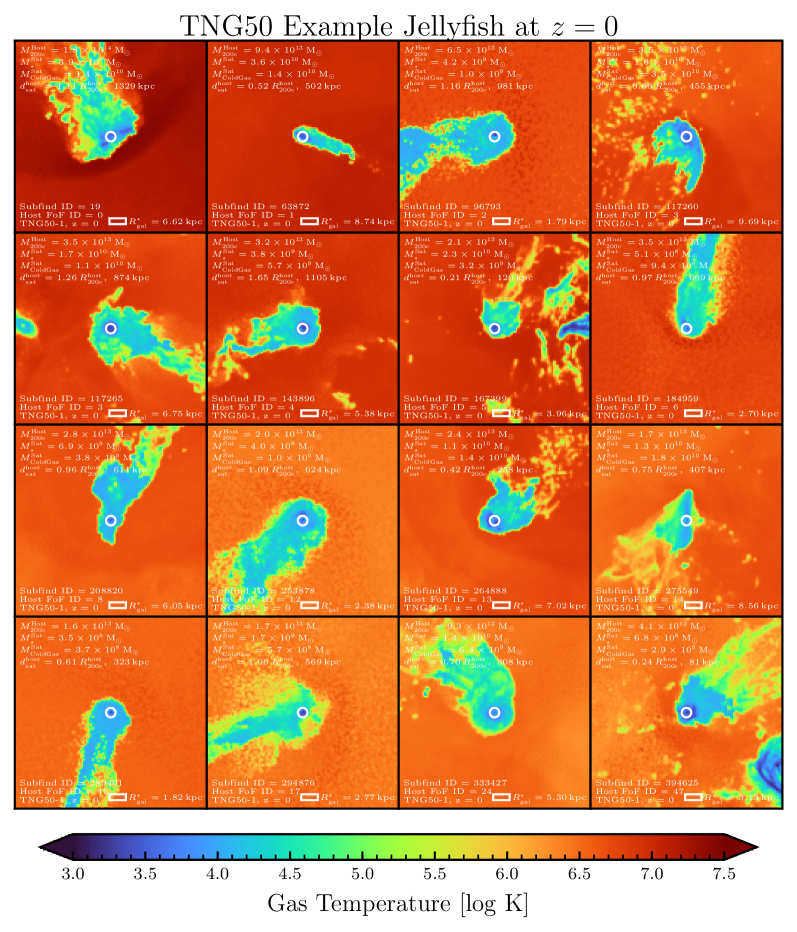
Jellyfish galaxies are prototypical examples of satellite galaxies undergoing strong ram pressure stripping (RPS). We analyze the evolution of 512 unique, first-infalling jellyfish galaxies from the TNG50 cosmological simulation. These have been visually inspected to be undergoing RPS sometime in the past 5 billion years (since $z=0.5$), have satellite stellar masses $\mstarsat\sim10^{8-10.5}\,M_\odot$, and live in hosts with $\mvir\sim10^{12-14.3}\,M_\odot$ at $z=0$. We quantify the cold gas ($T\leq10^{4.5}$ K) removal using the tracer particles, confirming that for these jellyfish, RPS is the dominant driver of cold gas loss after infall. Half of these jellyfish are completely gas-less by $z=0$, and these galaxies have earlier infall times and smaller satellite-to-host mass ratios than their gaseous counterparts. RPS can act on jellyfish galaxies over long time scales of $\approx1.5-8$ Gyr. Jellyfish in more massive hosts are impacted by RPS for a shorter time span and, at a fixed host mass, jellyfish with less cold gas at infall and lower stellar masses at $z=0$ have shorter RPS time spans. While RPS may act for long periods of time, the peak RPS period -- where at least 50 pecent of the total RPS occurs -- begins within $\approx1$ Gyr of infall and lasts $\lesssim2$ Gyr. During this period, the jellyfish are at host-centric distances $\sim0.2-2 vir$, illustrating that much of RPS occurs at large distances from the host galaxy. Interestingly, jellyfish continue forming stars until they have lost $\approx98$ percent of their cold gas. For groups and clusters in TNG50 $(\mvirhost\sim10^{13-14.3}\,M_\odot)$, jellyfish galaxies deposit more cold gas ($\sim10^{11-12}\,M_\odot$) into halos than exist in them at $z=0$, demonstrating that jellyfish, and in general satellite galaxies, are a significant source of cold gas accretion.
研究动机与目标
- 在宇宙学背景下,理解激波压力剥离(RPS)在水母星系中发生的时间、持续时间及空间分布。
- 量化卫星星系在落入后RPS对冷气体的作用时长,并识别延长或缩短该过程的条件。
- 评估水母星系向星系周围介质(CGM)和星系团内介质(ICM)沉积冷气体的作用,并与现有气体库进行比较。
- 研究水母星系在RPS过程中恒星形成的特性,特别是其在落入后仍能维持活跃恒星形成的时间。
- 确定RPS持续时间对宿主质量、卫星质量、落入时间及轨道历史的依赖关系。
提出的方法
- 通过在TNG50模拟中进行人工目视检查,识别出535个独特的水母星系,其选择标准为最近50亿年内首次落入,且宿主晕质量为10^12–14.3 M☉。
- 利用拉格朗日蒙特卡洛示踪粒子追踪冷气体(T ≤ 10^4.5 K),以量化随时间的气体质量损失。
- 将RPS timescale定义为从落入到冷气体完全被剥离的持续时间,峰值RPS期定义为至少50%的总剥离量发生的时段。
- 分析以宿主为中心的距离和轨道参数,以确定RPS最有效的区域,重点关注0.2–2 R_200c范围。
- 比较不同卫星恒星质量、宿主晕质量及落入时初始冷气体含量下的RPS持续时间与效率。
- 通过随时间积分剥离气体质量,并与z=0时的原位气体含量比较,量化向CGM/ICM中沉积的冷气体量。
实验结果
研究问题
- RQ1激波压力剥离(RPS)在水母星系落入后,对冷气体的作用时间尺度是什么?
- RQ2RPS的大部分作用发生在宿主中心距离的哪个范围内?这与轨道相位有何关联?
- RQ3在峰值RPS期间,有多少比例的冷气体被剥离?该过程相对于落入时间发生在何时?
- RQ4水母星系在落入后还能持续多长时间形成恒星?恒星形成熄灭发生在气体质量分数的哪个水平?
- RQ5水母星系向星系周围介质(CGM)和星系团内介质(ICM)沉积了多少冷气体?与现有气体库相比如何?
主要发现
- 激波压力剥离(RPS)在水母星系中作用时间跨度长,平均为15–80亿年,其中一半星系在z=0时已完全损失冷气体。
- 峰值RPS期——即至少50%的总剥离量发生的时段——在落入后约10亿年内开始,持续时间不超过20亿年,主要发生在宿主中心距离0.2–2 R_200c范围内。
- 水母星系在损失约98%的冷气体质量前仍持续形成恒星,最终熄灭仅在约99%的RPS完成之后发生。
- 在质量较大的宿主中(M_200c ~ 10^14 M☉),水母星系在过去50亿年中向ICM沉积了约10^12 M☉的冷气体,超过当前ICM中冷气体的总量。
- 对于M_200c ≥ 10^12.5 M☉的晕,卫星星系(包括水母星系)在过去50亿年中向CGM沉积了超过10^10 M☉的冷气体,与当前中心星系的恒星质量相当。
- 在质量更大的宿主中,以及初始冷气体含量较低、z=0时恒星质量较小、在完全剥离时轨道次数较少的卫星中,RPS持续时间更短。
阅读本论文
在 Nubint 阅读器中打开原文,边读边就任意段落提问。
在 Nubint 中阅读本论文本解读由 AI 根据论文原文生成,引用前请核对原文。