
[论文解读] Jupiter Mass Binary Objects in the Trapezium Cluster
本研究利用 JWST NIRCam 成像,在Trapezium Cluster识别540个行星质量候选对象,最低至0.6 木星质量,发现9%处于宽双星系统(JuMBOs),并讨论对行星质量端的初始质量函数(IMF)及形成机制的含义。
A key outstanding question in star and planet formation is how far the initial mass function of stars and sub-stellar objects extends, and whether or not there is a cut-off at the very lowest masses. Isolated objects in the planetary-mass domain below 13 Jupiter masses, where not even deuterium can fuse, are very challenging to observe as these objects are inherently faint. Nearby star-forming regions provide the best opportunity to search for them though: while they are young, they are still relatively warm and luminous at infrared wavelengths. Previous surveys have discovered a handful of such sources down to 3--5 Jupiter masses, around the minimum mass limit established for formation via the fragmentation of molecular clouds, but does the mass function extend further? In a new James Webb Space Telescope near-infrared survey of the inner Orion Nebula and Trapezium Cluster, we have discovered and characterised a sample of 540 planetary-mass candidates with masses down to 0.6 Jupiter masses, demonstrating that there is indeed no sharp cut-off in the mass function. Furthermore, we find that 9\% of the planetary-mass objects are in wide binaries, a result that is highly unexpected and which challenges current theories of both star and planet formation.
研究动机与目标
- 评估初始质量函数在年轻星团的行星质量范围延伸到何处。
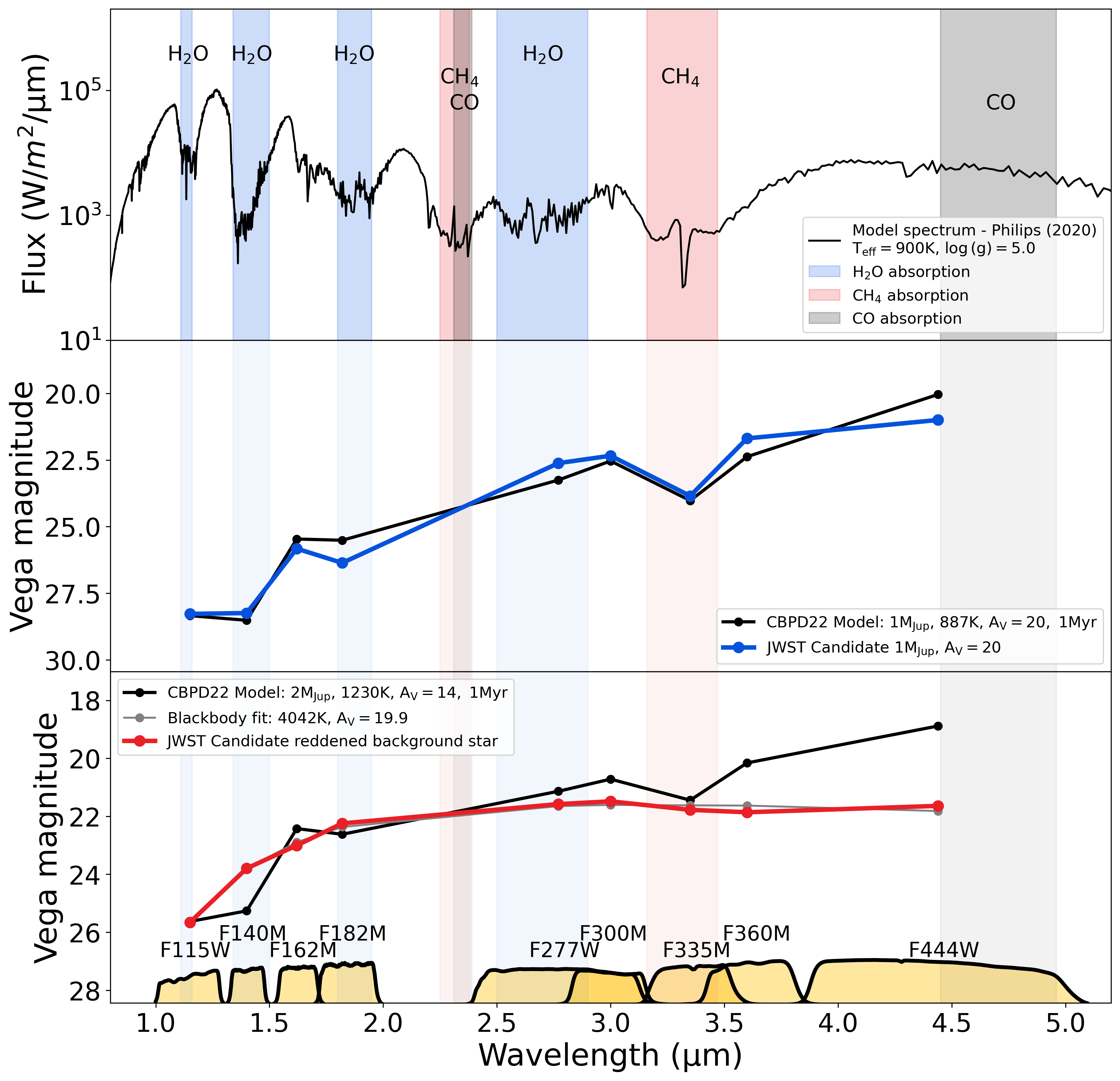
- 使用 JWST NIRCam 的中波段和宽波段光度测量,针对分子吸收特征(H2O和CH4)来识别PMO候选对象。
- 表征行星质量对象的多星性并量化宽双星比率。
- 将观测到的PMO人口统计学与形成情景(恒星样分裂 vs 行星样机制)进行比较。
- 提供一个目录和区分PMOs与密集恒星形成区背景/前景源的方法。
提出的方法
- JWST NIRCam 成像猎户座内 11' × 7.5' 区域在 Orion Nebula 和 Trapezium Cluster(34.9 小时,12 个滤镜)。
- 通过特定滤镜组合和定义的指数(方程式1–3),利用 H2O (1.4 和 1.9 μm) 与 CH4 (3.35 μm) 吸收特征,对 PMO 进行光度分类。
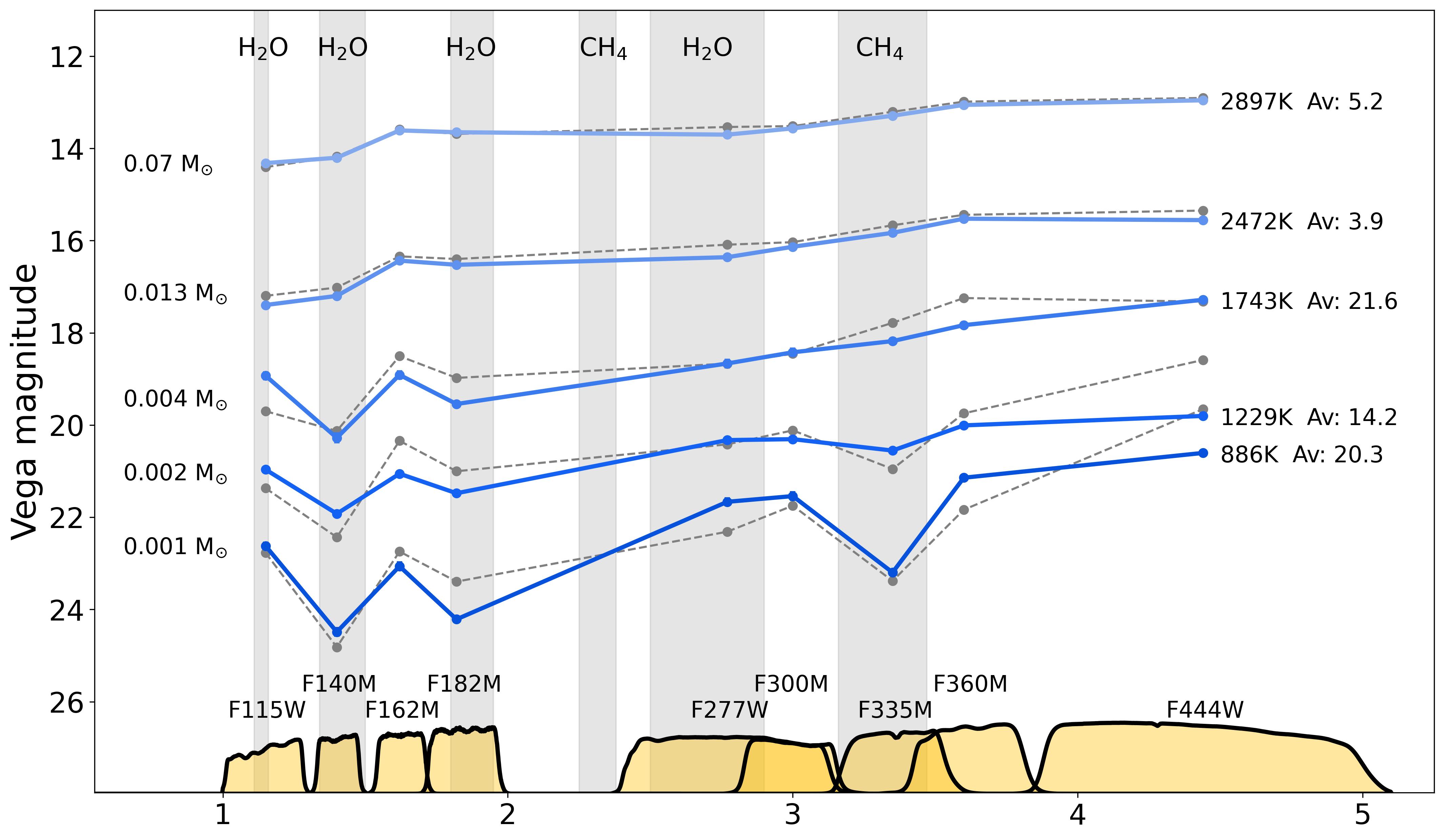
- 使用九滤波的 SED 拟合,结合演化模型网格(CEQ 与 NEQ,来自 ATMO 2020)以及 BHAC15(用于较高质量对象),在 AV 1–100、年龄 1 Myr、距离 390 pc 的条件下。
- 将去 redden 的光度与 1 Myr 的演化模型网格比较,以估算质量(0.0004–0.015 M⊙)并识别至 ≈0.6 Mjup 的 PMO。
- 通过目视检查和孔径光度测量(2.5 与 4.5 像素孔径)建立540对象的 PMO 候选目录。
- 補充材料详细介绍数据简化、源检测和污染评估(星系、背景恒星)。
实验结果
研究问题
- RQ1由 JWST 光度测量追踪,Trapezium Cluster 的 PMO 群体在较低质量的边界是多少?
- RQ2在此环境中,行星质量对象是否以宽双星(JuMBOs)的形式存在,它们的频率和特征是什么?
- RQ3PMO 的质函数在低于 1 Mjup 时如何延展,是否存在明显的截断证据?
- RQ4哪些形成机制(类星分裂式分裂 vs 行星式推进)能解释JuMBO群体及其分离/质量比?
主要发现
- 识别出一组540个PMO候选对象,质量下降至0.6 Mjup,显示IMF的平滑延续而非尖锐截断。
- 约9%的PMO处于宽双星系统(JuMBO),分离约为25–390 au,这是行星质量水平的一个令人惊讶的结果。
- JuMBOs 覆盖 0.7–7 Mjup,分离均匀分布;平均质量比 q = 0.66,只有约40% 的系统质量比 q ≥ 0.8。
- 以主体质量为自变量的宽双星分数在 PMO 质量处上升,与高质量区的下降趋势形成对比,提示在行星质量下出现新的形成通道。
- CEQ 大气/化学模型最适合拟合到 2 Mjup 的 PMO;在低于 2 Mjup 时偏好 NEQ 弱模型,表明可能存在垂直混合效应。
- 计划进行后续的 NIRSpec 光谱(JWST Cycle 2),以改进 PMO 和 JuMBO 的温度、光谱类型和化学组成。
阅读本论文
在 Nubint 阅读器中打开原文,边读边就任意段落提问。
在 Nubint 中阅读本论文本解读由 AI 根据论文原文生成,引用前请核对原文。