
[论文解读] New constraints on the gamma-ray and high energy neutrino fluxes from the circumstellar interaction of SN 2023ixf
本研究基于Fermi-LAT和IceCube对SN 2023ixf的非探测结果,通过建模致密星周物质中的质子-质子相互作用,推导出伽马射线和高能中微子通量的新上限。推导出的通量上限——伽马射线为7×10⁻⁹ GeV cm⁻² s⁻¹,中微子为4×10⁻⁹ GeV cm⁻² s⁻¹——显著优于实验约束,表明对邻近II型超新星中强子粒子加速过程具有强有力的多信使约束。
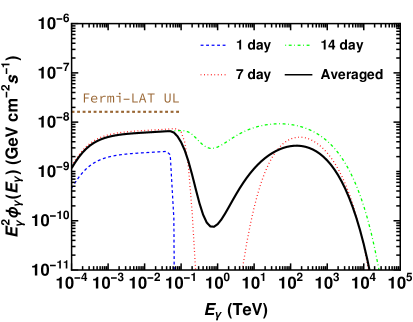
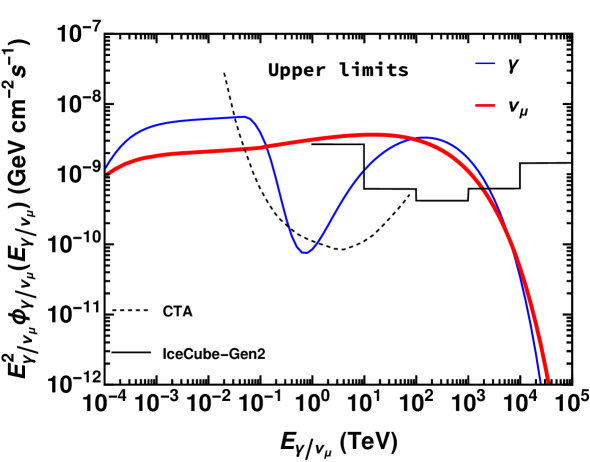
The recent supernova, SN 2023ixf, one of the closest observed type II SNe has revealed the presence of a dense circumstellar material (CSM). Interaction of the SN ejecta with this dense CSM might create high energy protons of PeV energies through shock acceleration. These accelerated protons then colliding with the CSM (inelastic $pp$ collision) can produce secondaries such as high energy gamma-rays and neutrinos. However, no gamma-rays and neutrinos have been detected by Fermi-LAT and IceCube from this event. Fermi-LAT has placed an upper limit on the gamma-ray flux above $100$~MeV to be $2.6 imes 10^{-11}~ m erg~cm^{-2}~s^{-1}$. On the other hand, IceCube's upper limit on muon neutrino flux is $7.3 imes 10^{-2} ~ m GeV~cm^{-2}$. {\color{black} Taking these limits into account and using the shock-CSM properties derived from multi-wavelength observations, we obtain new upper limits on the gamma-ray ($10^{-11}~ m erg~cm^{-2}~s^{-1}$) and neutrino ($10^{-3}~ m GeV~cm^{-2}$) fluxes from SN 2023ixf produced via the $pp$ interaction channel.} While we found the gamma-ray flux to be consistent with Fermi-LAT's upper limit, the neutrino flux is found to be about $2$ orders of magnitude smaller than the IceCube's upper limit. We further analyse the detection prospects of such secondary signals from future SN 2023 like events with upcoming detectors, CTA and IceCube-Gen2 and found to have great discovery potential, if any similar event occurs within $7$ Mpc.
研究动机与目标
- 利用Fermi-LAT和IceCube的观测约束,推导出SN 2023ixf的高能伽马射线和中微子通量的保守上限。
- 通过在致密星周物质(CSM)中进行非弹性pp碰撞,建模质子的激波特异加速及次级粒子的产生。
- 评估未来类似超新星在Cherenkov Telescope Array(CTA)和IceCube-Gen2等新型探测器中的探测潜力。
- 评估星周物质对称性和成分假设对通量预测的影响,确保估计结果保守。
提出的方法
- 采用球对称、风状星周物质分布模型,质量损失率ṀW ≈ 10⁻² M☉ yr⁻¹,风速vW ≈ 50 km s⁻¹,模拟激波特异-星周物质(CSM)相互作用。
- 假设质子能量分布为幂律谱,谱指数为2,与标准激波特异加速理论一致。
- 通过使用π介子和μ子的截面和衰变链,计算次级伽马射线和中微子通量。
- 将Fermi-LAT和IceCube对伽马射线和μ子中微子通量的上限作为观测约束,以优化激波特异和星周物质参数。
- 采用时间平均通量作为保守上限,尽管可能存在不对称性,但假设视线方向上的星周物质对称。
- 投影CTA(50小时观测)和IceCube-Gen2(10年积分)的探测灵敏度,以评估未来发现潜力。
实验结果
研究问题
- RQ1在Fermi-LAT和IceCube未探测到信号的前提下,通过pp相互作用,SN 2023ixf产生的伽马射线和高能中微子通量上限是多少?
- RQ2推导出的通量上限与Fermi-LAT和IceCube的实验上限相比如何?
- RQ3对于未来类似邻近超新星,CTA和IceCube-Gen2等探测器的探测潜力如何?
- RQ4星周物质对称性和成分假设如何影响预测的通量上限?
- RQ5对高能信号的观测非探测结果能否约束激波特异-星周物质相互作用中质子加速效率?
主要发现
- SN 2023ixf的伽马射线通量上限为7×10⁻⁹ GeV cm⁻² s⁻¹,与Fermi-LAT的上限2.6×10⁻¹¹ erg cm⁻² s⁻¹一致。
- 中微子通量上限为4×10⁻⁹ GeV cm⁻² s⁻¹,约为IceCube上限7.3×10⁻² GeV cm⁻²的两个数量级以下。
- 推导出的通量上限显著优于实验约束,表明对SN 2023ixf中强子过程具有强有力的多信使约束。
- 分析表明,若类似超新星发生在7 Mpc范围内,CTA和IceCube-Gen2将具有很高的发现潜力。
- 对称星周物质模型提供了保守估计,因为观测表明可能存在星周物质不对称性,但若星周物质未对准视线方向,通量可能更低。
- 本研究证实,在100 MeV以上的伽马射线中,轻子贡献可忽略不计,因此专注于纯强子过程是合理的。
阅读本论文
在 Nubint 阅读器中打开原文,边读边就任意段落提问。
在 Nubint 中阅读本论文本解读由 AI 根据论文原文生成,引用前请核对原文。