
[论文解读] PySAGES: flexible, advanced sampling methods accelerated with GPUs
PySAGES 是一个基于 Python 的 GPU 加速软件库,可在分子动力学模拟中实现高级采样方法,如自适应偏置力、元动力学和前向通量采样。它通过原生 GPU 加速与 OpenMM 和 hoomd-blue 等 MD 后端无缝集成,提供灵活且用户友好的集体变量和自由能计算接口,实现高性能计算。
Molecular simulations are an important tool for research in physics, chemistry, and biology. The capabilities of simulations can be greatly expanded by providing access to advanced sampling methods and techniques that permit calculation of the relevant underlying free energy landscapes. In this sense, software that can be seamlessly adapted to a broad range of complex systems is essential. Building on past efforts to provide open-source community supported software for advanced sampling, we introduce PySAGES, a Python implementation of the Software Suite for Advanced General Ensemble Simulations (SSAGES) that provides full GPU support for massively parallel applications of enhanced sampling methods such as adaptive biasing forces, harmonic bias, or forward flux sampling in the context of molecular dynamics simulations. By providing an intuitive interface that facilitates the management of a system's configuration, the inclusion of new collective variables, and the implementation of sophisticated free energy-based sampling methods, the PySAGES library serves as a general platform for the development and implementation of emerging simulation techniques. The capabilities, core features, and computational performance of this new tool are demonstrated with clear and concise examples pertaining to different classes of molecular systems. We anticipate that PySAGES will provide the scientific community with a robust and easily accessible platform to accelerate simulations, improve sampling, and enable facile estimation of free energies for a wide range of materials and processes.
研究动机与目标
- 开发一个灵活的开源软件框架,用于分子模拟中的高级采样。
- 通过 GPU 加速的增强采样技术实现,加速自由能计算。
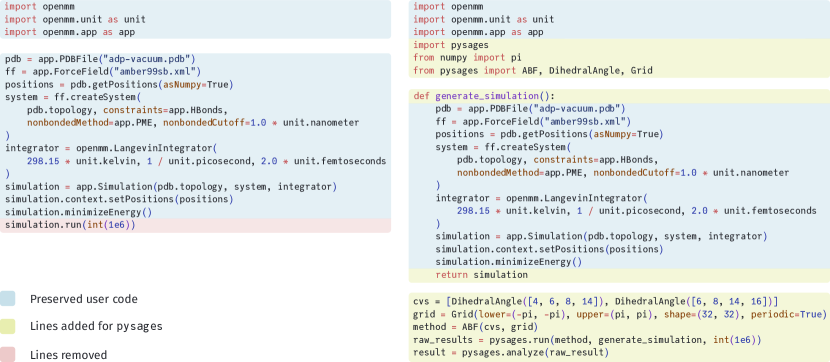
- 提供直观的 Python 接口,用于定义集体变量并集成到现有 MD 后端中。
- 支持广泛的复杂系统,包括生物分子和软物质材料。
- 实现对多样化分子系统中自由能景观的精确且高效的估算。
提出的方法
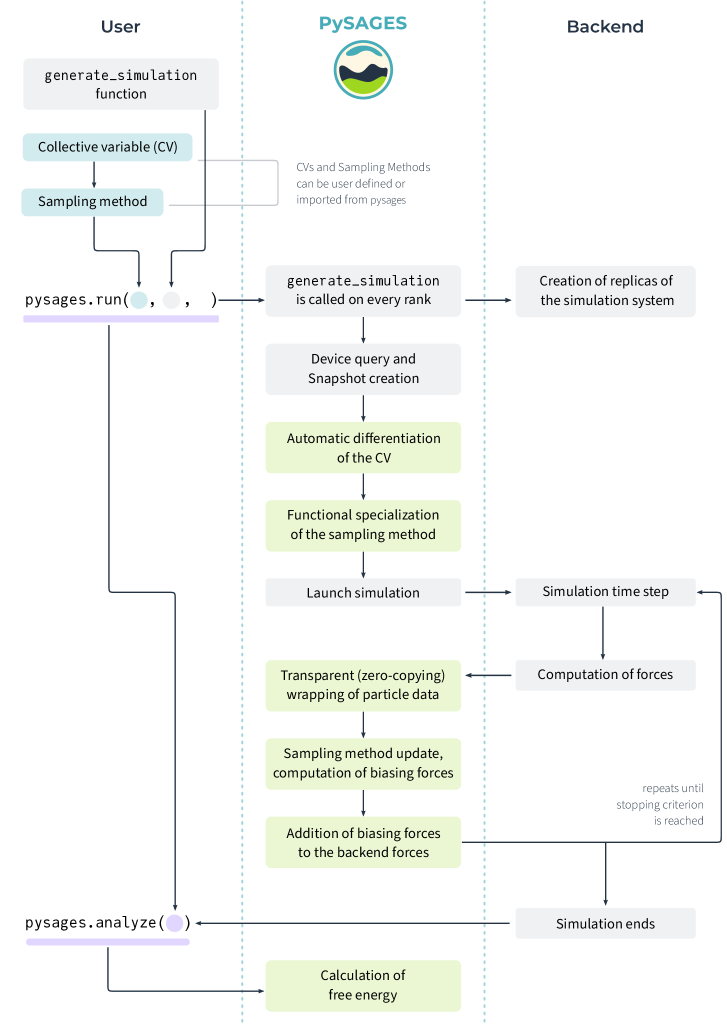
- 基于 SSAGES 框架构建模块化 Python 库,通过 CUDA 和 cuDNN 实现完整的 GPU 支持。
- 集成高级采样方法,包括自适应偏置力(ABF)、良好温度元动力学(WTMD)和前向通量采样(FFS)。
- 通过灵活接口实现用户自定义的集体变量(CVs),包括使用高斯加权投影的界面距离 CVs。
- 利用高性能 MD 后端(如 OpenMM 和 hoomd-blue)实现 GPU 加速的动力学模拟。
- 采用基于神经网络的偏置方法(ANN、FUNN)和谱 ABF,以提升收敛速度与采样效率。
- 提供基于 JSON 的配置系统,便于模拟工作流的快速设置与可重复性。
实验结果
研究问题
- RQ1如何在保持 GPU 性能的前提下,高效且灵活地在 Python 等高级语言中实现高级采样方法?
- RQ2GPU 加速在复杂系统中对自由能计算的收敛性和计算效率提升程度如何?
- RQ3统一的软件框架能否有效支持不同 MD 后端和系统类型下的多样化采样技术?
- RQ4与基准模拟相比,PySAGES 实现的方法在重现已知自由能景观方面的准确性如何?
- RQ5不同的集体变量定义与偏置策略对采样效率和收敛性有何影响?
主要发现
- PySAGES 通过 GPU 加速实现高性能,可高效执行 ABF、WTMD 和 FFS 等高级采样方法。
- 该库在丙氨酸二肽和丁烷的基准自由能景观上实现了高精度重现,与长时间 ABF 模拟结果一致。
- 相比基于 CPU 的方法,自由能收敛在显著更短的模拟时间内完成,尤其在能量景观崎岖的系统中表现更优。
- 采用高斯加权投影实现的界面距离集体变量,可提供鲁棒且可微分的 CV,适用于界面体系。
- 基于神经网络的偏置方法(ANN、FUNN)和谱 ABF 在测试系统中表现出更快的收敛速度与更短的采样时间,优于传统方法。
- 该软件与主流 MD 引擎(OpenMM、hoomd-blue)互操作性强,可在生物分子和软物质系统中广泛应用。
阅读本论文
在 Nubint 阅读器中打开原文,边读边就任意段落提问。
在 Nubint 中阅读本论文本解读由 AI 根据论文原文生成,引用前请核对原文。