
[论文解读] The metallicity dependence of the stellar initial mass function
本研究利用辐射磁流体动力学模拟,探究金属丰度对恒星初始质量函数(IMF)的影响,发现尽管金属丰度导致IMF发生微小偏移——在金属丰度较低的环境中由于辐射反馈减弱,IMF略微更偏向大质量星——但这些变化不足以解释早期型星系中观测到的IMF差异。表面密度才是IMF变化的主要驱动力,较高表面密度通过增强反馈效率,导致IMF更偏向大质量星。
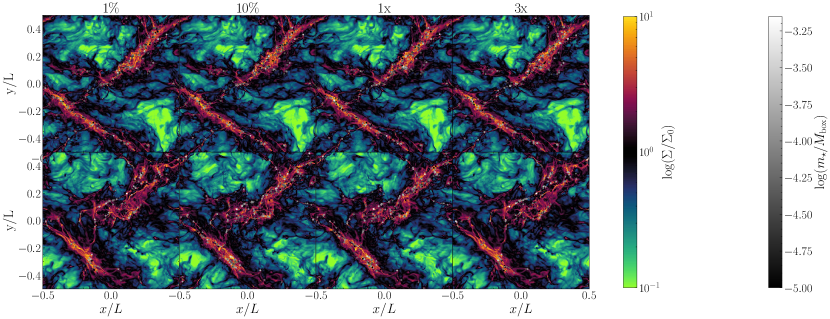
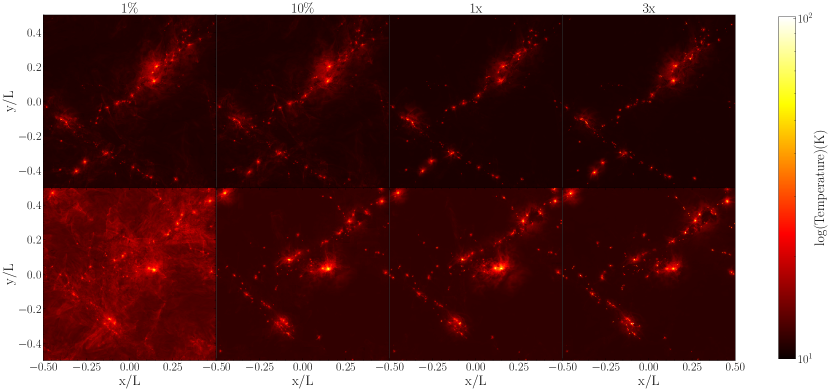
Dust is important for star formation because it is the crucial component that couples gas to stellar radiation fields, allowing radiation feedback to influence gas fragmentation and thus the stellar initial mass function (IMF). Variations in dust abundance therefore provide a potential avenue by which variation in galaxy metallicity might affect the IMF. In this paper we present a series of radiation-magnetohydrodynamic simulations in which we vary the metallicity and thus the dust abundance from 1% of Solar to 3$ imes$ Solar, spanning the range from the lowest metallicity dwarfs to the most metal-rich early-type galaxies found in the local Universe. We design the simulations to keep all dimensionless parameters constant so that the interaction between feedback and star-forming environments of varying surface density and metallicity is the only factor capable of breaking the symmetry between the simulations and modifying the IMF, allowing us to cleanly isolate and understand the effects of each environmental parameter. We find that at a fixed surface density more metal-rich clouds tend to form a slightly more bottom-heavy IMF than metal-poor ones, primarily because in metal-poor gas radiation feedback is able to propagate further, heating somewhat larger volumes of gas. However, shifts in IMF with metallicity at a fixed surface density are much smaller than shifts with surface density at fixed metallicity; metallicity-induced IMF variations are too small to explain the variations in mass-to-light ratio reported in galaxies of different mass and metallicity. We, therefore, conclude that metallicity variations are much less important than variations in surface density in driving changes in the IMF and that the latter rather than the former are most likely responsible for the IMF variations found in early-type galaxies.
研究动机与目标
- 通过在模拟中控制所有其他无量纲参数,隔离金属丰度对恒星初始质量函数(IMF)的影响。
- 确定金属丰度变化(通过尘埃丰度)是否能解释早期型星系与旋涡星系之间观测到的IMF差异。
- 厘清辐射反馈与原恒星喷流反馈在不同金属丰度和表面密度下对IMF形成的相对作用。
- 评估金属丰度引起的IMF偏移是否足以解释不同金属丰度星系中观测到的质量-光度比变化。
提出的方法
- 在金属丰度从太阳丰度的1%到300%的范围内进行辐射磁流体动力学(RMHD)模拟,同时保持所有无量纲参数(如virial参数、马赫数)恒定。
- 系统性地改变表面密度和金属丰度,以隔离其对IMF的独立影响,确保仅光学厚度发生变化。
- 采用一致的反馈模型,包含原恒星喷流和辐射反馈,且尘埃将气体与辐射场耦合。
- 使用等价年龄合成模型计算质量-光度比,并将模拟得到的IMF与太阳金属丰度下的Chabrier IMF进行比较,以量化偏差。
- 分析不同恒星群体年龄下的IMF形状和不匹配参数,评估时间依赖性影响。
- 将模拟的IMF偏移与早期型星系中观测到的质量-光度比变化进行比较,以评估其解释力。
实验结果
研究问题
- RQ1金属丰度变化(通过尘埃丰度变化)是否显著改变星形成区域的恒星初始质量函数(IMF)?
- RQ2辐射反馈与原恒星喷流反馈如何与金属丰度相互作用以塑造IMF?
- RQ3由金属丰度引起的IMF变化是否足够大,以解释早期型星系与旋涡星系之间观测到的质量-光度比差异?
- RQ4当所有其他无量纲参数保持不变时,IMF对表面密度变化与金属丰度变化的响应有何不同?
主要发现
- 在固定表面密度下,金属丰度较高的环境产生的IMF略偏向大质量星,主要由于高金属丰度下喷流冲击气体的冷却效率更高。
- IMF的高质质量端对原恒星喷流反馈更敏感,该反馈在高金属丰度下更有效地抑制大质量星形成。
- IMF的低质质量端由辐射反馈主导,由于辐射耦合减弱,该反馈在金属丰度较低的环境中更有效地抑制碎片化。
- 金属丰度引起的IMF净偏移极小,不足以解释早期型星系中观测到的质量-光度比变化。
- 表面密度变化引起的IMF偏移远大于金属丰度引起的偏移,使其成为IMF变化的主要驱动力。
- 本研究结论认为,表面密度而非金属丰度,是早期型星系与旋涡星系之间观测到的IMF差异的主要原因。
阅读本论文
在 Nubint 阅读器中打开原文,边读边就任意段落提问。
在 Nubint 中阅读本论文本解读由 AI 根据论文原文生成,引用前请核对原文。