
[论文解读] The vertical structure of T Tauri accretion disks II. Physical conditions in the disk
本文提出了一种自洽的解析模型,用于在薄盘近似下计算T Tauri吸积盘中的物理条件,其中垂直辐射转移被处理为平面平行情形。通过整合多种加热源——粘性耗散和恒星照射——该模型推导出温度、压强和密度的解析公式,从而能够准确计算光谱能量分布和干涉观测量,关键结果表明由于盘面的展平效应,SED更为平坦,且对内盘结构的物理约束更加精确。
We present a self-consistent analytical model for the computation of the physical conditions in a steady quasi-Keplerian accretion disk. The method, based on the thin disk approximation, considers the disk as concentric cylinders in which we treat the vertical transfer as in a plane-parallel medium. The formalism generalizes a work by Hubeny (1990), linking the disk temperature distribution to the local energy dissipation and leads to analytical formulae for the temperature distribution which help to understand the behaviour of the radiation propagated inside the disks. One of the main features of our new model is that it can take into account many heating sources. We apply the method first to two sources: viscous dissipation and stellar irradiation. We show that other heating sources like horizontal transfer or irradiation from the ambiant medium can also be taken into account. Using the analytical formulation in the case of a modified Shakura & Sunyaev radial distribution that allow the accretion rate to be partly self-similar in the inner region, and, for an alpha and beta prescription of the viscosity, we obtain two-dimensional maps of the temperature, pressure and density in the close environment of low mass young stars. We use these maps to derive the observational properties of the disks such as spectral energy distributions, high resolution spatial images or visibilities in order to underline their different behaviours under different input models.
研究动机与目标
- 开发一种自洽的T Tauri吸积盘垂直结构物理模型,考虑多种加热源。
- 基于平面平行几何中的辐射转移,推导盘内温度、压强和密度分布的解析表达式。
- 通过用物理解释的模型替代经验幂律假设,改进对SED、高分辨率图像和干涉可见度等观测数据的解释。
- 通过采用模块化能量源形式,为未来包含磁场和粘性输运的模型奠定基础。
提出的方法
- 使用薄盘近似,并将垂直辐射转移建模为平面平行介质,扩展了Hubeny (1990) 的形式化方法。
- 通过将局部能量耗散与出射辐射联系起来,利用Eddington近似推导出垂直温度分布的解析公式。
- 通过各独立源贡献的加权和,将多种加热源(如粘性耗散、恒星照射)纳入模型,能量分数经归一化以匹配总耗散。
- 采用改进的Shakura & Sunyaev径向粘性系数分布,允许内盘区域的自相似吸积,结合α和β粘性律。
- 从推导出的物理分布图中计算可观测量,如光谱能量分布(SED)、空间图像和干涉可见度。
- 采用一种形式化方法,允许未来通过独立处理每个能量源来扩展模型,以包含磁场或非局域能量输运。
实验结果
研究问题
- RQ1在T Tauri盘中,同时考虑粘性耗散和恒星照射等多种加热源,如何影响其垂直温度结构?
- RQ2由于径向温度和标高变化引起的盘面展平效应,在多大程度上使SED比标准薄盘模型更平坦?
- RQ3能否从辐射转移和能量平衡出发,一致地推导出盘内温度、压强和密度的解析公式,从而实现与观测的直接比较?
- RQ4不同的粘性律(α和β)如何影响盘的径向和垂直结构及其可观测特征?
- RQ5该模型能否作为蒙特卡洛散射代码的物理解释初始条件,以预测原恒星盘中的偏振图?
主要发现
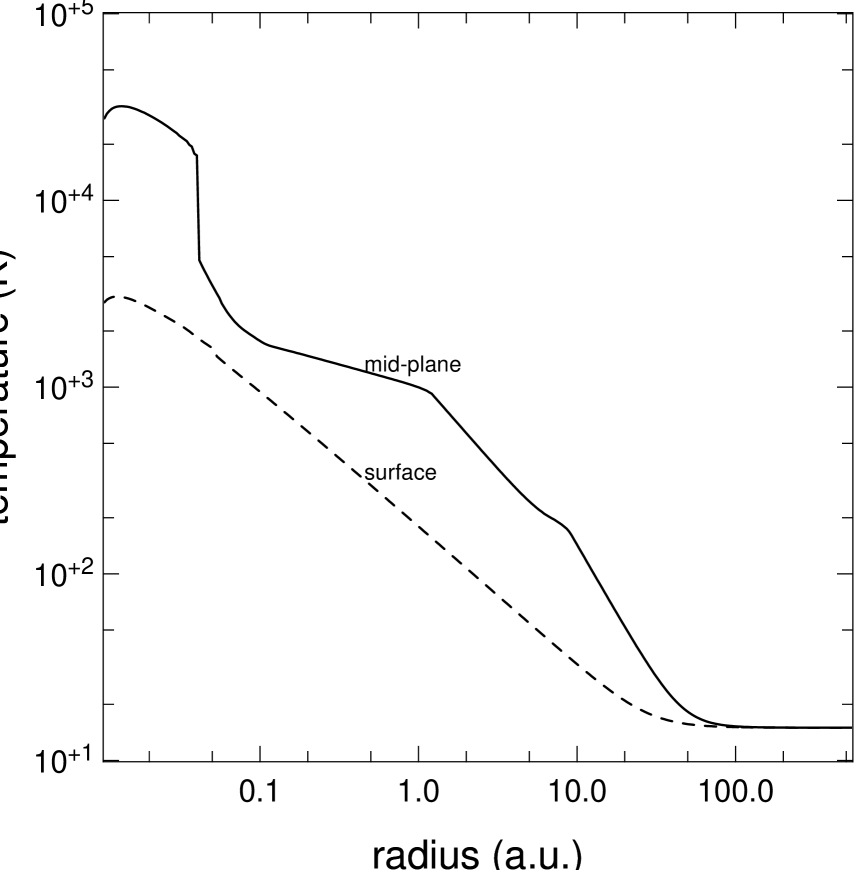
- 该模型通过考虑径向温度梯度和大半径处增强的恒星照射,成功再现了T Tauri恒星中出乎意料的平坦SED,其原因在于盘面展平效应。
- 推导出盘垂直温度分布的解析公式,表明盘光球层温度的上升主要由粘性加热和恒星照射的共同作用驱动。
- 该形式化方法可轻松扩展以包含额外加热源,如水平辐射转移或周围介质照射,从而增强模型灵活性。
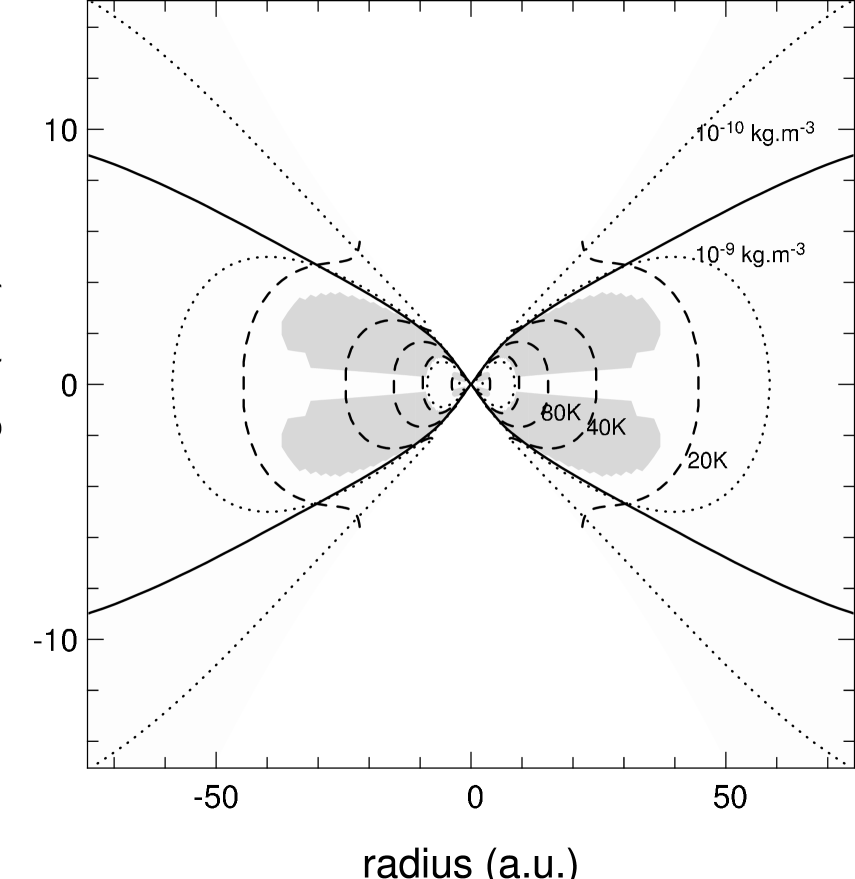
- 利用自相似吸积分布和α/β粘性律,计算了低质量主序前星的二维温度、压强和密度分布图。
- 该模型可直接计算可观测量,如SED、高分辨率图像和干涉可见度,从而比经验幂律模型更精确地约束盘参数。
- 推导出的各能量源(如粘性或照射)有效温度的表达式,使总加热贡献得以分解,清晰揭示了盘辐射的物理解释来源。
阅读本论文
在 Nubint 阅读器中打开原文,边读边就任意段落提问。
在 Nubint 中阅读本论文本解读由 AI 根据论文原文生成,引用前请核对原文。