
[论文解读] 1100 days in the life of the supernova 2018ibb -- The best pair-instability supernova candidate, to date
SN 2018ibb 被识别为迄今最佳的对偶不稳定超新星候选者,具有长扩散时间和与 PISN 预测一致的镍质量,并且没有中央发动机供能的证据。
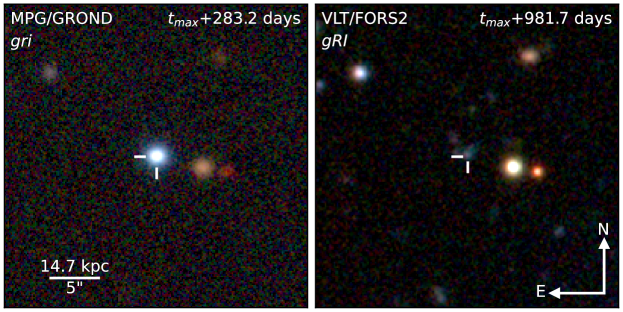
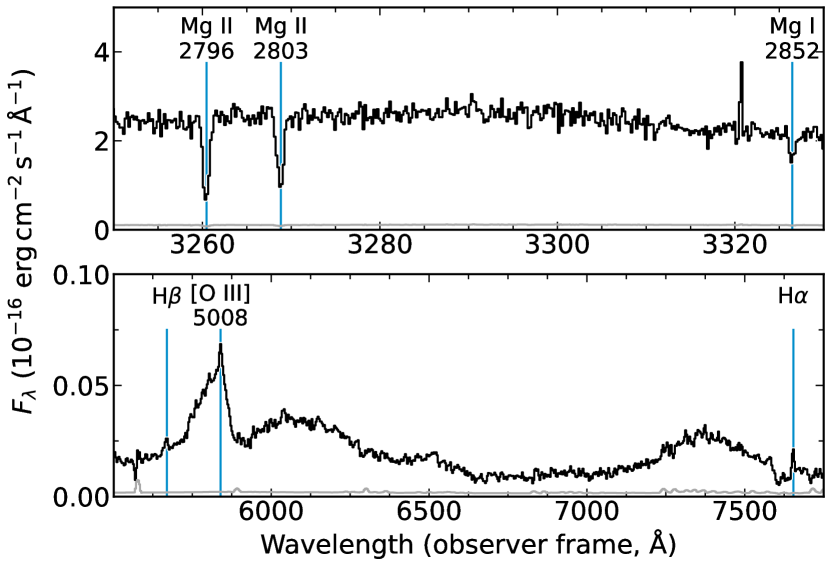
Abridged - Stars with ZAMS masses between 140 and $260 M_\odot$ are thought to explode as pair-instability supernovae (PISNe). During their thermonuclear runaway, PISNe can produce up to several tens of solar masses of radioactive nickel, resulting in luminous transients similar to some superluminous supernovae (SLSNe). Yet, no unambiguous PISN has been discovered so far. SN2018ibb is a H-poor SLSN at $z=0.166$ that evolves extremely slowly compared to the hundreds of known SLSNe. Between mid 2018 and early 2022, we monitored its photometric and spectroscopic evolution from the UV to the NIR with 2-10m class telescopes. SN2018ibb radiated $>3 imes10^{51} m erg$ during its evolution, and its bolometric light curve reached $>2 imes10^{44} m erg\,s^{-1}$ at peak. The long-lasting rise of $>93$ rest-frame days implies a long diffusion time, which requires a very high total ejected mass. The PISN mechanism naturally provides both the energy source ($^{56}$Ni) and the long diffusion time. Theoretical models of PISNe make clear predictions for their photometric and spectroscopic properties. SN2018ibb complies with most tests on the light curves, nebular spectra and host galaxy, potentially all tests with the interpretation we propose. Both the light curve and the spectra require 25-44 $M_\odot$ of freshly nucleosynthesised $^{56}$Ni, pointing to the explosion of a metal-poor star with a He-core mass of 120-130 $M_\odot$ at the time of death. This interpretation is also supported by the tentative detection of [Co II]$λ$1.025$μ$m, which has never been observed in any other PISN candidate or SLSN before. Powering by a central engine, such as a magnetar or a black hole, can be excluded with high confidence. This makes SN2018ibb by far the best candidate for being a PISN, to date.
研究动机与目标
- 在氢贫乏的超新星中寻找明确的 PISN 识别标志以推动研究。
- 用长期光度和光谱数据集(针对 SN 2018ibb)检验 PISN 的预测。
- 推断前体星性质和镍产生量以评估 SN 2018ibb 的 PISN 本质。
提出的方法
- 进行从紫外到近红外的多波段光度与光谱监测,覆盖约 1100 个休眠期日。
- 应用 s-校正和跨仪器标定,使来自多家观测设施的数据趋于同质。
- 进行主星减光和光谱绝对通量校准,并整合光度数据以获得全光度性质。
- 将观测的光曲线和星云光谱与 PISN 模型预测进行比较。
- 寻找替代能源(中央引擎)信号以及可能的周围物质相互作用的证据。
实验结果
研究问题
- RQ1 SN 2018ibb 是否主要由对偶不稳定超新星机制驱动,正如对极高质量、金属贫乏前体星的预测?
- RQ2观测需要的镍-56 质量与喷发/氦核质量是多少,这些是否与 PISN 预期一致?
- RQ3光度与光谱数据是否显示中央引擎能量源或喷发物与周环物质的相互作用的迹象,从而挑战纯粹的 PISN 解释?
- RQ4宿主星系环境(金属丰度、质量)如何支持或约束 SN 2018ibb 的 PISN 情景?
主要发现
- SN 2018ibb 的辐射能输出超过 3×10^51 erg,达到光度总峰值超过 2×10^44 erg s^-1。
- 较长的休眠原始时间上升(>93 天)意味着非常高的总喷发质量与长扩散时间。
- 建模表明需要 25–44 M⊙ 的新合成 56Ni 来解释光曲线和光谱。
- 数据指向金属贫乏的前体星,死亡时的氦核质量为 120–130 M⊙。
- 对 [Co II] 1.025 μm 的初步检出增强了 PISN 解释,这一特征在其他 PISN 候选对象或 SLSNe 中未见。
- 存在对爆发性质量损失事件的观测证据以及随后喷发物-周环介质相互作用对发射的贡献,可能解释与某些 PISN 模型的差异。
- 以高置信度排除了中央引擎(磁暴星或黑洞)供能,这进一步加强了 PISN 的论据。
更好的研究,从现在开始
从论文设计到论文写作,大幅缩短您的研究时间。
无需绑定信用卡
本解读由 AI 生成,并经人工编辑审核。