
[论文解读] 142 GHz Multipath Propagation Measurements and Path Loss Channel Modeling in Factory Buildings
本研究首次在室内工厂环境中进行了142 GHz亚太赫兹频段的信道测量,针对四种工厂的视 Line-of-Sight (LOS) 和非视 Line-of-Sight (NLOS) 条件建模路径损耗。结果表明,低接收机高度(0.5 m)在LOS和NLOS条件下分别比高接收机高度(1.5 m)产生10.7 dB和6.0 dB更高的路径损耗;同时发现,被动反射表面(PRS)可将全向增益提升高达22 dB,平均提升6.5 dB,从而为6G智能工厂中的可行亚太赫兹链路提供支持。
This paper presents sub-Terahertz (THz) radio propagation measurements at 142 GHz conducted in four factories with various layouts and facilities to explore sub-THz wireless channels for smart factories in 6G and beyond. Here we study spatial and temporal channel responses at 82 transmitter-receiver (TX-RX) locations across four factories in the New York City area and over distances from 5 m to 85 m in both line-of-sight (LOS) and non-LOS (NLOS) environments. The measurements were performed with a sliding-correlation-based channel sounder with 1 GHz RF bandwidth with steerable directional horn antennas with 27 dBi gain and 8\degree~half-power beamwidth at both TX and RX, using both vertical and horizontal antenna polarizations, yielding over 75,000 directional power delay profiles. Channel measurements of two RX heights at 1.5 m (high) emulating handheld devices and at 0.5 m (low) emulating automated guided vehicles (AGVs) were conducted for automated industrial scenarios with various clutter densities. Results yield the first path loss models for indoor factory (InF) environments at 142 GHz and show the low RX height experiences a mean path loss increase of 10.7 dB and 6.0 dB when compared with the high RX height at LOS and NLOS locations, respectively. Furthermore, flat and rotatable metal plates were leveraged as passive reflecting surfaces (PRSs) in channel enhancement measurements to explore the potential power gain on sub-THz propagation channels, demonstrating a range from 0.5 to 22 dB improvement with a mean of 6.5 dB in omnidirectional channel gain as compared to when no PRSs are present.
研究动机与目标
- 表征真实室内工厂环境中不同布局和杂乱密度下142 GHz亚太赫兹无线电波传播特性。
- 为工厂建筑中LOS和NLOS条件下的定向与全向路径损耗建立模型。
- 研究接收机高度对路径损耗的影响,特别是对地面附近移动设备(如AGV)的影响。
- 评估被动反射表面(PRS)在工业环境中提升亚太赫兹信道性能的潜力。
- 为未来可重构智能表面(RIS)部署及6G亚太赫兹信道标准化提供基础数据。
提出的方法
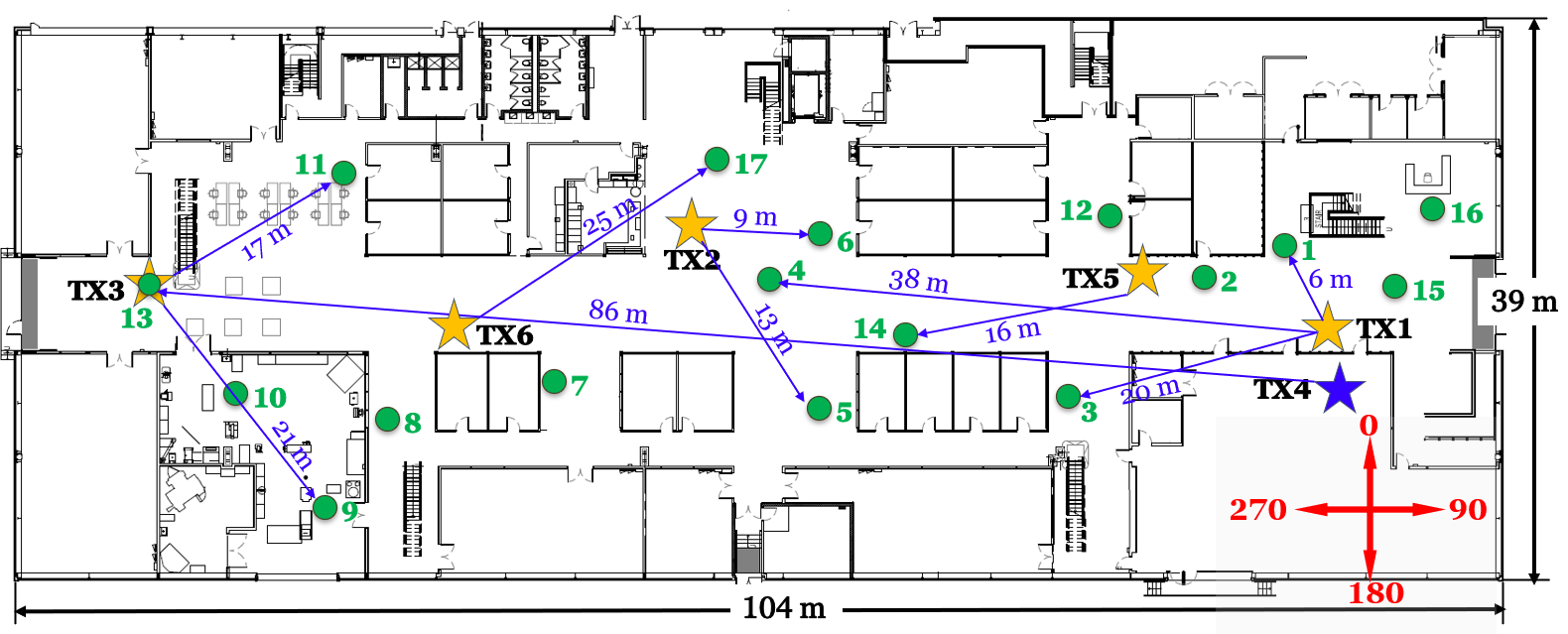
- 在纽约市四家工厂内进行82组发射-接收(TX-RX)链路测量,覆盖5–85 m距离,涵盖LOS和NLOS条件。
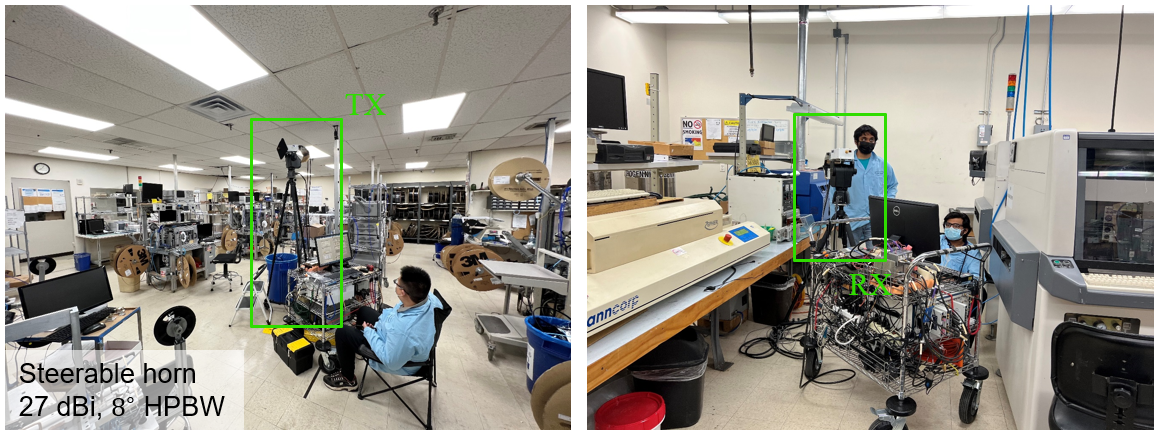
- 采用基于滑动互相关技术的宽带信道探测仪,射频带宽为1 GHz,使用增益为27 dBi、半功率波束宽度(HPBW)为8°的可定向喇叭天线。
- 在两个接收机高度(1.5 m,高;0.5 m,低)下进行定向测量,采用垂直和水平极化,模拟手持设备和AGV。
- 系统性地在水平平面内旋转1 m × 1 m的平坦铝制PRS,以确定最佳反射角度,模拟RIS波束成形。
- 采集超过75,000个定向功率延迟分布(PDP),并推导出共极化与交叉极化配置下的路径损耗模型。
- 将自然信道性能与PRS辅助性能进行对比,量化全向与定向路径损耗的降低程度。
实验结果
研究问题
- RQ1在真实室内工厂建筑中,142 GHz频段的路径损耗如何随距离和环境类型(LOS vs. NLOS)变化?
- RQ2在工厂环境中,接收机高度(1.5 m vs. 0.5 m)对路径损耗有何影响,特别是对AGV安装设备的影响?
- RQ3被动反射表面(PRS)在工厂场景中能在多大程度上增强亚太赫兹信道性能?
- RQ4PRS的放置与方向如何影响142 GHz频段下的定向与全向路径损耗?
- RQ5亚太赫兹工厂信道中交叉极化隔离度(XPD)的统计特性是什么?
主要发现
- 工厂环境中NLOS条件下的全向路径损耗指数(PLE)为3.1,高于办公室(2.7)和城市环境(2.9),表明因杂乱程度高导致路径损耗更大。
- 与高接收机高度(1.5 m)相比,低接收机高度(0.5 m)在LOS和NLOS条件下分别导致平均路径损耗增加10.7 dB和6.0 dB,主要由于遮挡和散射增加。
- 单个PRS在最优反射方向可实现最大定向路径损耗降低37.8 dB,平均降低25 dB,且在TX-RX距离最短时增益最高。
- PRS辅助的全向信道增益最高可提升22 dB,最低仅提升0.5 dB,平均提升6.5 dB,表明在NLOS和接近中断场景中具有显著优势。
- PRS效应在NLOS条件下最为显著,此时PRS增强路径成为主导路径;而在LOS条件下,其他多径分量(MPCs)通常仍为主要贡献者。
- 对交叉极化隔离度(XPD)进行了统计表征,支持共极化与交叉极化路径损耗建模,适用于多种天线配置。
更好的研究,从现在开始
从阅读论文到最终审阅,大幅缩短您的研究时间。
无需绑定信用卡
本解读由 AI 生成,并经人工编辑审核。