
[论文解读] 1D Convolutional neural networks and machine learning algorithms for spectral data classification with a case study for Covid-19
本文提出一种一维卷积神经网络(1D-CNN)用于分类光谱数据,特别应用于SARS-CoV-2检测。通过Savitzky-Golay滤波进行预处理,1D-CNN在公开的COVID-19光谱数据集上实现了96.5%的准确率、98%的特异度和94%的敏感度,优于传统的机器学习模型(如SVM和PLS-DA)。
Machine and deep learning algorithms have increasingly been applied to solve problems in various areas of knowledge. Among these areas, Chemometrics has been benefited from the application of these algorithms in spectral data analysis. Commonly, algorithms such as Support Vector Machines and Partial Least Squares are applied to spectral datasets to perform classification and regression tasks. In this paper, we present a 1D convolutional neural networks (1D-CNN) to evaluate the effectiveness on spectral data obtained from spectroscopy. In most cases, the spectrum signals are noisy and present overlap among classes. Firstly, we perform extensive experiments including 1D-CNN compared to machine learning algorithms and standard algorithms used in Chemometrics on spectral data classification for the most known datasets available in the literature. Next, spectral samples of the SARS-COV2 virus, which causes the COVID-19, have recently been collected via spectroscopy was used as a case study. Experimental results indicate superior performance of 1D-CNN over machine learning algorithms and standard algorithms, obtaining an average accuracy of 96.5%, specificity of 98%, and sensitivity of 94%. The promissing obtained results indicate the feasibility to use 1D-CNN in automated systems to diagnose COVID-19 and other viral diseases in the future.
研究动机与目标
- 评估1D-CNN在化学计量学应用中分类光谱数据的有效性。
- 比较1D-CNN与传统机器学习算法(SVM、PLS-DA、KNN、MOCHM)在公开光谱数据集上的性能。
- 研究数据预处理技术(特别是Savitzky-Golay滤波)对分类性能的影响。
- 展示1D-CNN在利用红外光谱数据实现自动化、低成本且快速的COVID-19诊断中的可行性。
- 评估模型在小规模训练数据集(光谱分析中常见)下的泛化能力。
提出的方法
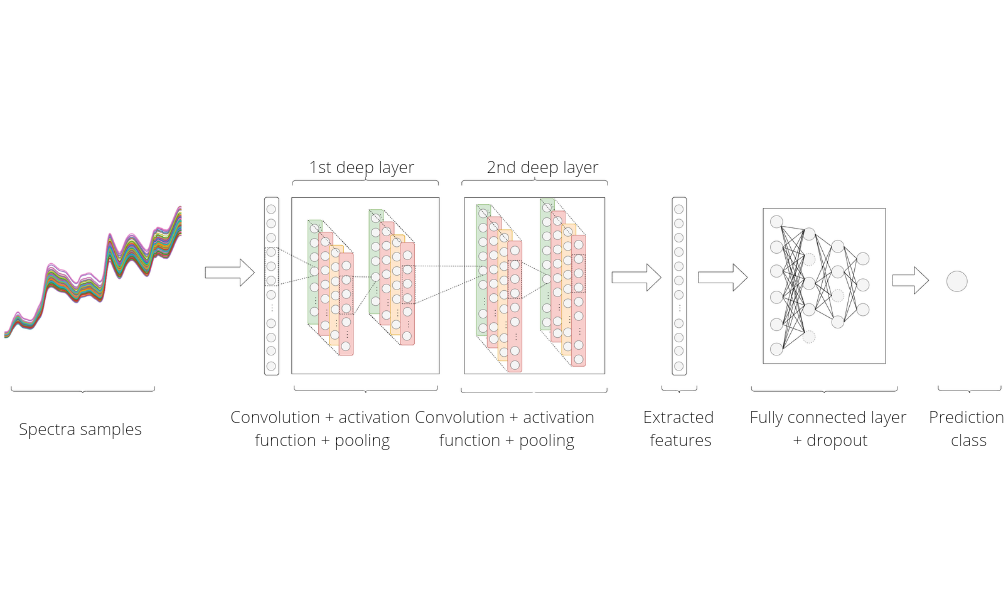
- 将1D-CNN应用于7个公开光谱数据集及一项关于SARS-CoV-2样本的红外光谱案例研究数据集。
- 使用Savitzky-Golay(SG)滤波器对光谱数据进行预处理,以减少噪声并提高信号质量。
- 使用ReLU激活函数、批量归一化和全局平均池化层训练并评估1D-CNN模型。
- 通过5折交叉验证,将1D-CNN结果与SVM、PLS-DA、KNN和MOCHM进行比较,以确保结果的稳健性。
- 采用标准指标:准确率、特异度、敏感度及标准差来评估性能。
- 开展消融研究,以评估预处理对模型结果的影响。
实验结果
研究问题
- RQ11D-CNN在分类光谱数据方面与传统机器学习模型(SVM、PLS-DA、KNN)相比表现如何?
- RQ2Savitzky-Golay滤波对光谱模型的分类准确率和稳定性有何影响?
- RQ31D-CNN能否在典型生物医学应用中常见的小规模光谱数据集上有效泛化?
- RQ41D-CNN在涉及SARS-CoV-2光谱数据的真实世界案例研究中的表现如何,相较于现有方法?
- RQ51D-CNN在从光谱特征检测COVID-19时,敏感度与特异度之间存在何种权衡?
主要发现
- 1D-CNN在SARS-CoV-2光谱数据集上实现了96.5%的平均准确率,优于SVM和PLS-DA。
- 特异度达到98.06%,标准差为1.86,表明在正确识别阴性病例方面具有高度可靠性。
- 敏感度为94.06%,展示了对阳性COVID-19病例的强大检测能力,对减少假阴性至关重要。
- Savitzky-Golay预处理与1D-CNN的结合显著提升了模型性能,并降低了结果的方差。
- 1D-CNN优于Yin等人(2021)报道的GA-LDA方法,后者在同一数据集上仅达到91%的准确率。
- 尽管训练样本有限(111例对照组,70例阳性病例),1D-CNN模型仍表现出良好的泛化能力,表明其对小样本数据集具有鲁棒性。
更好的研究,从现在开始
从阅读论文到最终审阅,大幅缩短您的研究时间。
无需绑定信用卡
本解读由 AI 生成,并经人工编辑审核。