
[论文解读] 2nd Place Winning Solution for the CVPR2023 Visual Anomaly and Novelty Detection Challenge: Multimodal Prompting for Data-centric Anomaly Detection
本文提出 SAA+,一种以数据为中心的零样本异常分割框架,通过利用源自领域专家知识和目标图像上下文的多模态提示,对 SAM 和 GroundingDINO 等基础模型进行正则化。通过整合语言、属性、显著性及置信度提示,SAA+ 在 VisA 和 MVTec-AD 基准上实现了最先进性能,显著降低了基线提示方法的误报率。
This technical report introduces the winning solution of the team Segment Any Anomaly for the CVPR2023 Visual Anomaly and Novelty Detection (VAND) challenge. Going beyond uni-modal prompt, e.g., language prompt, we present a novel framework, i.e., Segment Any Anomaly + (SAA$+$), for zero-shot anomaly segmentation with multi-modal prompts for the regularization of cascaded modern foundation models. Inspired by the great zero-shot generalization ability of foundation models like Segment Anything, we first explore their assembly (SAA) to leverage diverse multi-modal prior knowledge for anomaly localization. Subsequently, we further introduce multimodal prompts (SAA$+$) derived from domain expert knowledge and target image context to enable the non-parameter adaptation of foundation models to anomaly segmentation. The proposed SAA$+$ model achieves state-of-the-art performance on several anomaly segmentation benchmarks, including VisA and MVTec-AD, in the zero-shot setting. We will release the code of our winning solution for the CVPR2023 VAN.
研究动机与目标
- 解决由模糊、类别无关的语言提示引起的零样本异常分割中高误报率问题。
- 在无需微调的情况下,提升基础模型在异常检测中的零样本泛化能力。
- 将领域特定的专家知识与动态图像上下文整合到提示设计中,以实现更优的异常定位。
- 开发一种以数据为中心的框架,通过多模态提示正则化基础模型,而非模型微调。
- 在零样本设置下,实现在 VisA 和 MVTec-AD 上的最先进性能。
提出的方法
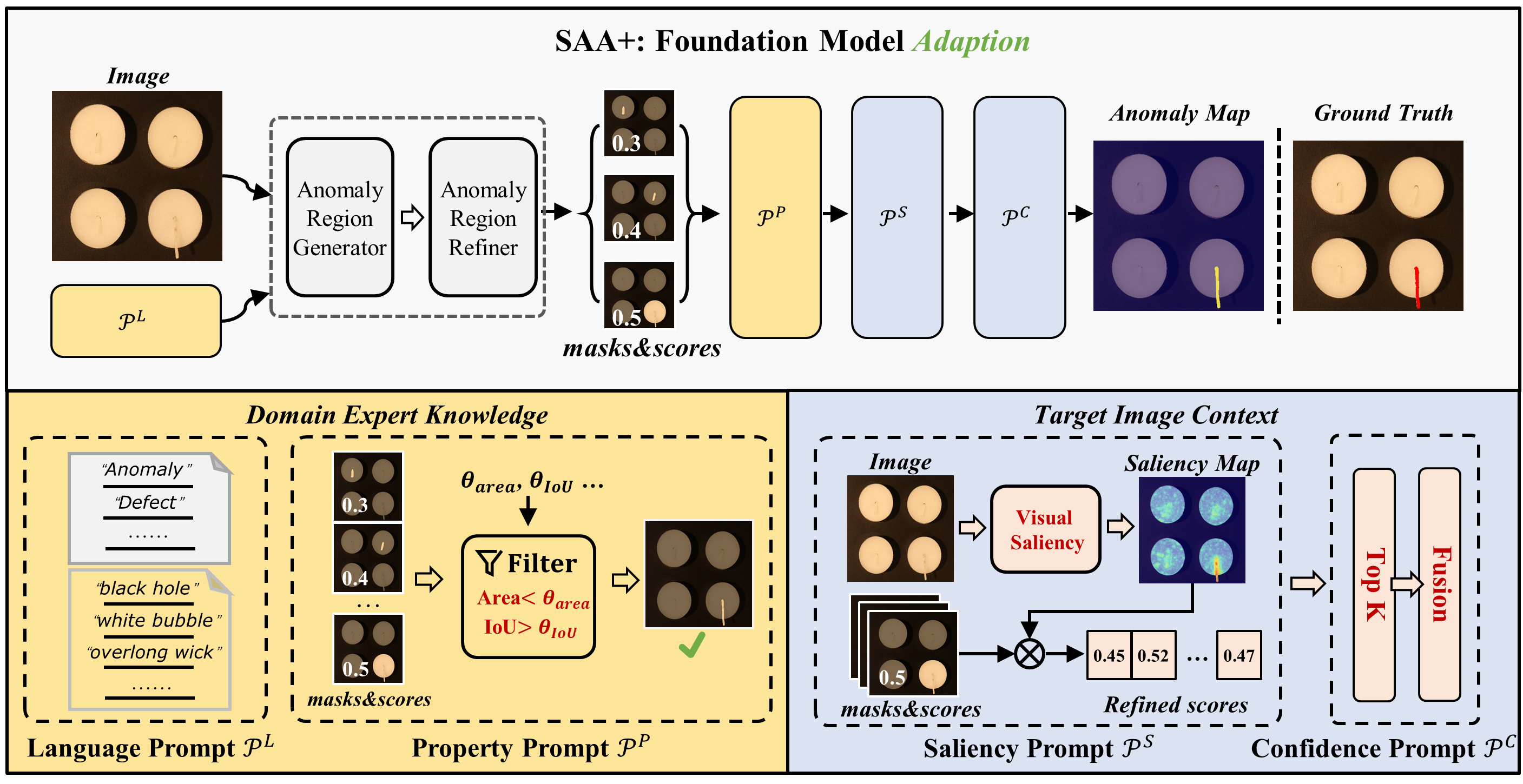
- 通过级联提示引导的目标检测器(GroundingDINO)与分割模型(SAM),构建基线方法 Segment Any Anomaly(SAA)。
- 在 SAA+ 中引入多模态提示,使用四种提示类型:语言提示(如“缺陷”)、属性提示(如“过长”)、显著性提示(来自图像特征)以及置信度提示(来自 top-K 区域得分)。
- 利用预训练的 WideResNet50 生成的视觉显著性图来指导区域选择,提升定位精度。
- 通过置信度排序对候选区域进行精炼,基于得分选择 top-K 预测结果,减少噪声。
- 通过加权聚合方式结合多种提示信号,利用软投票机制生成最终的异常图。
- 采用提示正则化策略,避免模型微调,实现完全的零样本适应。
![Figure 1 : Towards segmenting any anomaly without training, we first construct a vanilla baseline (Segment Any Anomaly, SAA) by prompting into a cascade of anomaly region generator ( e.g. , a prompt-guided object detection foundation model [ 2 ] ) and anomaly region refiner ( e.g. , a segmentation f](https://ar5iv.labs.arxiv.org/html/2306.09067/assets/figures/tech_teaser.png)
实验结果
研究问题
- RQ1与朴素语言提示相比,多模态提示是否能显著降低零样本异常分割中的误报率?
- RQ2由领域专家生成的提示(如特定缺陷描述)在提升定位精度方面效果如何?
- RQ3图像上下文(如视觉显著性和置信度得分)在多大程度上能提升基础模型预测的鲁棒性?
- RQ4结合多种提示模态是否能带来优于单一模态提示的泛化性能?
- RQ5是否可通过以数据为中心的提示方法,在无需任何模型微调的情况下实现最先进性能?
主要发现
- SAA+ 在 VisA 上达到最大 F1-pixel 得分为 27.07,在 MVTec-AD 上为 39.40,显著优于 WinClip、ClipSeg 和 UTAD 等先前方法。
- 消融实验表明,移除任意一种提示类型(语言、属性、显著性、置信度)均导致性能下降,证实了各组件的贡献。
- 移除语言提示(w/o 𝒫ᴸ)在 VisA 上导致 3.78 分的下降,表明即使基础提示对基准定位也至关重要。
- 移除显著性提示(w/o 𝒫ˢ)在 MVTec-AD 上导致 7.68 分的下降,凸显空间上下文在异常检测中的重要性。
- 置信度提示的缺失(w/o 𝒫ᶜ)在 VisA 上性能下降最明显(从 27.07 降至 26.70),表明基于得分的过滤可显著提升预测可靠性。
- 定性结果表明,SAA+ 能够以高精度检测各类对象中的多样化异常类型,包括细微和复杂缺陷,且误报极少。
更好的研究,从现在开始
从阅读论文到最终审阅,大幅缩短您的研究时间。
无需绑定信用卡
本解读由 AI 生成,并经人工编辑审核。