
[论文解读] 3D-Var Data Assimilation using a Variational Autoencoder
该论文提出了一种新颖的神经网络数据同化(NNDA)框架,利用变分自编码器(VAE)在降维潜空间中执行3D-Var数据同化,通过自动微分梯度实现高效优化。该方法捕捉了与流场相关的、季节性变化的背景误差协方差——在潜空间中表现为准对角B矩阵——并能以单一模型成功表示热带与副热带的误差结构,从而为单一温度变量提供精确的分析增量。
Data assimilation of atmospheric observations traditionally relies on variational and Kalman filter methods. Here, an alternative neural-network data assimilation (NNDA) with variational autoencoder (VAE) is proposed. The three-dimensional variational (3D-Var) data assimilation cost function is utilised to determine the analysis that optimally fuses simulated observations and the encoded short-range persistence forecast (background), accounting for their errors. The minimisation is performed in the reduced-order latent space, discovered by the VAE. The variational problem is auto-differentiable, simplifying the computation of the cost function gradient necessary for efficient minimisation. We demonstrate that the background-error covariance ($\mathbf{B}$) matrix measured and represented in the latent space is quasi-diagonal. The background-error covariances in the grid-point space are flow-dependent, evolving seasonally and depending on the current state of the atmosphere. Data assimilation experiments with a single temperature observation in the lower troposphere indicate that the $\mathbf{B}$-matrix simultaneously describes both tropical and extratropical background-error covariances.
研究动机与目标
- 开发一种基于神经网络的数据同化(NNDA)框架,用变分自编码器(VAE)学习的低维表示替代传统3D-Var中的背景误差协方差建模。
- 通过在VAE学习的潜空间中执行优化,实现3D-Var代价函数的高效最小化,利用自动微分进行梯度计算。
- 探究单一VAE学习的潜空间背景误差协方差(B矩阵)是否能够同时表征热带与副热带的大气动力学。
- 评估VAE-NNDA框架在多变量设置下生成地转平衡分析增量的能力,特别是风场与位势高度场。
- 为未来扩展至4D-Var和独立神经网络天气预报奠定基础,通过集成概率自编码器和混合预报模型。
提出的方法
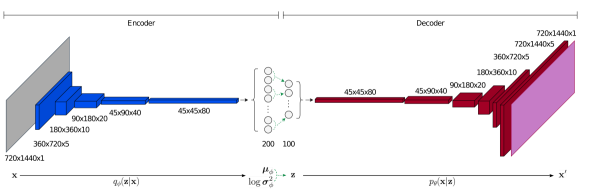
- 在ERA5再分析数据上训练变分自编码器(VAE),以学习大气状态场(如850 hPa温度)的低维、高斯分布潜空间表示。
- 在潜空间中重新表述并最小化3D-Var代价函数,其中背景态由短时预报(持续性)编码,观测值被投影至潜空间。
- 背景误差协方差矩阵(B)在潜空间中隐式表示,结果显示为准对角形式,表明对复杂误差结构实现了有效的低秩近似。
- 通过自动微分计算代价函数的梯度,利用L-BFGS等标准非线性求解器实现高效优化。
- 在潜空间中计算分析增量,并解码回网格点空间以进行评估。
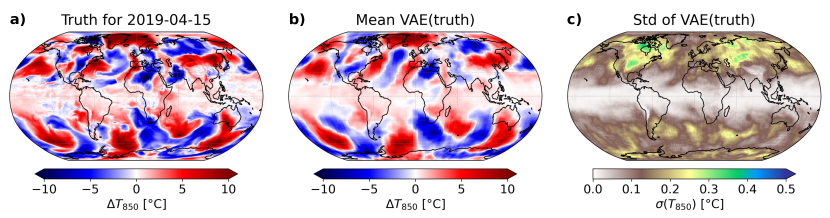
- 使用850 hPa温度的合成观测对框架进行测试,验证分析增量结构与背景误差协方差的准确性。
实验结果
研究问题
- RQ1VAE学习的潜空间是否能有效表征3D-Var数据同化所需的背景误差协方差结构?
- RQ2潜空间中的B矩阵是否能同时捕捉热带与副热带与流场相关的背景误差特征?
- RQ3基于VAE的3D-Var框架的可微分特性是否能实现代价函数的高效且精确的最小化?
- RQ4该方法在多变量设置下,能在多大程度上生成地转平衡的分析增量?
- RQ5该框架是否能以极少的架构开销扩展至4D-Var和独立神经网络天气预报?
主要发现
- 潜空间中的背景误差协方差矩阵(B)为准对角形式,表明VAE在低维、平滑表示中捕捉了主要误差结构。
- VAE学习的B矩阵使用单一模型成功表征了热带与副热带的背景误差协方差,展现出与流场相关及季节性变化的特性。
- 该方法为中纬度200 hPa风场与位势高度场生成了地转平衡的分析增量,表明在多变量同化中具有物理一致性。
- VAE的可微分特性实现了高效的梯度计算,简化了潜空间中的优化过程。
- 该框架具备表征多变量背景误差协方差的能力,尽管在多个变量和垂直层次上的完整验证仍需进一步扩展。
- 该方法在集成4D-Var和混合预报模型方面展现出前景,特别是结合概率自编码器与归一化流以改进潜空间建模。
更好的研究,从现在开始
从阅读论文到最终审阅,大幅缩短您的研究时间。
无需绑定信用卡
本解读由 AI 生成,并经人工编辑审核。