
[论文解读] A broadband thermal emission spectrum of the ultra-hot Jupiter WASP-18b
本研究利用詹姆斯·韦布空间望远镜/NIRISS首次获得了超热木星WASP-18b的超宽带热辐射光谱,检测到三个水汽发射特征,显著性超过6σ,并在3.8σ显著性水平下探测到可能来自H⁻、TiO和VO的光学消光,光谱揭示了热反演、分子离解、太阳金属丰度(M/H = 1.03⁺¹.¹¹₋₀.₅₁)以及C/O比值<1,白昼面亮度温度分布图显示对称的向星点峰值,向晨昏线方向急剧下降。
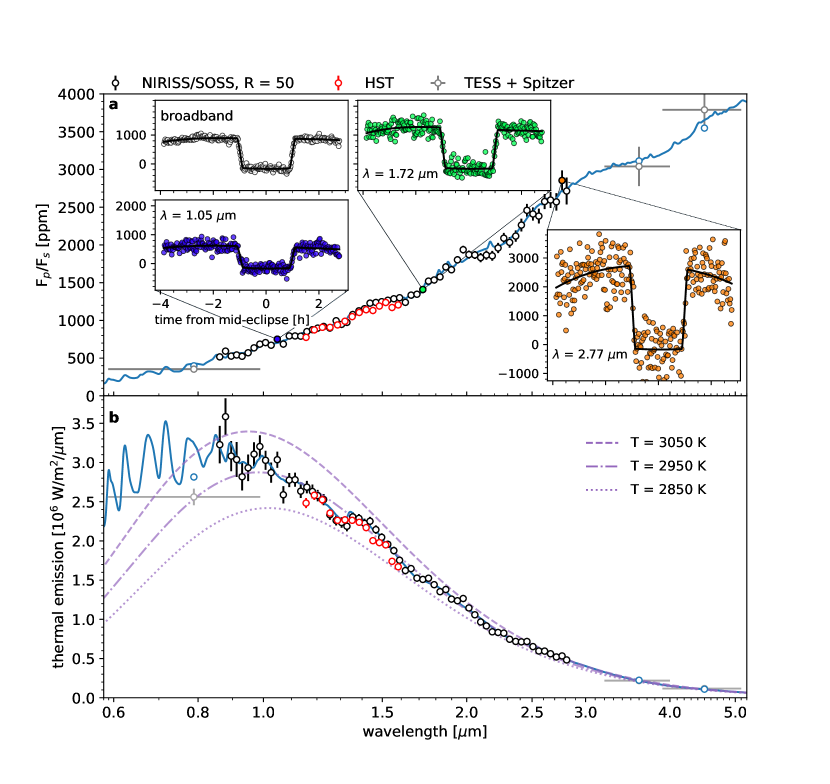
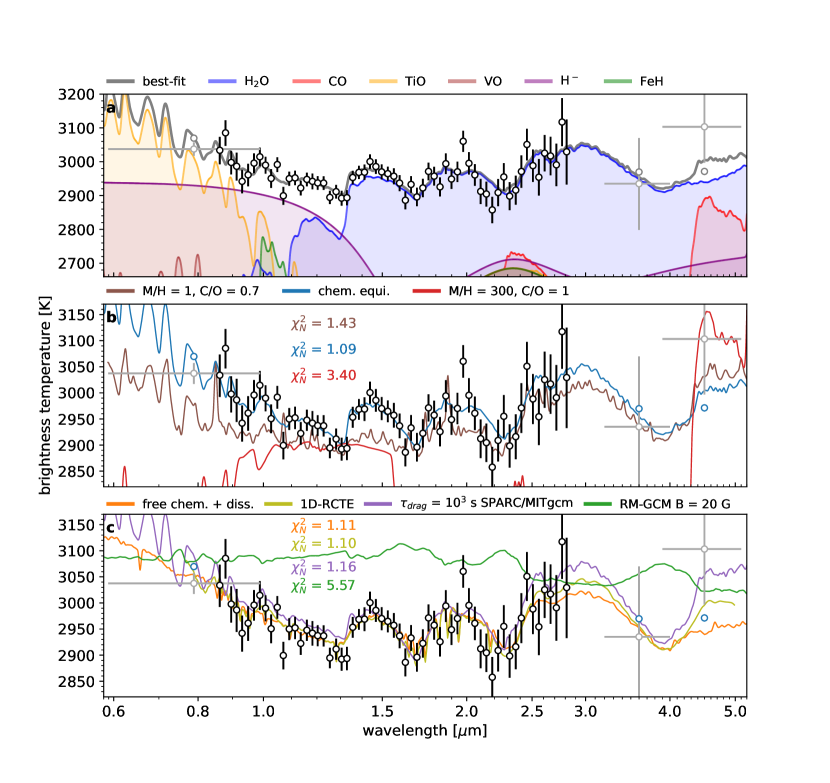
Close-in giant exoplanets with temperatures greater than 2,000 K (''ultra-hot Jupiters'') have been the subject of extensive efforts to determine their atmospheric properties using thermal emission measurements from the Hubble and Spitzer Space Telescopes. However, previous studies have yielded inconsistent results because the small sizes of the spectral features and the limited information content of the data resulted in high sensitivity to the varying assumptions made in the treatment of instrument systematics and the atmospheric retrieval analysis. Here we present a dayside thermal emission spectrum of the ultra-hot Jupiter WASP-18b obtained with the NIRISS instrument on JWST. The data span 0.85 to 2.85 $μ$m in wavelength at an average resolving power of 400 and exhibit minimal systematics. The spectrum shows three water emission features (at $>$6$σ$ confidence) and evidence for optical opacity, possibly due to H$^-$, TiO, and VO (combined significance of 3.8$σ$). Models that fit the data require a thermal inversion, molecular dissociation as predicted by chemical equilibrium, a solar heavy element abundance (''metallicity'', M/H = 1.03$_{-0.51}^{+1.11}$ $ imes$ solar), and a carbon-to-oxygen (C/O) ratio less than unity. The data also yield a dayside brightness temperature map, which shows a peak in temperature near the sub-stellar point that decreases steeply and symmetrically with longitude toward the terminators.
研究动机与目标
- 利用高精度JWST观测,表征超热木星WASP-18b的白昼面热辐射光谱。
- 尽管先前哈勃和斯皮策望远镜研究存在系统误差和信噪比低的挑战,仍需解析大气成分、热结构与能量分布。
- 通过从低系统误差的超宽带光谱中反演金属丰度、C/O比值与热结构,检验大气模型。
- 生成高保真的白昼面亮度温度分布图,以推断大气环流模式。
提出的方法
- 使用JWST/NIRISS/SOSS以SUBSTRIP96模式在0.85–2.85 μm波段、R ≈ 400的分辨率下观测WASP-18b的第二次凌星,最小化饱和并最大化积分效率(67%)。
- 采用四种独立的数据处理流水线(NAMELESS、nirHiss、supreme-SPOON、transitspectroscopy),使用固定宽度或最优提取方法以最小化系统误差。
- 通过建模并剔除与通量相关的光谱轨迹形态变化,实现先进的1/f噪声抑制。
- 使用ExoTEP拟合光谱光变曲线与白光光变曲线,利用TESS全轨道相位曲线数据约束系统参数(如中点凌星时刻、轨道倾角)。
- 采用SCARLET、ScCHIMERA、HyDRA与POSEIDON进行大气反演,推导金属丰度、C/O比值与分子丰度的后验分布。
- 利用球谐函数与傅里叶级数构建日食映射模型,以推断空间亮度分布,并对经度与纬度结构施加约束。
实验结果
研究问题
- RQ1在0.85–2.85 μm波段,WASP-18b的超宽带热辐射光谱为何?哪些大气物种以高显著性被检测到?
- RQ2WASP-18b的大气层是否表现出热反演?其推断的金属丰度与C/O比值为何?
- RQ3白昼面亮度的空间分布如何?与大气环流模型相比有何异同?
- RQ41/f噪声与光谱轨迹漂移等系统误差如何影响光谱提取?哪些方法可有效减轻其影响?
主要发现
- 检测到三个水汽发射特征,显著性超过6σ,证实大气中水汽丰度较高。
- 在3.8σ显著性水平下联合检测到来自H⁻、TiO和VO的光学消光,但未单独分辨。
- 大气反演结果支持热反演,金属丰度与太阳一致(M/H = 1.03⁺¹.¹¹₋₀.₅₁ × 太阳),C/O比值小于1。
- 白昼面亮度温度分布图显示在向星点附近存在峰值,且随经度向晨昏线方向对称且急剧下降。
- 模型比较表明,具有强大气阻尼(如τ = 10³ s)的GCM模型比无阻尼模型更符合观测相位曲线。
- 日食图中的纬向结构尚无法约束,但无论采用球谐函数还是傅里叶级数,经向亮度分布均稳健地被反演得出。
更好的研究,从现在开始
从阅读论文到最终审阅,大幅缩短您的研究时间。
无需绑定信用卡
本解读由 AI 生成,并经人工编辑审核。