
[论文解读] A Careful Examination of Large Language Model Performance on Grade School Arithmetic
论文引入 GSM1k,这是一个新的包含 1250 个问题的基准,旨在模仿 GSM8k 以评估 LLM 在小学算术上的表现是否反映真正的推理能力还是数据污染所致,结果在若干模型家族中发现显著的过拟合,但在前沿模型中具备较强的泛化能力。
Large language models (LLMs) have achieved impressive success on many benchmarks for mathematical reasoning. However, there is growing concern that some of this performance actually reflects dataset contamination, where data closely resembling benchmark questions leaks into the training data, instead of true reasoning ability. To investigate this claim rigorously, we commission Grade School Math 1000 (GSM1k). GSM1k is designed to mirror the style and complexity of the established GSM8k benchmark, the gold standard for measuring elementary mathematical reasoning. We ensure that the two benchmarks are comparable across important metrics such as human solve rates, number of steps in solution, answer magnitude, and more. When evaluating leading open- and closed-source LLMs on GSM1k, we observe accuracy drops of up to 8%, with several families of models showing evidence of systematic overfitting across almost all model sizes. Further analysis suggests a positive relationship (Spearman's r^2 = 0.36) between a model's probability of generating an example from GSM8k and its performance gap between GSM8k and GSM1k, suggesting that some models may have partially memorized GSM8k. Nevertheless, many models, especially those on the frontier, show minimal signs of overfitting, and all models broadly demonstrate generalization to novel math problems guaranteed to not be in their training data.
研究动机与目标
- 评估 GSM8k 风格基准是否存在数据污染,通过构建独立的人为制作的 GSM1k 小学数学题数据集。
- 将 GSM1k 与 GSM8k 在多种模型家族和规模上进行比较,以量化过拟合和泛化。
提出的方法
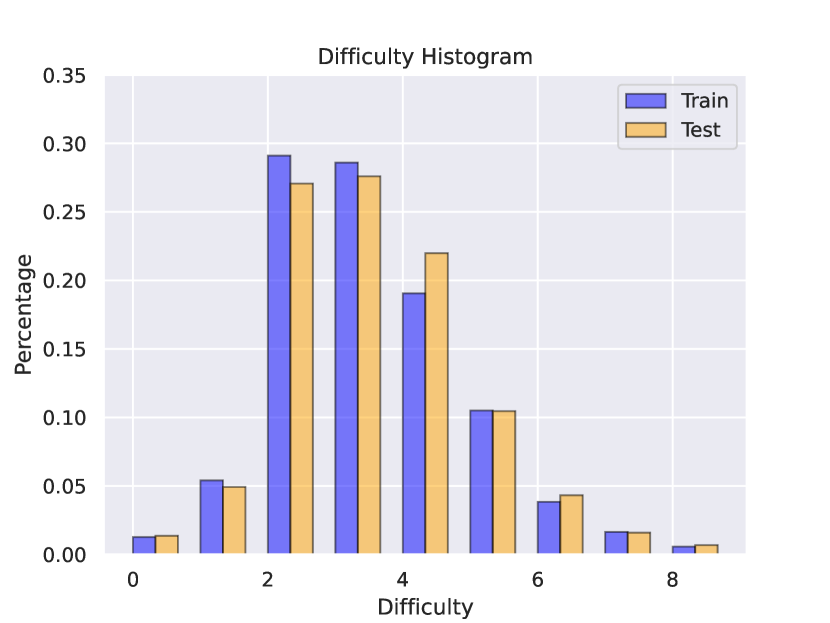
- 使用 1250 道人工注释题构建 GSM1k,其难度分布与 GSM8k 相匹配。
- 在 GSM1k 上使用 EleutherAI LM Evaluation Harness 的分叉版本评估开源和闭源 LLM。
- 通过比较 GSM8k 与 GSM1k 在不同模型家族中的性能差距来分析过拟合。
- 测量模型生成 GSM8k 示例的似然性,以评估数据污染。
- 提供定性教训并讨论除污染之外的潜在过拟合来源。
实验结果
研究问题
- RQ1GSM1k 是否揭示出在 GSM8k 中可能被掩盖的过拟合?
- RQ2哪些模型家族在不同规模和版本中表现出系统性过拟合?
- RQ3前沿模型是否表现出较少的过拟合和对新问题的更好泛化?
- RQ4模型生成 GSM8k 数据的似然性与其 GSM8k–GSM1k 绩效差距之间的关系是什么?
- RQ5数据污染在多大程度上能解释观察到的过拟合,还有其他因素吗?
主要发现
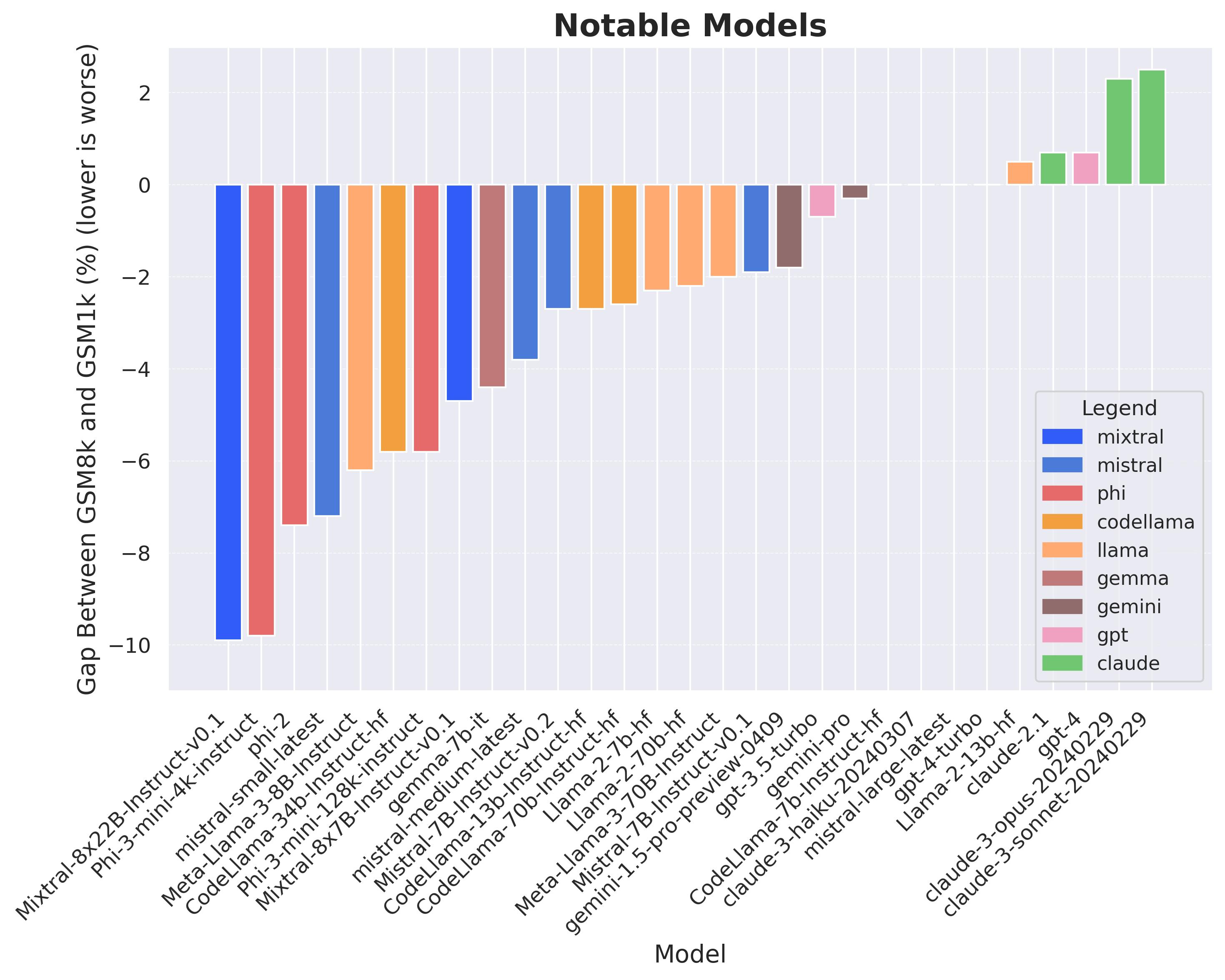
- GSM1k 显示在若干模型家族中,GSM1k 相对于 GSM8k 的准确率下降高达 13%。
- Mistral 与 Phi 家族在不同规模上表现出系统性过拟合;前沿模型显示出最小的过拟合。
- 前沿模型(如 Gemini、GPT、Claude)在 GSM8k 与 GSM1k 上的表现相似,表明更强的泛化能力或对污染的防护。
- 模型产生 GSM8k 数据的可能性与 GSM8k–GSM1k 绩效差距之间存在正相关(Spearman r^2 = 0.32),表明部分记忆了 GSM8k 测试数据。
- 过拟合模型仍然能够有效地推理并解决新颖的 GSM1k 问题,挑战了“过拟合就等于失去推理能力”的观点。
- 数据污染很可能不是过拟合的唯一解释;其他因素如基准驱动的数据收集也可能造成。
更好的研究,从现在开始
从阅读论文到最终审阅,大幅缩短您的研究时间。
无需绑定信用卡
本解读由 AI 生成,并经人工编辑审核。