
[论文解读] A collider test of nano-Hertz gravitational waves from pulsar timing arrays
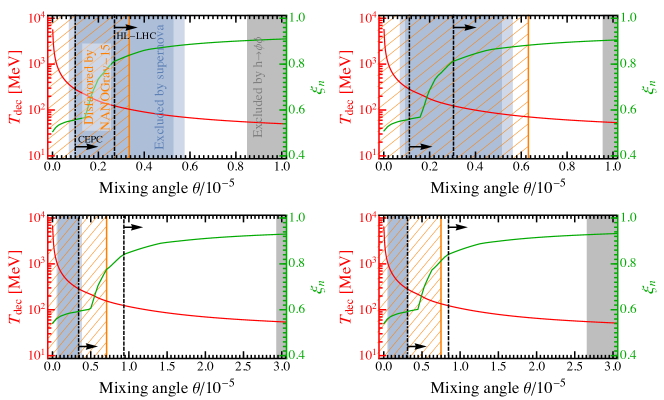
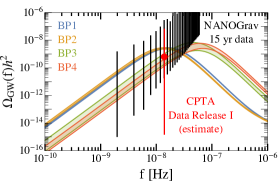
本文提出,脉冲星时标阵列(PTA)探测到的纳赫兹引力波(GW)背景可能源自一个与标准模型通过希格斯门户耦合的MeV量级隐秘规范场的的一阶相变(FOPT)。研究证明,为产生观测到的GW信号而必需的较大门户耦合,可通过大型强子对撞机(LHC)以及未来正负电子对撞机(如CEPC、ILC和FCC-ee)中的希格斯玻色子隐形衰变进行探测,从而为随机GW背景的起源提供直接的对撞机检验。
A cosmic first-order phase transition (FOPT) occurring at MeV-scale provides an attractive explanation for the nano-Hertz gravitational wave (GW) background indicated by the recent pulsar timing array data from the NANOGrav, CPTA, EPTA and PPTA collaborations. We propose this explanation can be further tested at the colliders if the hidden sector couples to the Standard Model sector via Higgs portal. Through a careful analysis of the thermal history of the hidden sector, we demonstrate that in order to successfully explain the observed GW signal, the portal coupling must be sizable that it can be probed through Higgs invisible decay at the LHC or future lepton colliders such as CEPC, ILC, and FCC-ee. Our research offers a promising avenue to uncover the physical origin of the nano-Hertz GWs through particle physics experiments.
研究动机与目标
- 研究脉冲星时标阵列(PTA)观测到的纳赫兹引力波(GW)背景是否可由一个MeV量级隐秘规范场的一阶相变(FOPT)解释。
- 确定此类FOPT对粒子物理实验(特别是对撞机搜索)的启示。
- 建立GW信号幅度与希格斯门户耦合强度至隐秘规范场之间的联系。
- 评估当前及未来对撞机(如HL-LHC、CEPC、ILC和FCC-ee)对解释PTA数据所需门户耦合的探测灵敏度。
提出的方法
- 该研究采用一个包含规范U(1)X暗物质规范场的最小模型,其中包含一个标量粒子和一个暗规范玻色子,通过希格斯门户与标准模型耦合。
- 计算有限温度下暗标量的有效势,包含一阶量子修正和Daisy重求和以描述热效应。
- 分析隐秘规范场的热历史,以确定其温度相对于标准模型场的相对关系,考虑由于弱门户耦合导致的早期解耦。
- 利用一阶相变动力学的标准框架,通过气泡碰撞和声波机制计算引力波谱。
- 推导出希格斯玻色子隐形衰变宽度作为门户耦合的函数,从而实现对撞机探测灵敏度的直接估计。
- 对基准参数点进行数值分析,比较GW产生所需的门户耦合与HL-LHC及未来对撞机的探测能力。
实验结果
研究问题
- RQ1PTA探测到的纳赫兹引力波背景是否可由一个MeV量级隐秘规范场的一阶相变解释?
- RQ2为产生观测到的GW幅度,希格斯门户耦合的强度需达到多大?该耦合是否可在对撞机中探测到?
- RQ3隐秘规范场的早期热解耦如何影响引力波信号及所需的门户耦合?
- RQ4HL-LHC以及未来正负电子对撞机(如CEPC、ILC和FCC-ee)在多大程度上可探测到解释PTA引力波信号所需的参数空间?
- RQ5是否存在一条直接的、可检验的联系,将随机引力波背景与通过希格斯门户耦合的希格斯玻色子隐形衰变联系起来?
主要发现
- 为产生观测到的纳赫兹引力波背景,需要较大的希格斯门户耦合,因为较小的耦合会导致相变期间能量释放不足。
- 所需的门户耦合会导致希格斯玻色子具有显著的隐形分支比,使其可通过HL-LHC中的希格斯玻色子隐形衰变被探测到。
- HL-LHC有望探测到与PTA引力波信号一致的参数空间的大部分区域。
- 未来正负电子对撞机(如CEPC、ILC和FCC-ee)可覆盖几乎全部解释引力波背景所需的参数空间。
- 本研究建立了引力波背景的天体物理观测与特定粒子物理过程(即通过希格斯门户耦合的希格斯玻色子隐形衰变)之间的直接、可检验的联系。
更好的研究,从现在开始
从阅读论文到最终审阅,大幅缩短您的研究时间。
无需绑定信用卡
本解读由 AI 生成,并经人工编辑审核。