
[论文解读] A compact instrument for gamma-ray burst detection on a CubeSat platform I: Design drivers and expected performance
本文介绍了GMOD,一种用于2U立方体卫星EIRSAT-1的紧凑型伽马射线暴(GRB)探测器,采用铈溴化物闪烁体和硅光电倍增管,由抗辐射ASIC读出。尽管在120 keV能量下的天空平均有效面积仅为10 cm²,蒙特卡罗模拟预测GMOD每年可检测到11至14次GRB,显著性水平超过10σ,证明了该技术为未来小型卫星GRB任务做好了准备。
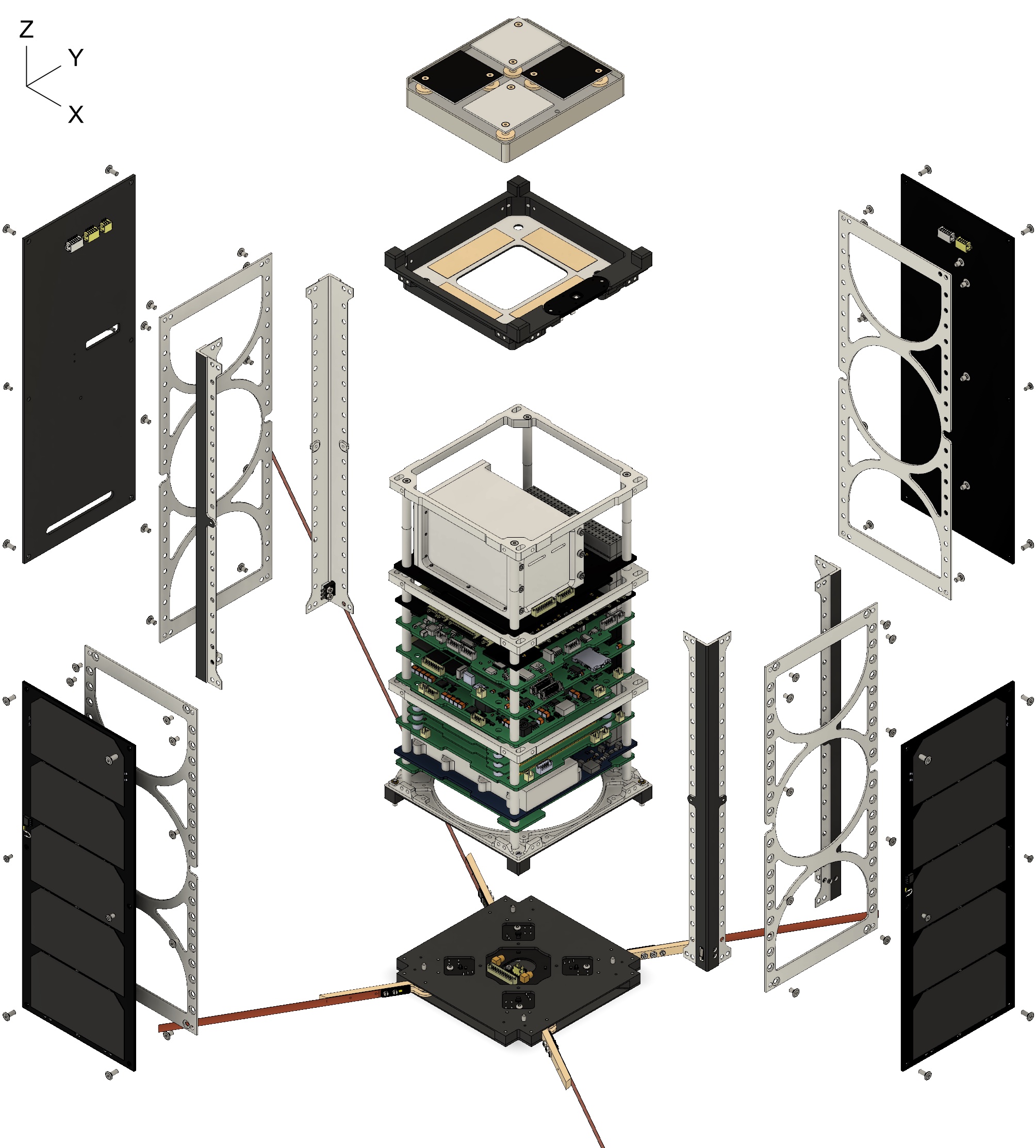
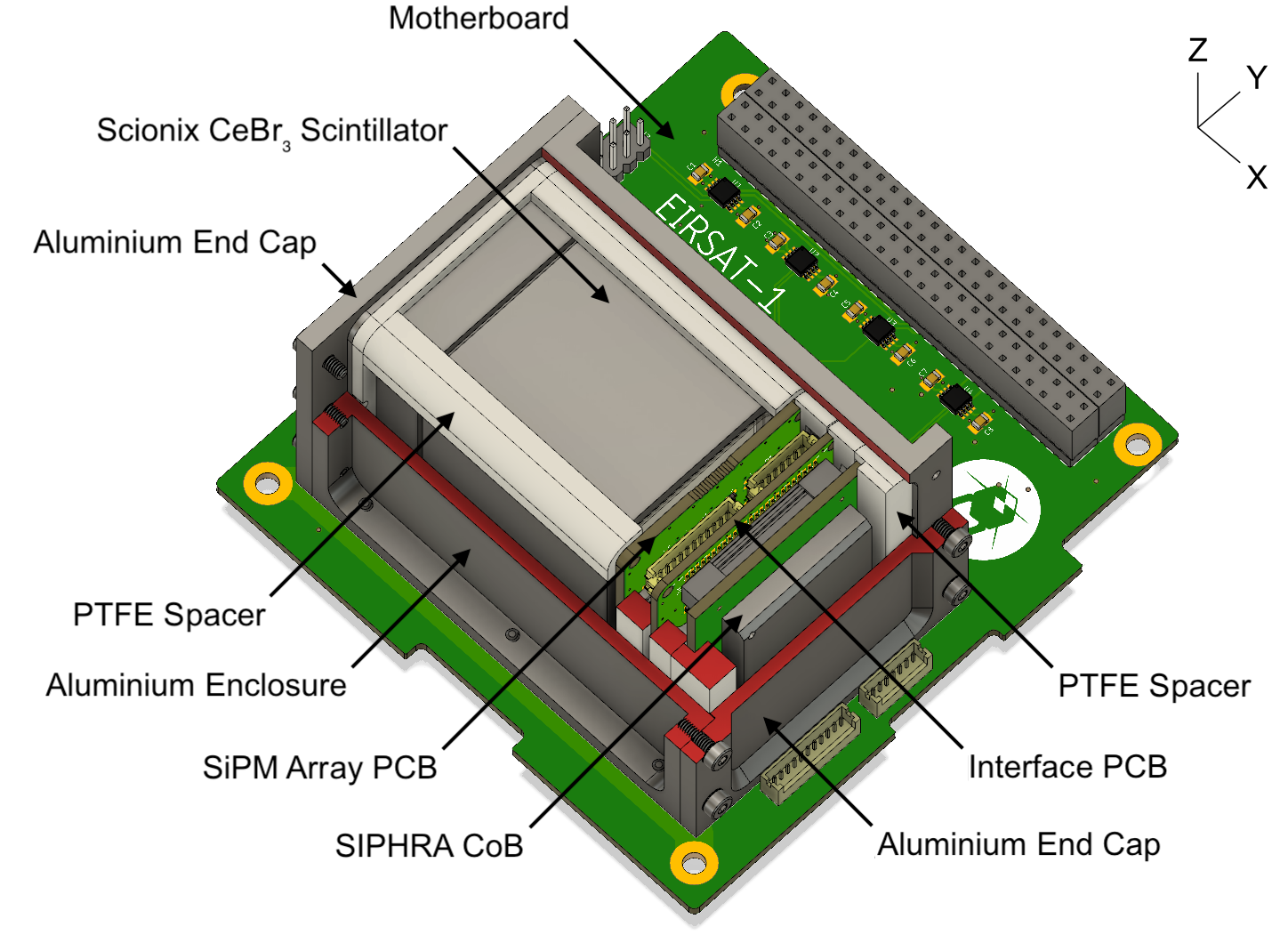
The Educational Irish Research Satellite 1 (EIRSAT-1) is a 2U CubeSat being developed under ESA's Fly Your Satellite! programme. The project has many aspects, which are primarily educational, but also include space qualification of new detector technologies for gamma-ray astronomy and the detection of gamma-ray bursts (GRBs). The Gamma-ray Module (GMOD), the main mission payload, is a small gamma-ray spectrometer comprising a 25 mm × 25 mm × 40 mm cerium bromide scintillator coupled to an array of 16 silicon photomultipliers. The readout is provided by IDE3380 (SIPHRA), a low-power and radiation tolerant readout ASIC. GMOD will detect gamma-rays and measure their energies in a range from tens of keV to a few MeV. Monte Carlo simulations were performed using the Medium Energy Gamma-ray Astronomy Library to evaluate GMOD's capability for the detection of GRBs in low Earth orbit. The simulations used a detailed mass model of the full spacecraft derived from a very high-fidelity 3D CAD model. The sky-average effective area of GMOD on board EIRSAT-1 was found to be 10 cm<sup>2</sup> at 120 keV. The instrument is expected to detect between 11 and 14 GRBs, at a significance greater than 10<i>σ</i> (and up to 32 at 5<i>σ</i>), during a nominal one-year mission. The shape of the scintillator in GMOD results in omni-directional sensitivity which allows for a nearly all-sky field of view.
研究动机与目标
- 开发并验证适用于2U立方体卫星平台的紧凑型、低质量伽马射线探测器。
- 展示铈溴化物闪烁体、硅光电倍增管以及SIPHRA ASIC在近地轨道环境中的空间适应性。
- 通过详细的蒙特卡罗模拟评估仪器的灵敏度和GRB探测性能。
- 尽管有效面积有限,仍实现全天空GRB探测,具有近乎全向视场。
- 通过验证伽马射线暴天文探测中的关键技术,为未来小型卫星任务提供支持。
提出的方法
- GMOD仪器采用25 mm × 25 mm × 40 mm的铈溴化物(CeBr3)闪烁体,与16个硅光电倍增管(SiPMs)耦合。
- 读出采用IDE3380(SIPHRA)ASIC,因其在太空中具备低功耗和抗辐射特性而被选中。
- 使用中能伽马射线天文学库进行蒙特卡罗模拟,采用EIRSAT-1全尺寸航天器的高保真3D CAD模型。
- 通过考虑地球掩星、南大西洋异常带穿越以及仪器停机时间,计算天空平均有效面积,得出有效曝光因子为0.496。
- 在三种触发时间窗(128 ms、256 ms、1024 ms)下模拟GRB探测率,采用各时间窗中最佳响应结果估算探测效率。
- 通过将模拟的GRB光 light curves 和 spectra 与5σ和10σ显著性水平下的检测阈值进行比较,评估灵敏度。
实验结果
研究问题
- RQ1GMOD仪器在数十keV至数MeV能量范围内的有效面积是多少?
- RQ2在轨道约束和仪器响应条件下,GMOD每年可探测到多少次显著性水平超过10σ的伽马射线暴?
- RQ3触发积分时间(128 ms、256 ms、1024 ms)的选择如何影响短暴和长暴的探测效率?
- RQ4闪烁体形状带来的全向灵敏度在多大程度上可补偿仪器低有效面积对GRB探测的影响?
- RQ5SIPHRA ASIC与CeBr3-SiPM系统能否在立方体卫星环境中实现可靠、抗辐射的性能,用于伽马射线暴探测?
主要发现
- GMOD在120 keV处的天空平均有效面积为10 cm²,比Fermi GBM或更大尺寸的立方体卫星GRB任务低一个数量级。
- 根据航天器姿态不同,GMOD预计每年可探测到11至14次显著性水平超过10σ的伽马射线暴。
- 在5σ显著性水平下,探测率上升至每年28至32次,表明对暗弱或短时标暴具有高灵敏度。
- 1024 ms触发时间窗的性能几乎与所有时间窗中的最佳响应相当,表明其可作为在轨处理能力有限任务的稳健备用方案。
- 地球掩星和仪器停机时间(来自SAA和范艾伦带穿越)使有效曝光时间减少至名义时间的49.6%,该因素已纳入探测率模拟。
- 仪器的全向灵敏度使其具备近乎全天空视场,补偿了其相对于薄型定向闪烁体的有限方向灵敏度。
更好的研究,从现在开始
从阅读论文到最终审阅,大幅缩短您的研究时间。
无需绑定信用卡
本解读由 AI 生成,并经人工编辑审核。