
[论文解读] A Comprehensive Survey on the Applications of Blockchain for Securing Vehicular Networks
本综述对车联网中的区块链安全框架进行了全面分析,从应用、安全和区块链三个视角评估了75种方案。它识别出可扩展性、量子威胁和仿真局限性等关键挑战,同时为安全、去中心化的车联网(IoV)系统提出未来研究方向。
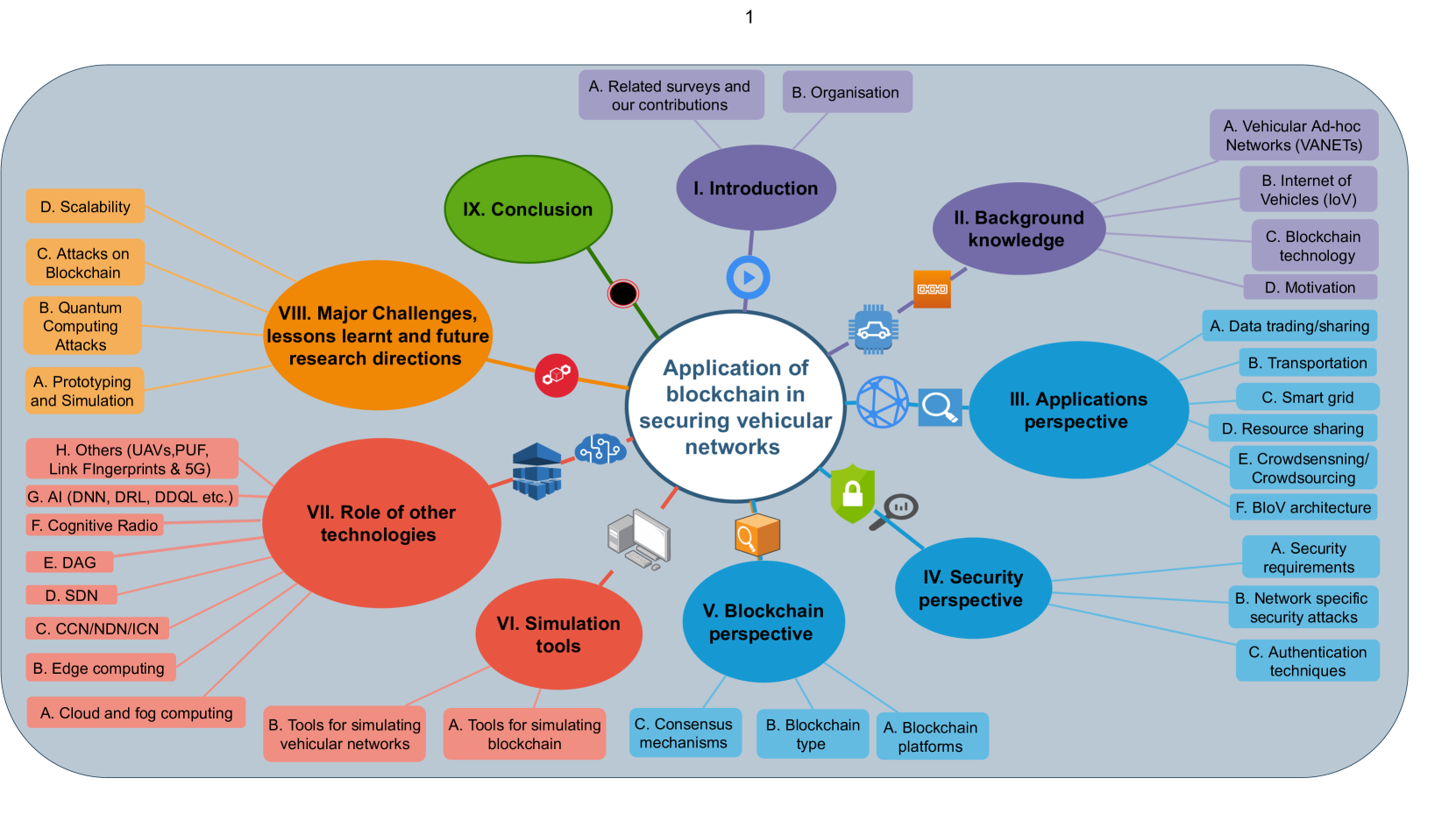
Vehicular networks promise features such as traffic management, route scheduling, data exchange, entertainment, and much more. With any large-scale technological integration comes the challenge of providing security. Blockchain technology has been a popular choice of many studies for making the vehicular network more secure. Its characteristics meet some of the essential security requirements such as decentralization, transparency, tamper-proof nature, and public audit. This study catalogues some of the notable efforts in this direction over the last few years. We analyze around 75 blockchain-based security schemes for vehicular networks from an application, security, and blockchain perspective. The application perspective focuses on various applications which use secure blockchain-based vehicular networks such as transportation, parking, data sharing/ trading, and resource sharing. The security perspective focuses on security requirements and attacks. The blockchain perspective focuses on blockchain platforms, blockchain types, and consensus mechanisms used in blockchain implementation. We also compile the popular simulation tools used for simulating blockchain and for simulating vehicular networks. Additionally, to give the readers a broader perspective of the research area, we discuss the role of various state-of-the-art emerging technologies in blockchain-based vehicular networks. Lastly, we summarize the survey by listing out some common challenges and the future research directions in this field.
研究动机与目标
- 系统性地对75种基于区块链的车联网安全方案从应用、安全和区块链视角进行分类与分析。
- 识别并分类这些框架中使用的安全需求、攻击类型以及密码学技术。
- 评估在车联网应用中采用的区块链平台、类型(公有、私有、许可)以及共识机制。
- 评估边缘计算和物联网等新兴技术在提升基于区块链的车联网安全方面的作用。
- 突出显示开放挑战,如量子计算威胁、仿真局限性以及区块链赋能的IoV系统在实际部署中的障碍。
提出的方法
- 对近年来发表的75种基于区块链的车联网安全方案进行了系统性文献回顾。
- 根据应用领域对框架进行分类:交通管理、数据共享/交易、停车、资源共享及其他。
- 通过将安全机制映射到具体威胁(如51%攻击、Sybil攻击)并评估其在身份认证、加密和访问控制方面的应用,分析安全机制。
- 根据平台(如Ethereum、Hyperledger)、类型(公有、私有、联盟)和共识算法(PoW、PoS、PBFT等)对区块链实现进行分类。
- 审查并整理了广泛使用的仿真工具列表,如NS-3、OMNeT++和自定义区块链仿真器,用于测试车联网区块链系统。
- 评估了边缘计算、人工智能和零知识证明等新兴技术的集成,以提升基于区块链的IoV系统在性能和隐私方面的表现。
实验结果
研究问题
- RQ1区块链在车联网中的主要应用领域是什么,它们如何利用去中心化和信任机制?
- RQ2在基于区块链的车联网中,哪些安全威胁最为普遍,现有方案如何缓解这些威胁?
- RQ3不同的区块链平台和共识机制如何影响车联网系统的性能和可扩展性?
- RQ4在仿真和原型设计中,基于区块链的车联网面临哪些关键挑战,它们如何影响实际部署?
- RQ5新兴技术如抗量子密码学和边缘计算如何提升基于区块链的IoV系统的安全性和效率?
主要发现
- 该综述识别出75种针对车联网的基于区块链的安全方案,其中大多数集中于数据共享、交通管理和资源共享等应用。
- 大量方案依赖许可型区块链(如Hyperledger)以及PBFT或实用拜占庭容错等共识机制,以确保在动态车联网环境中实现低延迟和高吞吐量。
- 量子计算对当前区块链密码学构成严重威胁,特别是Shor算法和Grover算法,可破解广泛使用的数字签名和哈希函数。
- NS-3和OMNeT++等仿真工具被广泛使用,但其无法准确建模车联网的随机性和高移动性特征,限制了测试结果的真实性。
- 许多框架集成了边缘计算和零知识证明等新兴技术,以降低延迟并增强隐私,同时保持透明性。
- 尽管研究广泛,可扩展性、能效和实际部署等挑战仍未解决,尤其在大规模、高移动性的IoV环境中。
更好的研究,从现在开始
从阅读论文到最终审阅,大幅缩短您的研究时间。
无需绑定信用卡
本解读由 AI 生成,并经人工编辑审核。