
[论文解读] A distinct magnetic property of the inner penumbral boundary. II. Formation of a penumbra at the expense of a pore
本研究表明,当孔的垂直磁场(≤1.4 kG)低于1.8 kG的典型稳定 umbra-penumbra 边界值时,孔的磁通量会以形成半影为代价而减少。当半影亮斑颗粒侵入孔区时,磁通量从垂直方向重新配置为水平方向,导致孔完全消失,并形成孤立半影。
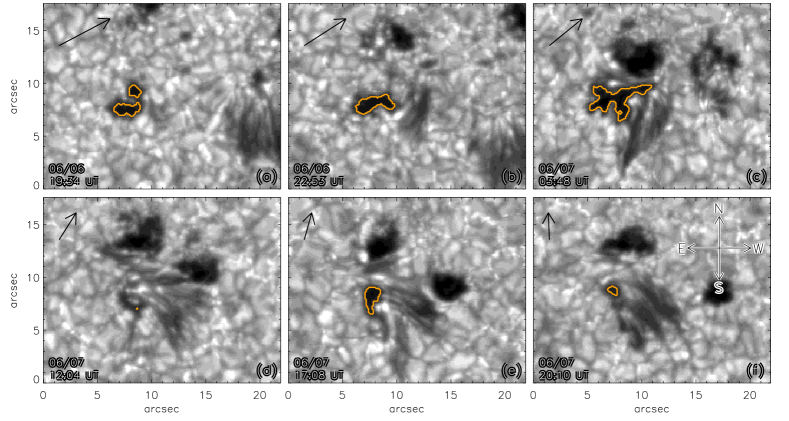
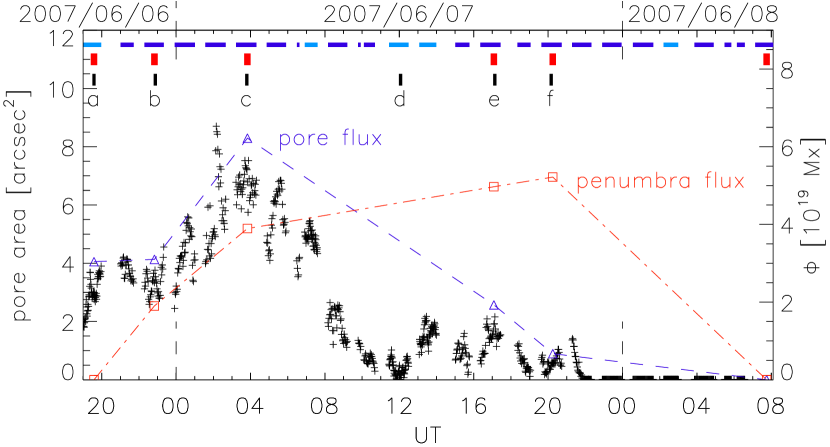
We recently presented evidence that stable umbra-penumbra boundaries are characterised by a distinct canonical value of the vertical component of the magnetic field, $B^{ m stable}_{ m ver}$. In order to trigger the formation of a penumbra, large inclinations in the magnetic field are necessary. In sunspots, the penumbra develops and establishes by colonising both umbral areas and granulation, that is, penumbral magneto-convection takes over in umbral regions with $B_{ m ver} < B^{ m stable}_{ m ver}$, as well as in granular convective areas. Eventually, a stable umbra-penumbra boundary settles at $B^{ m stable}_{ m ver}$. Here, we aim to study the development of a penumbra initiated at the boundary of a pore, where the penumbra colonises the entire pore ultimately. We have used Hinode/SOT G-band images to study the evolution of the penumbra. Hinode/SOT spectropolarimetric data were used to infer the magnetic field properties in the studied region. The penumbra forms at the boundary of a pore located close to the polarity inversion line of NOAA\,10960. As the penumbral bright grains protrude into the pore, the magnetic flux in the forming penumbra increases at the expense of the pore magnetic flux. Consequently, the pore disappears completely giving rise to an orphan penumbra. At all times, the vertical component of the magnetic field in the pore is smaller than $B^{ m stable}_{ m ver} \approx 1.8$~kG. Our findings are in an agreement with the need of $B^{ m stable}_{ m ver}$ for establishing a stable umbra-penumbra boundary: while $B_{ m ver}$ in the pore is smaller than $B^{ m stable}_{ m ver}$, the protrusion of penumbral grains into the pore area is not blocked, a stable pore-penumbra boundary does not establish, and the pore is fully overtaken by the penumbral magneto-convective mode. This scenario could also be one of the mechanisms giving rise to orphan penumbrae.
研究动机与目标
- 研究孔边界处半影的形成机制,特别是磁通量如何从孔向半影转移。
- 确定典型的垂直磁场值1.8 kG(B_ver^stable)是否作为稳定半影-孔边界的关键阈值。
- 探讨孔如何被半影磁对流完全占据,从而形成孤立半影的机制。
- 分析磁场倾角与磁通量演化在低通量环境中触发和维持半影发展的角色。
提出的方法
- 利用高分辨率 Hinode/SOT G-band 图像(空间分辨率为0.11″)追踪活动区 NOAA 10960 中孔与半影结构的时间演化。
- 应用 Hinode/SOT 光谱偏振数据,测量 Fe I 线在630.15 和 630.25 nm 处的磁场矢量,包括垂直分量(B_ver)、倾角及磁通量分布。
- 使用 SIR 反演代码从斯托克斯轮廓中反演物理参数,实现对孔与半影区域磁场特性精确映射。
- 追踪孔与半影区域磁通量的随时间演变,观察通过半影颗粒侵入导致的磁通量从孔向半影的转移。
- 将孔中垂直磁场强度(最大1.4 kG)与典型的 B_ver^stable 值1.8 kG进行比较,以评估边界稳定性。
- 利用倾角图分析磁力线连通性,判断半影是否与相反极性孔保持磁隔离。
实验结果
研究问题
- RQ1典型的垂直磁场值1.8 kG(B_ver^stable)是否作为稳定半影-孔边界的阈值?
- RQ2当孔的垂直磁场在半影侵入期间持续低于 B_ver^stable 时,孔会发生什么变化?
- RQ3半影能否通过磁通量转移完全占据孔区域,从而形成孤立半影?
- RQ4在孔向半影转化过程中,磁场构型如何演变,特别是磁场倾角与磁通量再分布的特征?
主要发现
- 孔的最大垂直磁场强度为1.4 kG,显著低于典型的 B_ver^stable 值1.8 kG,导致无法形成稳定的孔-半影边界。
- 半影亮斑颗粒持续侵入孔区,推动孔的磁通量向半影磁通量转化,半影磁通量达到孔峰值磁通量的84%。
- 孔被半影完全取代,形成以水平磁场为主的孤立半影。
- 半影区域的磁力线未与相反极性孔相连,证实了半影的磁隔离性及其自持特性。
- 孔消失的过程未显示磁通量抵消或新磁通量浮现的证据,表明磁通量通过磁对流转移是主导机制。
- 观测到的演化过程支持如下假设:B_ver^stable 阈值控制着半影边界的稳定性,其缺失使得半影对流能够完全占据低B_ver区域。
更好的研究,从现在开始
从阅读论文到最终审阅,大幅缩短您的研究时间。
无需绑定信用卡
本解读由 AI 生成,并经人工编辑审核。