
[论文解读] A dormant, overmassive black hole in the early Universe
研究报告在z=6.68的星系检测到广义H-alpha线,来自星系(JADES GN+189.09144+62.22811),指示一个约4×10^8太阳质量的黑洞正在以约2.4% Eddington比率吸积,导致其黑洞质量相对于宿主星质量偏大,并暗示早期宇宙中潜伏的、过大质量的黑洞群体。
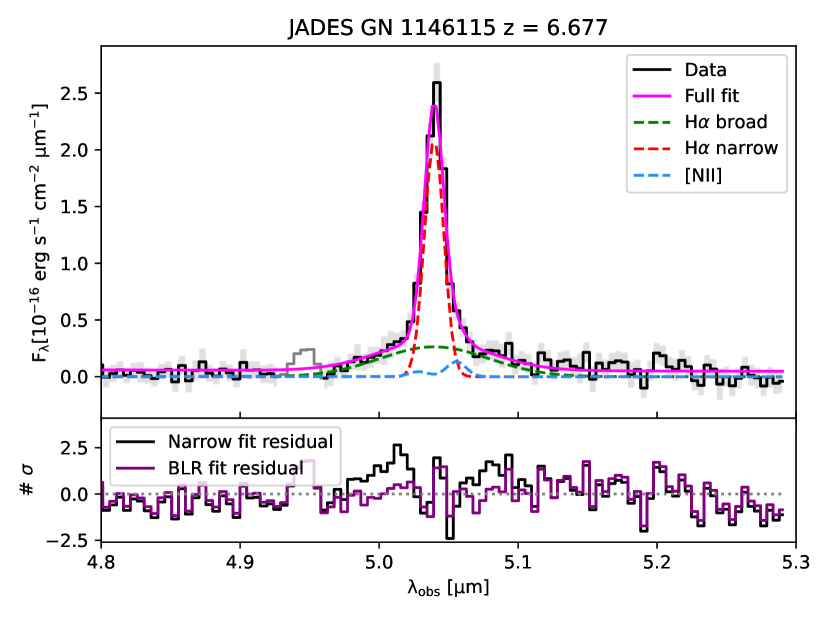
Recent observations have found a large number of supermassive black holes already in place in the first few hundred million years after Big Bang. The channels of formation and growth of these early, massive black holes are not clear, with scenarios ranging from heavy seeds to light seeds experiencing bursts of high accretion rate. Here we present the detection, from the JADES survey, of broad Halpha emission in a galaxy at z=6.68, which traces a black hole with mass of ~ 4 * 10^8 Msun and accreting at a rate of only 0.02 times the Eddington limit. The host galaxy has low star formation rate (~ 1 Msun/yr, a factor of 3 below the star forming main sequence). The black hole to stellar mass ratio is ~ 0.4, i.e. about 1,000 times above the local relation, while the system is closer to the local relations in terms of dynamical mass and velocity dispersion of the host galaxy. This object is most likely the tip of the iceberg of a much larger population of dormant black holes around the epoch of reionisation. Its properties are consistent with scenarios in which short bursts of super-Eddington accretion have resulted in black hole overgrowth and massive gas expulsion from the accretion disk; in between bursts, black holes spend most of their life in a dormant state.
研究动机与目标
- 推动理解超大质量黑洞在大爆炸后前十亿年内的形成与成长机制。
- 通过广义H-alpha发射特征表征JADES GN+189.09144+62.22811的中心黑洞,以估算黑洞质量与吸积率。
- 评估宿主星系的性质(恒星质量、SFR、形态)及其与局部BH-星系尺度关系的关系。
- 将观测结果与理论模型及模拟进行比较,以评估种子起始情景(重种子与轻种子)及吸积模式(包括超-Eddington爆发)。
- 讨论在高红移下潜伏、过大质量黑洞的普遍性及对宿主星系演化的反馈效应的含义
提出的方法
- 从JADES观测项目获取用于z=6.677星系的JWST NIRSpec/prism与NIRCam成像数据。
- 用两组分模型(窄线+宽线)拟合H-alpha区域,以识别宽BLR信号并估算黑洞质量。
- 结合局部到威尔关系并考虑尘埃遮蔽因素,从宽H-alpha的宽度与通量推导M_BH。
- 从宽H-alpha分量及核区域SED拟合估算总辐射光度,以推导Eddington比率(lambda_Edd)。
- 用ForcePho分解宿主星系光照,分离核区与宿主贡献;使用BAGPIPES和Prospector进行SED拟合以推导M_*和SFR。
- 分析辅助线(H-beta、[O III]、[O II]、[N II]、[S II])以约束金属量、电子温度及电离状态;评估潜在的吹出。
实验结果
研究问题
- RQ1What is the black hole mass and accretion rate in the z=6.677 galaxy JADES GN+189.09144+62.22811?
- RQ2How does the black hole–host galaxy mass relation at high redshift compare to local scaling relations, particularly for overmassive BHs?
- RQ3Do observations favor light-seed or heavy-seed scenarios, and are super-Eddington accretion bursts required to explain the BH growth?
- RQ4What are the host galaxy properties (stellar mass, SFR, morphology, metallicity) and what do they imply about BH feedback and coevolution?
主要发现
- Broad H-alpha emission with FWHM ≈ 5700 km/s indicates a central AGN with M_BH ≈ 10^8.61 M_⊙ (≈ 4×10^8 M_⊙) and L_bol/L_Edd ≈ 0.024.
- Host galaxy stellar mass ≈ 10^8.92 M_⊙ and SFR ≈ 1.38 M_⊙ yr^-1, placing it below the star-forming main sequence by about a factor of 3.
- BH-to-stellar mass ratio is ~0.43 (M_BH/M_* ≈ 0.43), about 1,000× above the local relation, while dynamical mass and velocity dispersion place it closer to local relations.
- Evidence suggests short bursts of super-Eddington accretion with strong feedback lead to rapid BH growth followed by long dormant periods; models with light seeds + super-Eddington bursts can reproduce observed properties.
- The object appears underluminous for an AGN given its mass, implying a dormant phase with low accretion rate, and indicating such dormant, overmassive BHs may be common at high redshift.
- Metallicity inferred from [O III] 4363 yields Z ≈ 0.04 Z_⊙, and gas mass fraction is high (~0.74) with a long depletion time (~1.6 Gyr), suggesting recent metal-poor gas accretion and potential AGN feedback effects on star formation.
![Figure 2: Star-formation rate versus stellar mass diagram showing the location of JADES GN 1146115 with respect to the star forming main sequence. The black dash-dotted line shows the star forming main sequence fit from [ 24 ] extrapolated to z = 6.677, with the grey shaded area representing the unc](https://ar5iv.labs.arxiv.org/html/2403.03872/assets/x2.png)
更好的研究,从现在开始
从论文设计到论文写作,大幅缩短您的研究时间。
无需绑定信用卡
本解读由 AI 生成,并经人工编辑审核。