
[论文解读] A Full Dive into Realizing the Edge-enabled Metaverse: Visions, Enabling Technologies,and Challenges
本文综述边缘化的元宇宙,详细介绍架构、使能技术(通信、计算与区块链)、挑战,以及未来研究方向,以在移动边缘网络上实现可扩展、沉浸式、可互操作的元宇宙。
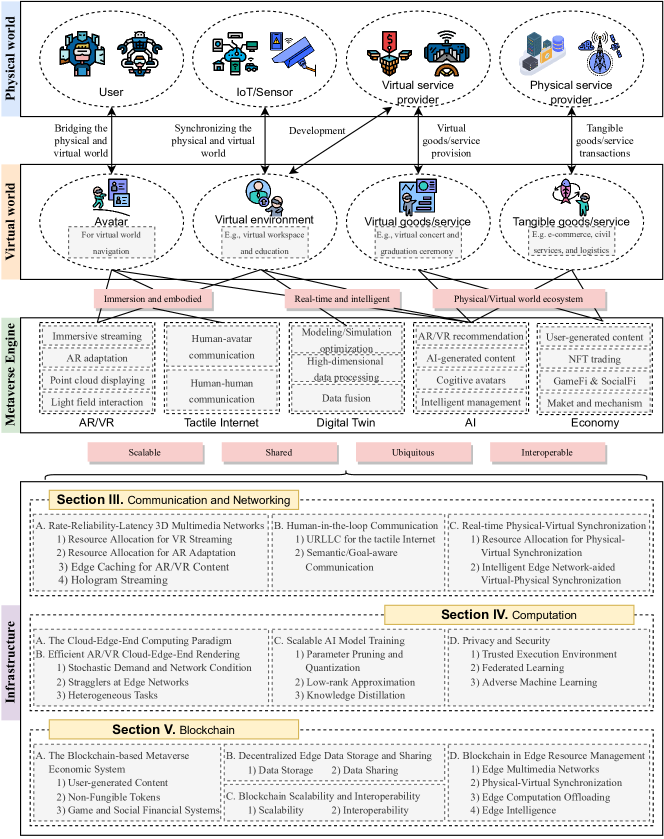
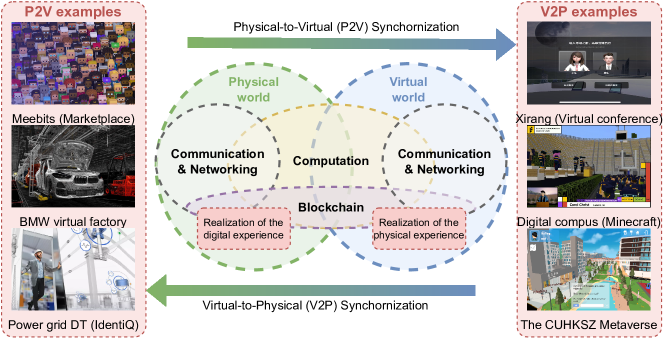
Dubbed "the successor to the mobile Internet", the concept of the Metaverse has grown in popularity. While there exist lite versions of the Metaverse today, they are still far from realizing the full vision of an immersive, embodied, and interoperable Metaverse. Without addressing the issues of implementation from the communication and networking, as well as computation perspectives, the Metaverse is difficult to succeed the Internet, especially in terms of its accessibility to billions of users today. In this survey, we focus on the edge-enabled Metaverse to realize its ultimate vision. We first provide readers with a succinct tutorial of the Metaverse, an introduction to the architecture, as well as current developments. To enable ubiquitous, seamless, and embodied access to the Metaverse, we discuss the communication and networking challenges and survey cutting-edge solutions and concepts that leverage next-generation communication systems for users to immerse as and interact with embodied avatars in the Metaverse. Moreover, given the high computation costs required, e.g., to render 3D virtual worlds and run data-hungry artificial intelligence-driven avatars, we discuss the computation challenges and cloud-edge-end computation framework-driven solutions to realize the Metaverse on resource-constrained edge devices. Next, we explore how blockchain technologies can aid in the interoperable development of the Metaverse, not just in terms of empowering the economic circulation of virtual user-generated content but also to manage physical edge resources in a decentralized, transparent, and immutable manner. Finally, we discuss the future research directions towards realizing the true vision of the edge-enabled Metaverse.
研究动机与目标
- 激发并界定元宇宙架构及其边缘使能实现。
- 在移动边缘网络中识别核心的通信、网络、计算和区块链挑战。
- 调研当前及新兴的解决方案和技术,以实现无处不在、沉浸式的元宇宙访问。
- 突出边缘部署中的互操作性、安全性和资源管理的考量。
- 概述面向可扩展、具身感的元宇宙的未来研究方向。
提出的方法
- 提供关于元宇宙架构及当前发展情况的简明教程。
- 系统性地回顾通信与网络挑战,并调研下一代解决方案(例如,语义/目标感知通信、实时同步)。
- 将计算解决方案分类为云-边-端范式,以及用于边缘设备的人工智能加速技术。
- 考察区块链/DLT在互操作性、安全数据共享、资源管理和经济体系中的作用。
- 讨论在架构、技术和部署方面的未来研究方向和待解决的问题。
- 以示例和当前发展(MMO游戏、智慧城市、行业用例)为讨论依据。
实验结果
研究问题
- RQ1在边缘使能情境下,元宇宙的架构原则和当前发展是什么?
- RQ2面向边缘使能的元宇宙访问,主要的通信、网络和同步挑战是什么,以及存在哪些解决方案?
- RQ3如何在云、边缘和终端设备之间高效地卸载与加速计算以支持元宇宙工作负载?
- RQ4区块链和分布式账本技术在边缘元宇宙中的互操作性、数据管理和经济方面可以扮演哪些角色?
- RQ5实现可扩展、沉浸式、无处不在的边缘使能元宇宙的关键未来研究方向和待解决的挑战是什么?
主要发现
- 提供对元宇宙的教程式定义与架构,强调具身、可互操作、沉浸式和共享生态系统。
- 识别并讨论对实现基于边缘的元宇宙体验至关重要的通信、网络、计算和区块链方面的挑战。
- 评估包括语义/目标感知通信、多层计算卸载(云-边-端)以及AI驱动的加速在内的解决方案。
- 阐述区块链如何实现所有权(NFTs)、数据互操作性(跨链)和边缘网络的去中心化资源管理。
- 概述在移动边缘实现无处不在的访问、互操作性和可扩展元宇宙部署的未来研究方向与指南。
更好的研究,从现在开始
从论文设计到论文写作,大幅缩短您的研究时间。
无需绑定信用卡
本解读由 AI 生成,并经人工编辑审核。