
[论文解读] A guided light system for agile individual addressing of Ba$^+$ qubits with $10^{-4}$ level intensity crosstalk
该论文提出了一种基于激光直写波导与光纤耦合声光调制器(AOMs)的引导光单离子地址系统(GLIAS),实现了对16束光束的独立、灵活的强度、频率和相位控制。该系统在相邻离子间实现了10⁻⁴量级的相对强度串扰,显著降低了串扰引起的量子门误差,为可扩展的离子阱量子计算提供了支持。
Trapped ions are one of the leading platforms for quantum information processing, exhibiting the highest gate and measurement fidelities of all contending hardware. In order to realize a universal quantum computer with trapped ions, independent and parallel control over the state of each qubit is necessary. The manipulation of individual qubit states in an ion chain via stimulated Raman transitions generally requires light focused on individual ions. In this manuscript, we present a novel, guided-light individual addressing system for hyperfine Ba$^+$ qubits. The system takes advantage of laser-written waveguide technology, enabled by the atomic structure of Ba$^+$, allowing the use of visible light to drive Raman transitions. Such waveguides define the spatial mode of light, suppressing aberrations that would have otherwise accumulated in a free-space optics set up. As a result, we demonstrate a nearest neighbour relative intensity crosstalk on the order of 10$^{-4}$, without any active aberration compensation. This is comparable to or better than other previous demonstrations of individual addressing. At the same time, our modular approach provides independent and agile control over the amplitude, frequency, and phase of each channel; combining the strengths of previous implementations.
研究动机与目标
- 开发一种可扩展、模块化的光学系统,用于对长链Ba⁺离子实现低串扰的单离子地址控制。
- 实现对每个地址光束的强度、频率和相位的独立且灵活的控制,以实现通用量子控制。
- 将相邻离子间的强度串扰降低至10⁻⁴以下,接近容错量子计算的阈值要求。
- 利用Ba⁺中可见光波段的拉曼跃迁,以实现与激光直写波导和光纤技术的兼容性。
- 通过493 nm波段的兼容态检测,实现中间电路测量与高保真度量子误差纠正。
提出的方法
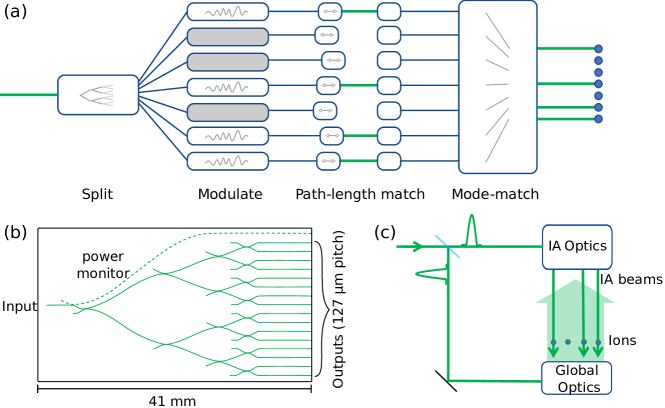
- 采用飞秒激光直写(FLDW)技术制造激光直写波导分束器,定义光的光场模式,抑制像差。
- 使用光纤耦合声光调制器(AOMs)对每个光路通道实现独立、灵活的幅度、频率和相位控制。
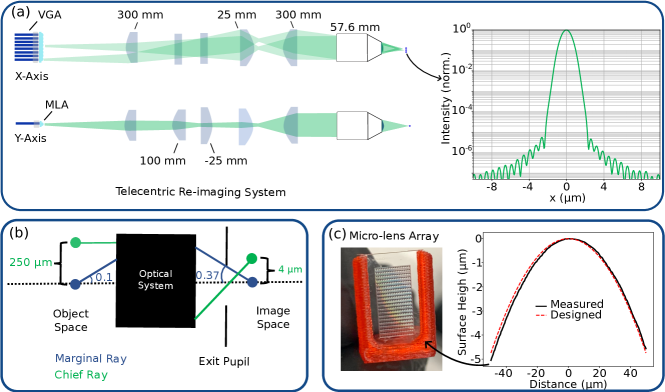
- 通过62.5×缩小系统将光束聚焦至离子平面处0.9 µm的光斑腰斑,匹配典型离子链的离子间距。
- 使用微透镜阵列(MLA)将光从波导耦合至物镜,但其引入了串扰的非对称性。
- 利用配备1.12 µm像素的Raspberry Pi Noir V2相机测量强度串扰,捕获离子平面上的光束轮廓。
- 系统设计为模块化,支持在不重新对准的情况下更换波导芯片,并与未来高对比度集成波导兼容。
实验结果
研究问题
- RQ1基于激光直写波导的引导光系统能否在Ba⁺离子单离子地址中实现低于10⁻⁴的强度串扰?
- RQ2光纤耦合AOM能否在离子阱系统中对多束光实现强度、频率和相位的独立、灵活控制?
- RQ3在Ba⁺中使用可见光波段拉曼跃迁是否比基于紫外光的系统更有利于与波导和光纤技术集成?
- RQ4在不使用主动像差补偿的情况下,能否将串扰水平降低至10⁻⁴,以确保高保真度单量子比特门操作?
- RQ5该系统能否通过与493 nm态检测兼容,支持中间电路测量与量子误差纠正?
主要发现
- 系统在未使用主动像差补偿的情况下,实现了相邻离子间约10⁻⁴的相对强度串扰。
- 前三个通道的串扰约为10⁻³,其余通道为10⁻⁴量级,表明串扰存在非对称性,可能源于MLA制造缺陷。
- 在距离光束峰值4 µm处,串扰略高于10⁻⁴,与离子平面上的测量结果一致。
- 串扰引起的拉曼Rabi速率误差估计为1%,与当前最先进的性能水平相当。
- 通过分别对两个拉曼光束实施单离子地址控制,可将Rabi速率误差降低至0.01%,满足容错量子误差纠正的要求。
- 模块化设计支持系统升级与波导芯片更换而无需重新对准,为扩展至更大离子链提供了可扩展性支持。
更好的研究,从现在开始
从阅读论文到最终审阅,大幅缩短您的研究时间。
无需绑定信用卡
本解读由 AI 生成,并经人工编辑审核。