
[论文解读] A Hierarchy of Normalizing Flows for Modelling the Galaxy-Halo Relationship
该论文提出了一种分层归一化流模型,利用CAMELS流体动力学模拟,学习在宇宙学和天体物理学参数条件下的星系与晕属性的联合分布。通过实现精确的密度估计和高效的采样,该模型能够生成自洽的星系-晕关系,并量化参数依赖性,同时对冗余变量进行边缘化。
Using a large sample of galaxies taken from the Cosmology and Astrophysics with MachinE Learning Simulations (CAMELS) project, a suite of hydrodynamic simulations varying both cosmological and astrophysical parameters, we train a normalizing flow (NF) to map the probability of various galaxy and halo properties conditioned on astrophysical and cosmological parameters. By leveraging the learnt conditional relationships we can explore a wide range of interesting questions, whilst enabling simple marginalisation over nuisance parameters. We demonstrate how the model can be used as a generative model for arbitrary values of our conditional parameters; we generate halo masses and matched galaxy properties, and produce realisations of the halo mass function as well as a number of galaxy scaling relations and distribution functions. The model represents a unique and flexible approach to modelling the galaxy-halo relationship.
研究动机与目标
- 开发一种非确定性的、生成式的星系-晕关联模型,以捕捉来自潜在变量的固有离散性。
- 对星系和晕属性的联合多维分布进行建模,条件依赖于宇宙学和天体物理学参数。
- 在星系形成模拟中实现对冗余参数的高效采样和边缘化。
- 展示模型在多样化参数集合下重现关键标度关系和分布函数的能力。
- 为基于模拟的推断和N体模拟中快速生成星系属性提供一个灵活的框架。
提出的方法
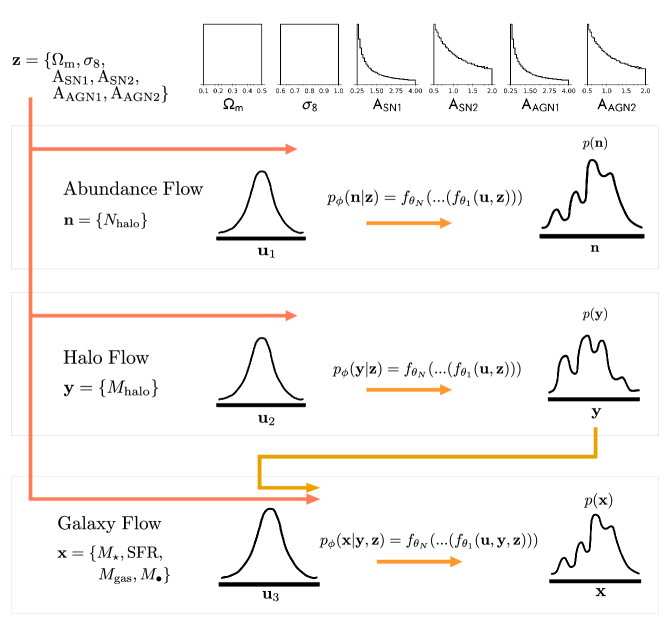
- 该模型采用分层归一化流(NFs)来学习条件概率分布 p(x|z),其中 x 表示星系和晕的属性,z 表示宇宙学和天体物理学参数。
- 每一层流使用基于神经样条流的耦合层实现的可逆神经网络,实现精确的似然估计和从基高斯分布出发的双射变换。
- 模型在CAMELS Simba模拟套件上进行训练,使用6维条件参数(Ωm, σ8, ASN1, ASN2, AAGN1, AAGN2)和目标变量(Mh, M⋆, Mgas, M•, SFR)。
- 该分层结构包含三个流:用于子晕计数的丰度流、用于晕质量分布的晕流,以及用于联合星属性分布的星系流。
- 通过早停策略和基于验证的检查点机制,在模拟数据集上训练过程中防止过拟合。
- 通过从基分布采样并应用学习到的逆变换(指定 z 参数)实现条件生成。
实验结果
研究问题
- RQ1分层归一化流模型在多样化宇宙学和天体物理学参数下,对晕质量函数和星系标度关系的重现能力如何?
- RQ2该模型在固定晕质量下,对星属性中固有离散性的捕捉程度如何,是否考虑了随机反馈过程的影响?
- RQ3宇宙学参数(如 Ωm)和天体物理学反馈强度(如 ASN1)的变化在多大程度上影响预测的星系-晕关系?
- RQ4该模型能否生成与CAMELS模拟中观测关系一致的自洽多维星属性分布?
- RQ5在推断或生成采样过程中,该模型对冗余参数的边缘化效率如何?
主要发现
- 该模型在50次实现的散度范围内成功重现了晕质量函数,且在不同参数集合下均保持了准确的归一化和形状。
- 当从丰度流和晕流生成的晕中生成星系时,星系恒星质量函数(GSMF)被准确恢复,与真实模拟分布一致。
- 该模型捕捉到了Ωm与晕质量函数和星系质量函数归一化之间的强正相关性,这与宇宙学理论预期一致。
- 恒星形成序列、恒星与气体质量关系、黑洞质量关系以及恒星与晕质量关系在参数变化下均被一致重现。
- 该模型对参数变化表现出鲁棒性,在预测关系中清晰且物理上合理地体现了对ASN1、ASN2和Ωm的依赖性。
- 分层结构实现了星系和晕属性的一致联合采样,保留了多维相关性,而无需对各个关系分别建模。

更好的研究,从现在开始
从阅读论文到最终审阅,大幅缩短您的研究时间。
无需绑定信用卡
本解读由 AI 生成,并经人工编辑审核。