
[论文解读] A Hitchhiker's Guide to Geometric GNNs for 3D Atomic Systems
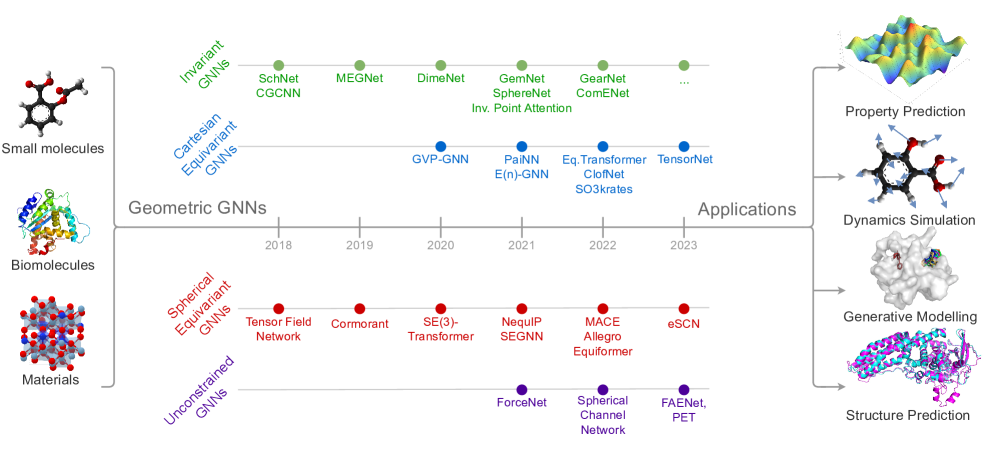
对 Geometric Graph Neural Networks (GNNs) 在 3D 原子系统中的全面、独立自洽的综述,详细阐述了 架构、输入流程、对称性 与 应用。它提出一个四分 taxonomy(invariant, Cartesian-equivariant, spherical-equivariant, unconstrained),并讨论数据集、任务与未来方向。
Recent advances in computational modelling of atomic systems, spanning molecules, proteins, and materials, represent them as geometric graphs with atoms embedded as nodes in 3D Euclidean space. In these graphs, the geometric attributes transform according to the inherent physical symmetries of 3D atomic systems, including rotations and translations in Euclidean space, as well as node permutations. In recent years, Geometric Graph Neural Networks have emerged as the preferred machine learning architecture powering applications ranging from protein structure prediction to molecular simulations and material generation. Their specificity lies in the inductive biases they leverage - such as physical symmetries and chemical properties - to learn informative representations of these geometric graphs. In this opinionated paper, we provide a comprehensive and self-contained overview of the field of Geometric GNNs for 3D atomic systems. We cover fundamental background material and introduce a pedagogical taxonomy of Geometric GNN architectures: (1) invariant networks, (2) equivariant networks in Cartesian basis, (3) equivariant networks in spherical basis, and (4) unconstrained networks. Additionally, we outline key datasets and application areas and suggest future research directions. The objective of this work is to present a structured perspective on the field, making it accessible to newcomers and aiding practitioners in gaining an intuition for its mathematical abstractions.
研究动机与目标
- 提供对 Geometric GNNs for 3D atomic systems 的结构化、教学性概览。
- 解释物理对称性与归纳偏置在 geometric graph 学习中的作用。
- 提出 Geometric GNN 架构的分类法,并将设计选择与应用联系起来。
- 总结领域内的数据集、任务与未来研究方向。
提出的方法
- 引入带有 3D 坐标和向量/张量特征的几何图。
- 将 Geometric GNN 分类为 invariant、equivariant (Cartesian 和 spherical) 与 unconstrained 家族。
- 描述 Geometric GNNs 中的输入准备、嵌入、交互(message passing)与输出模块。
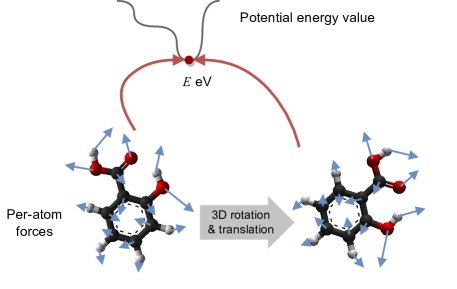
- 解释欧几里得对称性(置换、旋转、平移)如何塑造 invariant/equivariant 设计。
- 讨论图构建策略(cutoff、complete、long-range、periodic boundary conditions)与预处理。
实验结果
研究问题
- RQ1Geometric GNNs 中哪些架构选择能最好地强化 3D 原子系统的物理对称性?
- RQ2invariant、Cartesian-equivariant、spherical-equivariant 与 unconstrained 的 GNN 在表现力与应用适配性上有何差异?
- RQ3用于建模原子相互作用的有效图构建策略(cutoff、long-range、periodic)是什么?
- RQ4哪些数据集与任务推动 Geometric GNNs 在化学与材料科学中的评价与进展?
主要发现
- Geometric GNNs 明确编码物理对称性,以产生有意义的、帧不变量或等变的预测。
- 四分法分类法(invariant、Cartesian-equivariant、spherical-equivariant、unconstrained)组织核心架构并指导设计取舍。
- 包含图构建、嵌入、交互块与输出的输入流程支撑对 3D 原子系统的有效建模。
- 不同的图构建策略(cutoff、smooth cutoff、long-range、periodic boundaries)在局部性、准确性与计算效率之间进行权衡。
- 本文对应用领域在性质预测、原子间势、生成式设计与结构预测等方面的综述。
更好的研究,从现在开始
从论文设计到论文写作,大幅缩短您的研究时间。
无需绑定信用卡
本解读由 AI 生成,并经人工编辑审核。