
[论文解读] A hybrid discrete-continuum modelling approach for the interactions of the immune system with oncolytic viral infections
本研究提出了一种混合离散-连续模型,将免疫细胞、感染和未感染癌细胞的随机代理动力学与趋化因子驱动的免疫细胞募集的连续PDE模型相结合。模型揭示,过度迅速的免疫激活会损害溶瘤病毒治疗的疗效,凸显了根据肿瘤和患者特异性因素调节免疫反应的必要性。
Oncolytic virotherapy, utilizing genetically modified viruses to combat cancer and trigger anti-cancer immune responses, has garnered significant attention in recent years. In our previous work arXiv:2305.12386, we developed a stochastic agent-based model elucidating the spatial dynamics of infected and uninfected cells within solid tumours. Building upon this foundation, we present a novel stochastic agent-based model to describe the intricate interplay between the virus and the immune system; the agents' dynamics are coupled with a balance equation for the concentration of the chemoattractant that guides the movement of immune cells. We formally derive the continuum limit of the model and carry out a systematic quantitative comparison between this system of PDEs and the individual-based model in two spatial dimensions. Furthermore, we describe the traveling waves of the three populations, with the uninfected proliferative cells trying to escape from the infected cells while immune cells infiltrate the tumour. Simulations show a good agreement between agent-based approaches and numerical results for the continuum model. Some parameter ranges give rise to oscillations of cell number in both models, in line with the behaviour of the corresponding nonspatial model, which presents Hopf bifurcations. Nevertheless, in some situations the behaviours of the two models may differ significantly, suggesting that stochasticity plays a key role in the dynamics. Our results highlight that a too rapid immune response, before the infection is well-established, appears to decrease the efficacy of the therapy and thus some care is needed when oncolytic virotherapy is combined with immunotherapy. This further suggests the importance of clinically improving the modulation of the immune response according to the tumour's characteristics and to the immune capabilities of the patients.
研究动机与目标
- 开发一种混合建模框架,以捕捉溶瘤病毒、肿瘤细胞和免疫细胞之间的空间与随机相互作用。
- 研究通过趋化因子介导的免疫细胞募集如何影响实体瘤中溶瘤病毒治疗的疗效。
- 将代理模型模拟与其中的连续PDE极限进行比较,以验证模型行为并识别由随机性引起差异。
- 探讨免疫反应时机与强度对治疗疗效的影响,特别是在联合病毒治疗与免疫治疗的背景下。
- 通过识别免疫激活增强或阻碍病毒溶瘤作用的条件,为最佳治疗时间安排提供建议。
提出的方法
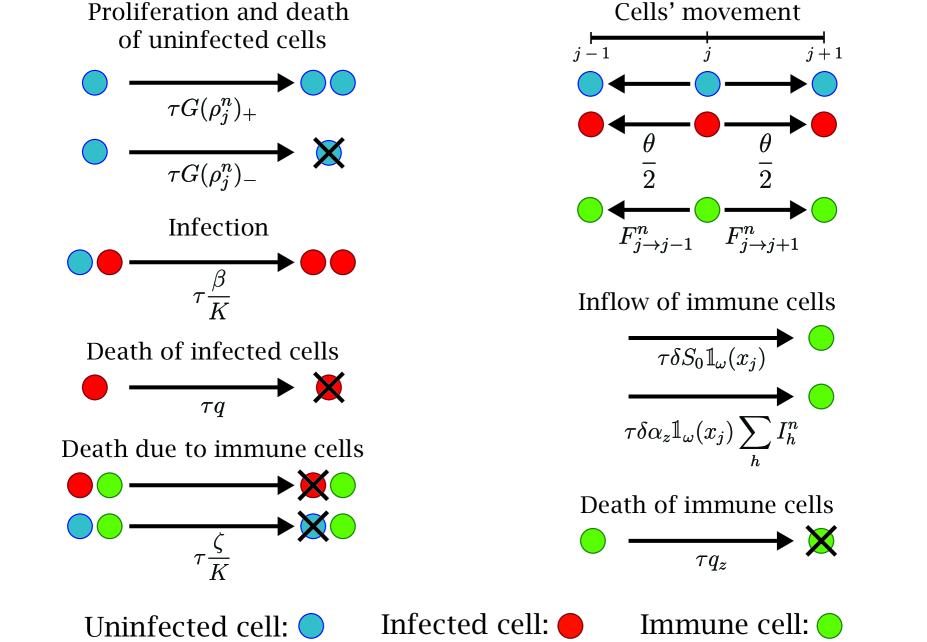
- 使用随机代理模型模拟个体免疫细胞、感染和未感染癌细胞的运动、增殖、死亡、感染及趋化因子产生。
- 免疫细胞的趋化性由基于PDE的趋化因子场驱动,采用诺伊曼边界条件和迎风有限差分格式以保证稳定性。
- 正式推导代理模型的连续极限,得到细胞密度与趋化因子浓度的耦合PDE系统。
- 数值模拟采用显式有限差分法,时间步长较小(Δt = 10⁻⁴ h),空间分辨率高(Δx = 0.01 mm),以解析尖锐的免疫细胞波。
- 参数值通过实验数据校准,包括免疫细胞速度(χ = 0.165 mm²/h)、流入速率(S₀ = 5.00×10⁻² cells/(mm²·h))和免疫杀伤速率(ζ = 0.50 或 5.00 h⁻¹)。
- 模型验证通过在多个模拟运行和空间构型下,直接比较代理模型与连续模型的输出结果完成。
实验结果
研究问题
- RQ1由趋化因子驱动的免疫细胞浸润的空间动力学如何影响实体瘤中溶瘤病毒治疗的结局?
- RQ2在哪些参数范围内,代理模型与连续模型出现偏离?这反映了随机性在免疫反应动力学中的何种作用?
- RQ3免疫反应的时机与强度如何影响溶瘤病毒扩散与肿瘤控制的成功?
- RQ4在肿瘤微环境中,未感染细胞、感染细胞与免疫细胞的行进波在何种条件下出现?
- RQ5在高空间异质性条件下,连续极限能否准确表征单个免疫细胞与感染细胞的随机行为?
主要发现
- 在大多数参数范围内,代理模型与连续模型表现出强烈的定量一致性,验证了PDE近似在大尺度动力学中的有效性。
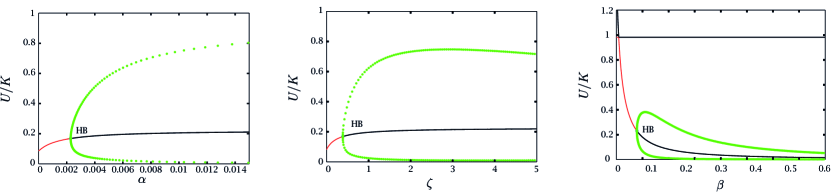
- 在某些参数范围,特别是高免疫杀伤速率(ζ = 5.00 h⁻¹)下,两种模型均表现出与非空间模型中观察到的霍普夫分岔一致的振荡动力学。
- 若在病毒感染尚未充分建立之前就启动过快的免疫反应,会显著降低治疗疗效,提示存在不利的时间效应。
- 在实际条件下,免疫细胞速度估计约为~0.06 mm/h(χ = 0.165 mm²/h),与肿瘤微环境中的物理屏障一致。
- 模型预测感染可增强免疫细胞流入(α_z = 3.75×10⁻⁵ (mm²·h)⁻¹),有助于将免疫细胞招募至肿瘤部位。
- 波前分析表明,未感染细胞试图逃离感染区域,而免疫细胞则从周围组织浸润,形成明显不同的行进波模式。
更好的研究,从现在开始
从阅读论文到最终审阅,大幅缩短您的研究时间。
无需绑定信用卡
本解读由 AI 生成,并经人工编辑审核。