
[论文解读] A JWST/NIRSpec First Census of Broad-Line AGNs at z=4-7: Detection of 10 Faint AGNs with M_BH~10^6-10^8 M_sun and Their Host Galaxy Properties
JWST/NIRSpec 在 z=4-7 发现了 10 个低质量黑洞的宽线型AGN,并分析其宿主星系、形态及对再电离的贡献。
We present a first statistical sample of faint type-1 AGNs at $z>4$ identified by JWST/NIRSpec deep spectroscopy. Among the 185 galaxies at $z_\mathrm{spec}=3.8-8.9$ confirmed with NIRSpec, our systematic search for broad-line emission reveals 10 type-1 AGNs at $z=4.015-6.936$ whose broad component is only seen in the permitted H$α$ line and not in the forbidden [OIII]$λ$5007 line that is detected with greater significance than H$α$. The broad H$α$ line widths of $\mathrm{FWHM}\simeq1000-6000\ \mathrm{km\ s^{-1}}$ suggest that the AGNs have low-mass black holes with $M_\mathrm{BH}\sim10^6-10^8\ M_\odot$, remarkably lower than those of low-luminosity quasars previously identified at $z>4$ with ground-based telescopes. JWST and HST high-resolution images reveal that the majority of them show extended morphologies indicating significant contribution to the total lights from their host galaxies, except for three compact objects two of which show red SEDs, probably in a transition phase from faint AGNs to low luminosity quasars. Careful AGN-host decomposition analyses show that their host's stellar masses are systematically lower than the local relation between the black hole mass and the stellar mass, implying a fast black hole growth consistent with predictions from theoretical simulations. A high fraction of the broad-line AGNs ($\sim5\%$), higher than $z\sim0$, indicates that a number density of such faint AGNs is higher than an extrapolation of the quasar luminosity function, implying a large population of AGNs including type 1 and type 2 in the early universe. Such faint AGNs contribute to cosmic reionization, while the total contribution is not large, up to $\sim50\%$ at $z\sim6$, because of their faint nature.
研究动机与目标
- 在通过 JWST/NIRSpec 光谱识别的 z>4 的 faint broad-line (type-1) AGN 群体进行调查。
- 表征这些低质量 SMBH 的黑洞质量、总功率以及 Eddington 比率。
- 考察宿主星系的性质,包括恒星质量、形态与尘埃衰减。
- 评估微弱 AGN 对宇宙再电离的贡献,并与本地及高-z AGN 群体进行比较。
提出的方法
- 对来自 ERO GLASS、CEERS 及相关计划的 185 个 z-spec 3.8-8.9 的星系的宽线发射进行系统性搜索,使用 JWST/NIRSpec 光谱。
- 通过拟合 Hβ、[OIII]、Hα 和 [NII] 的窄、宽分量来分解发射线;要求宽 Hα 或 Hβ 的 FWHM > 1000 km/s 且 SNR > 5。
- 应用 [OIII]、[NII] 窄分量标准以将 AGN 宽线特征与来自喷溅或并合的信号区分开来。
- 利用基于 z~0 校准的宽 Hα 关系(Greene & Ho 2005)估算 M_BH,并推导 L_bol 与 Eddington 比率。
- 通过高分辨率的 JWST/HST 成像评估宿主星系性质并进行 AGN-宿主分解。
- 使用 Balmer 减色和 Calzetti 尘埃定律评估 AGN 的 E(B-V) 与尘埃衰减。
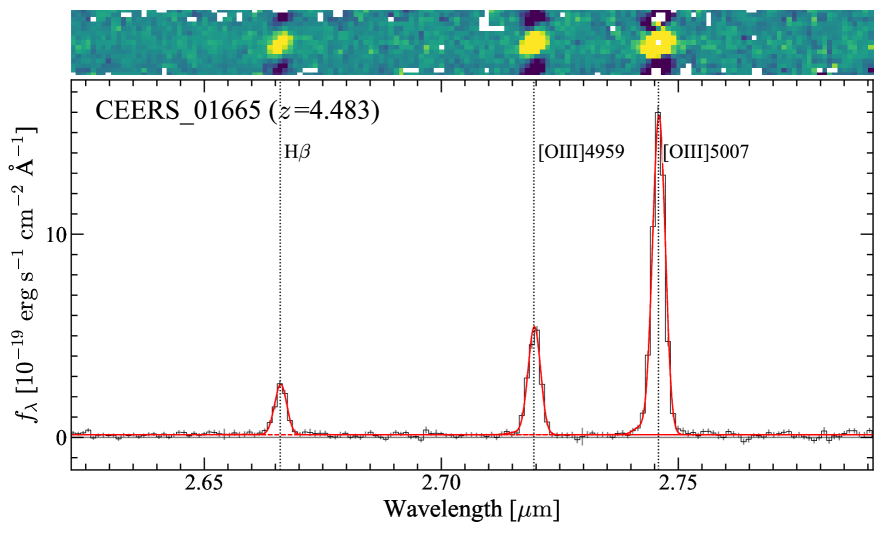
![Figure 1: NIRSpec spectra of CEERS_01244, GLASS_160133, GLASS_150029, and CEERS_00746. For each object, the left and middle panels show spectra around H $\beta$ +[ Oiii ] $\lambda\lambda$ 4959,5007 and H $\alpha$ +[ Nii ] $\lambda\lambda$ 6548,6584, respectively. The 2D and 1D spectra are shown in t](https://ar5iv.labs.arxiv.org/html/2303.11946/assets/x1.png)
实验结果
研究问题
- RQ1这些来自 JWST/NIRSpec 样本的 z=4-7 的微弱宽线型 AGN 的发生率与性质是什么?
- RQ2这些低质量 SMBH 的黑洞质量、总功率与 Eddington 比率是多少?
- RQ3这些 AGN 宿主的恒星质量、形态与尘埃含量如何?
- RQ4这些微弱 AGN 是否落在本地观测到的 M_BH–M_* 关系中,还是显示出早期 SMBH 的增长?
主要发现
| Name | R.A. | Decl. | z_spec | M_UV | 12+log(O/H) | E(B-V) | SNR_Halpha,broad | Delta_AIC |
|---|---|---|---|---|---|---|---|---|
| CEERS_01244 | 14:20:57.76 | +53:02:09.8 | 4.478 | -19.50^{+0.18}_{-0.18} | 7.67^{+0.20}_{-0.23} | 0.00 | 37.3 | 789.8 |
| GLASS_160133 | 00:14:19.27 | -30:25:27.8 | 4.015 | -18.94^{+0.08}_{-0.09} | 7.95^{+0.06}_{-0.05} | 0.16 | 32.5 | 2022.4 |
| GLASS_150029 | 00:14:18.52 | -30:25:21.3 | 4.583 | -19.20^{+0.10}_{-1.08} | 7.70^{+0.09}_{-0.08} | 0.17 | 18.1 | 431.1 |
| CEERS_00746 | 14:19:14.19 | +52:52:06.5 | 5.624 | -17.82^{+0.33}_{-0.61} | 8.29^{+0.24}_{-0.22} | 1.38 | 17.3 | 210.5 |
| CEERS_01665 | 14:20:42.77 | +53:03:33.7 | 4.483 | -21.66^{+0.07}_{-0.07} | 8.05^{+0.19}_{-0.19} | 0.42 | 11.6 | 132.0 |
| CEERS_00672 | 14:19:33.52 | +52:49:58.7 | 5.666 | -16.71^{+0.31}_{-1.16} | 8.57^{+0.30}_{-0.23} | 0.80 | 11.6 | 51.9 |
| CEERS_02782 | 14:19:17.63 | +52:49:49.0 | 5.241 | -19.50^{+0.12}_{-0.00} | 7.51^{+0.16}_{-0.16} | 0.28 | 11.2 | 78.6 |
| CEERS_00397 | 14:19:20.69 | +52:52:57.7 | 6.000 | -21.23^{+0.17}_{-0.24} | 7.87^{+0.14}_{-0.14} | 0.19 | 6.2 | 51.2 |
| CEERS_00717 | 14:20:19.54 | +52:58:19.9 | 6.936 | -21.49^{+0.12}_{-0.12} | 7.87^{+0.17}_{-0.18} | 0.00 | 6.1 | 23.9 |
| CEERS_01236 | 14:20:34.87 | +52:58:02.2 | 4.484 | -19.61^{+0.27}_{-0.23} | 7.55^{+0.29}_{-0.28} | 0.00 | 5.9 | 23.3 |
- 在 z=4.015-6.936 的 10 个 type-1 AGN 被识别,它们具有宽 Hα 发射且在 [OIII] 中无宽分量,表明黑洞质量在 M_BH ~ 10^6–10^8 M_sun。
- 宽 Hα 的线宽约为 FWHM ~ 1000–6000 km/s,相对于通过地面观测到的高-z 类星体,暗示较低质量的 SMBH。
- 大多数宿主在 JWST/HST 成像中呈现为扩展型,表明存在显著的宿主星系光;三个紧致对象具有尘埃红色 SED,表明宿主环境多样。
- AGN-宿主分解显示宿主星质量系统性低于本地的 M_BH–M_* 关系,暗示黑洞相对于宿主的快速增长。
- 在 z=4-7 的星系样本中,AGN 占比约为 5%,对应 -22 < M_UV < -17,高于 z ~ 0 的 AGN 比例,提示早期宇宙中微弱 AGN 群体更为丰富。
- 对某些对象的 Rest-UV 线诊断显示复合特征;部分对象展现更红的连续光谱与显著的尘埃衰减(E(B-V) 最高可达 ~1.4),指示有尘埃包覆的 AGN。
更好的研究,从现在开始
从论文设计到论文写作,大幅缩短您的研究时间。
无需绑定信用卡
本解读由 AI 生成,并经人工编辑审核。