
[论文解读] A large-scale magnetic field produced by a solar-like dynamo in binary neutron star mergers
本研究通过超高分辨率、全广义相对论磁流体动力学模拟表明,由磁旋转不稳定性驱动的 $α\Omega$ 发电机可在双中子星并合残骸中产生大尺度磁场。该磁场驱动的 Poynting-通量主导喷流具有约 $10^{51}$ erg/s 的光度,并引发约 $0.1M_\odot$ 的磁力驱动质量抛射,支持了短时伽马射线暴和明亮千新星的磁星场景。
The merger of neutron stars drives a relativistic jet which can be observed as a short gamma-ray burst. A strong large-scale magnetic field is necessary to launch the relativistic jet. However, the magnetohydrodynamical mechanism to build up this magnetic field remains uncertain. Here we show that the $αΩ$ dynamo mechanism driven by the magnetorotational instability builds up the large-scale magnetic field inside the long-lived binary neutron star merger remnant by performing an {\it ab initio} super-high resolution neutrino-radiation magnetohydrodynamics merger simulation in full general relativity. As a result, the magnetic field induces the Poynting-flux dominated relativistic outflow with the luminosity $\sim 10^{51}$\,erg/s and magnetically-driven post-merger mass ejection with the mass $\sim 0.1M_\odot$. Therefore, the magnetar scenario in binary neutron star mergers is possible. These can be the engines of short-hard gamma-ray bursts and very bright kilonovae. Therefore, this scenario is testable in future observation.
研究动机与目标
- 确定双中子星并合长寿命残骸中产生大尺度磁场的机制。
- 研究由磁旋转不稳定性驱动的 $α\Omega$ 发电机是否能产生足够强且相干的磁场以驱动相对论喷流。
- 通过模拟 Poynting-通量主导喷流和磁力驱动的质量抛射,检验双中子星并合中磁星场景的可行性。
- 建立并合残骸磁场演化与短时硬伽马射线暴和千新星等可观测特征之间的定量关联。
提出的方法
- 在全广义相对论框架下,采用静态局部加密的 2:1 网格加密策略,执行从头算的超高分辨率中微子辐射磁流体动力学模拟。
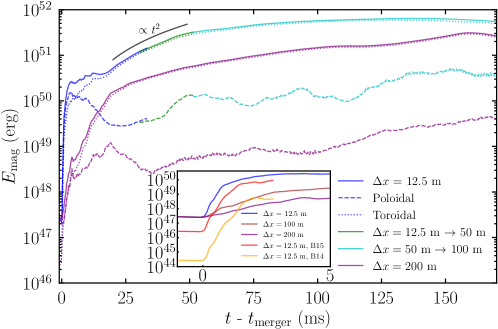
- 采用 16 个区域的笛卡尔网格结构,网格点数 $N=361$,达到 $\Delta x_{\rm finest} = 12.5$ m 的最细网格分辨率,为迄今双中子星并合模拟中的最高水平。
- 使用 DD2 状态方程描述中子星物质,采用总质量为 $2.7M_\odot$ 的对称双星系统,形成一个存活时间超过 1 秒的超大质量中子星残骸。
- 通过初始纯轴向磁场环($B_{0,\mathrm{max}} = 10^{15.5}$ G)启动发电机过程。
- 分析电磁能量与磁场分量随时间的增长,通过电磁力与平均磁场之间的相关性识别出 $α\Omega$ 发电机机制。
- 应用伯努利判据识别喷流物质,并通过跟踪重子质量守恒验证模拟精度。
实验结果
研究问题
- RQ1由磁旋转不稳定性驱动的 $\alpha\Omega$ 发电机机制是否能在双中子星并合残骸中生成大尺度磁场?
- RQ2数值分辨率在凯尔文-赫姆霍兹不稳定性与磁旋转不稳定性驱动磁场放大过程中的作用是什么?
- RQ3模拟得到的磁场增长是否导致光度与观测到的短时硬伽马射线暴相当的 Poynting-通量主导喷流?
- RQ4磁力驱动的质量抛射在千新星形成中起到多大程度的贡献?
- RQ5磁场放大与喷流活动对初始磁场强度和网格分辨率的变化是否具有鲁棒性?
主要发现
- 并合后 $1$ ms 内,电磁能量因凯尔文-赫姆霍兹不稳定性而呈指数增长,其增长与初始磁场强度无关,但依赖于网格分辨率。
- 在 $t - t_{\mathrm{merger}} \approx 5$ ms 时,电磁能量稳定在 $\approx 3 \times 10^{50}$ erg,且在 $20$ ms 后,环向磁场贡献显著上升。
- 环向磁场随时间呈 $t^2$ 比例增长,表明由相干轴向磁场驱动的高效磁场缠绕,与 $α\Omega$ 发电机行为一致。
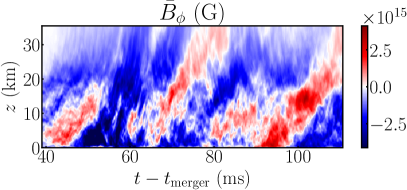
- $α\Omega$ 发电机机制通过时间平均的电磁力与磁场分量之间的相关性得到证实,尤其在密度 $\rho \geq 10^{13}$ g/cm$^3$ 的核心区域表现显著。
- 成功启动了光度约为 $10^{51}$ erg/s 的 Poynting-通量主导喷流,与短时硬伽马射线暴的引擎一致。
- 由洛伦兹力驱动的磁化质量抛射约为 $0.1M_\odot$,抛射物质量与喷流光度强烈依赖于分辨率与发电机活动强度。
更好的研究,从现在开始
从阅读论文到最终审阅,大幅缩短您的研究时间。
无需绑定信用卡
本解读由 AI 生成,并经人工编辑审核。