
[论文解读] A massive quiescent galaxy at redshift 4.658
光谱学 JWST 证实 GS-9209 为 z=4.658 的大质量静止星系,质量为 3.8±0.2×10^10 M⊙,在 z≈6.5 完成抑制,提示早期、迅速的形成与抑制。
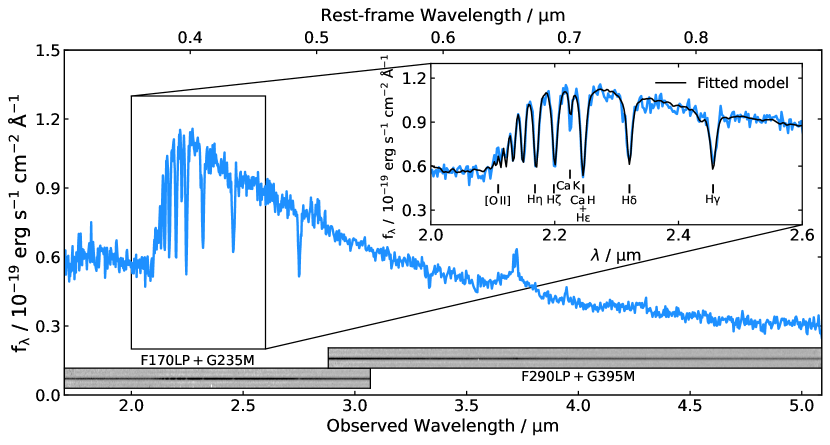
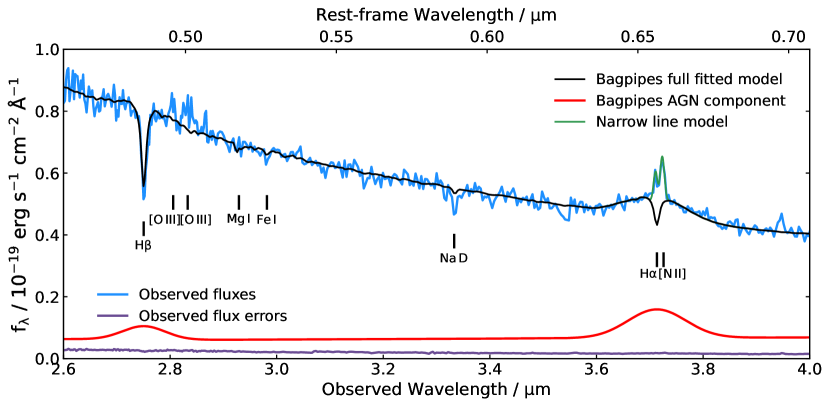
The extremely rapid assembly of the earliest galaxies during the first billion years of cosmic history is a major challenge for our understanding of galaxy formation physics. The advent of JWST has exacerbated this issue by confirming the existence of galaxies in significant numbers as early as the first few hundred million years. Perhaps even more surprisingly, in some galaxies, this initial highly efficient star formation rapidly shuts down, or quenches, giving rise to massive quiescent galaxies as little as 1.5 billion years after the Big Bang. However, due to their faintness and red colour, it has proven extremely challenging to learn about these extreme quiescent galaxies, or to confirm whether any exist at earlier times. Here we report the spectroscopic confirmation of a massive quiescent galaxy, GS-9209, at redshift $z=4.658$, just 1.25 billion years after the Big Bang, using JWST NIRSpec. From these data we infer a stellar mass of $M_* = 3.8\pm0.2 imes10^{10}\ M_\odot$, which formed over a $\simeq200$ Myr period before this galaxy quenched its star formation activity at $z=6.5^{+0.2}_{-0.5}$, when the Universe was $\simeq800$ million years old. Based on the presence of broad H$α$ in the spectrum and a high narrow-line [NII]/H$α$ ratio, we infer the presence of an accreting supermassive black hole, with a mass of $M_\bullet = 5\pm1 imes10^{8}\ M_\odot$. This large black hole mass relative to the stellar mass suggests that active galactic nucleus (AGN) feedback may have been responsible for quenching this galaxy. GS-9209 is also extremely compact, with an effective radius, $r_e=215\pm20$ parsecs. This galaxy is both a likely descendent of the highest-redshift submillimetre galaxies and quasars, and a likely progenitor for the dense, ancient cores of the most massive local galaxies.
研究动机与目标
- 使用 JWST NIRSpec 数据证明 z>4 的大质量静止星系的存在。
- 推断恒星族群属性,包括质量、恒星形成历史和抑制的年代。
- 评估 AGN 的存在及其对观测光谱和星系演化的影响。
- 描绘星系尺度、密度和动力学质量,以将 GS-9209 放在早期大质量系统的背景中。
提出的方法
- 使用 G235M 与 G395M 光栅的 JWST NIRSpec 光谱(分辨率约 R=1000),覆盖 1.7–5.1 μm 并探测 Balmer 特征。
- 使用 Bagpipes 代码进行全谱光度拟合,将光谱与多波长光度测量结合。
- 包含恒星、尘埃、星 nebular 和 AGN 成分的 22 参数模型,先验受 BC03/MILES 库和双幂律星形成史的启发。
- 在拟合星云组分以检测潜在星形成时,对来自 AGN 的窄线发射进行掩蔽。
- 对 AGN 连续体和 broad Hα/Hβ 发射进行建模,以分离恒星与非恒星贡献。
- 使用 JWST NIRCam F210M 成像配合 PetroFit 进行尺寸与结构分析,将恒星与 AGN 成分分解。
实验结果
研究问题
- RQ1GS-9209 的红移及光谱确认状态是什么?
- RQ2GS-9209 的恒星质量与恒星形成历史是什么,它在何时形成并抑制?
- RQ3GS-9209 是否 host 有 AGN,它如何影响观测光谱和推断属性?
- RQ4GS-9209 的结构与动力学属性(尺寸、密度、速度色散、动力学质量)是什么,且与其他高红移静止系统相比如何?
主要发现
- GS-9209 的红移为 z = 4.6582 ± 0.0002,具有 Balmer 主导的光谱,指示最近恒星形成率急剧下降。
- 恒星质量为 log10(M*/M⊙) = 10.58 ± 0.02,尘埃衰减可忽略(AV = 0.02 ± 0.02)。
- 形成时刻为 zform = 6.9 ± 0.2,抑制发生在 zquench = 6.5^{+0.2}_{-0.5},在抑制前有约200 Myr 的恒星形成时期。
- 宽带 Hα 发射与 ~ -0.01 ± 0.04 的 [N II]/Hα 比值指示 AGN 活动;AGN 在 5100 Å 处约贡献 7.5% 的通量,且宽 Hα 的 FWHM ≈ 10300 ± 700 km s⁻¹。
- 恒星组分的有效半径为 re = 0.033 ± 0.003 arcsec,在 z = 4.658 时对应 215 ± 20 pc,Sérsic 指数 n = 2.3 ± 0.3,恒星-质量表面密度 log10(Σeff/M⊙ kpc⁻²) = 11.15 ± 0.08。
- 动力学质量为 log10(Mdyn/M⊙) = 10.3 ± 0.1,与恒星质量略低;通过 Hα 与速度色散测量推断超大质量黑洞质量约为 (0.5–1)×10^9 M⊙。
更好的研究,从现在开始
从阅读论文到最终审阅,大幅缩短您的研究时间。
无需绑定信用卡
本解读由 AI 生成,并经人工编辑审核。