
[论文解读] A Mathematical Description of the IDSA for Supernova Neutrino transport, its discretization and a comparison with a finite volume scheme for Boltzmann's Equation
本文为中子星坍缩超新星中中微子输运的各向同性扩散源近似(IDSA)提供了严格的数学推导,将其与通过时间分裂和有限体积法求解的简化玻尔兹曼方程进行比较。结果表明,尽管离散化误差较低,IDSA在从束缚到自由流射的过渡区域引入了显著的建模误差,相对 $L^2$ 范数下的误差约为 20%。
In this paper we give an introduction to the Boltzmann equation for neutrino transport used in core collapse supernova models as well as a detailed mathematical description of the \emph{Isotropic Diffusion Source Approximation} (IDSA). Furthermore, we present a numerical treatment of a reduced Boltzmann model problem based on time splitting and finite volumes and revise the discretization of the IDSA for this problem. Discretization error studies carried out on the reduced Boltzmann model problem and on the IDSA show that the errors are of order one in both cases. By a numerical example, a detailed comparison of the reduced model and the IDSA is carried out and interpreted. For this example the IDSA modeling error with respect to the reduced Boltzmann model is numerically determined and localized.
研究动机与目标
- 为中子星坍缩超新星中微子输运的各向同性扩散源近似(IDSA)提供数学上严谨的推导与描述。
- 基于时间分裂和有限体积法,为具有冻结背景物质的简化玻尔兹曼模型开发数值格式。
- 将 IDSA 的离散化重新表述并适配至简化模型,以实现一致比较。
- 通过数值实验量化并定位 IDSA 相对于简化玻尔兹曼模型的建模误差。
- 评估 IDSA 在捕捉中微子输运关键物理区域(尤其是束缚与自由流射行为之间的过渡)时的有效性与局限性。
提出的方法
- 推导球对称条件下包含能量、半径和角度依赖性的 $Ø(v/c)$ 玻尔兹曼方程用于中微子输运。
- 将 IDSA 定义为将分布函数分解为束缚与自由流射分量,并通过基于扩散的源项耦合。
- 应用时间分裂方法解耦反应与输运算子,反应部分解析求解,输运部分采用保守型有限体积格式求解。
- 将先前工作中 IDSA 的离散化方法适配至简化模型,确保空间与角度网格的一致性。
- 采用高分辨率网格($N_r=257$,$N_\mu=129$,$\Delta t=1.5625\cdot10^{-3}$),确保离散化误差低于 1%。
- 通过 IDSA 与玻尔兹曼解之间的 $L^2$ 相对差计算建模误差,并在空间上绘制绝对差值以定位误差区域。
实验结果
研究问题
- RQ1IDSA 模型在解的精度方面与简化玻尔兹曼方程相比如何?
- RQ2IDSA 的建模误差在空间上最显著的位置在哪里,特别是与物理区域的关系如何?
- RQ3IDSA 建模误差的大小相对于简化玻尔兹曼模型是多少?其在过渡区域的表现如何?
- RQ4两种模型中的离散化误差如何影响比较结果的可靠性?
- RQ5为何 IDSA 在反应主导区域比玻尔兹曼模型更快收敛至平衡态?
主要发现
- IDSA 相对于简化玻尔兹曼模型的建模误差在 $L^2$ 范数下约为 20%,误差范围为 ±2%。
- 建模误差主要集中于反应主导区与自由流射区之间的中间过渡区域,具体位于空间区间 $(3,6)$。
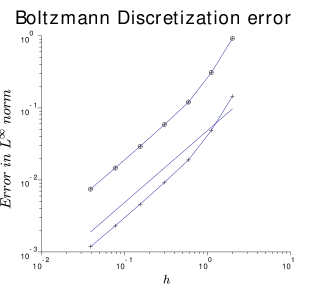
- 简化玻尔兹曼模型与 IDSA 的离散化误差均为一阶量级,但作者通过高分辨率网格将误差控制在 1% 以下。
- 在反应区与输运区,IDSA 均低估了玻尔兹曼解,其中误差最大的区域出现在过渡区。
- 由于通过稳态近似强耦合束缚与流射分量,IDSA 在反应主导区域表现出更快的平衡态收敛速度。
- 在反应主导区域,IDSA 的流射分量未如预期那样消失,导致束缚分量减少,从而加剧了建模误差。
更好的研究,从现在开始
从阅读论文到最终审阅,大幅缩短您的研究时间。
无需绑定信用卡
本解读由 AI 生成,并经人工编辑审核。