
[论文解读] A nebular origin for the persistent radio emission of fast radio bursts
本文报告了与邻近重复快速射电暴 FRB 20201124A 相关的持久射电源(PRS)的探测,该源表现出倒谱射电谱和低法拉第旋转测量值(RM < 1000 rad/m²),支持其辐射起源于星云。PRS 与围绕年轻磁星的磁化电离星云产生的同步辐射一致,将观测到的 RM–光度关系拓展至低光度区域,并表明大多数 FRB 缺乏可探测的 PRS,原因在于周围介质较弱。
Fast radio bursts (FRBs) are millisecond-duration, bright ($\sim$Jy) extragalactic bursts, whose production mechanism is still unclear. Recently, two repeating FRBs were found to have a physically associated persistent radio source of non-thermal origin. These two FRBs have unusually large Faraday rotation measure values likely tracing a dense magneto-ionic medium, consistent with synchrotron radiation originating from a nebula surrounding the FRB source. Recent theoretical arguments predict that, if the observed Faraday rotation measure mostly arises from the persistent radio source region, there should be a simple relation between the luminosity of the latter and the first. We report here the detection of a third, less luminous persistent radio source associated with the repeating FRB source FRB20201124A at a distance of 413 Mpc, significantly expanding the predicted relation into the low luminosity - low Faraday rotation measure regime ($<$1000 rad m-2). At lower values of the Faraday rotation measure, the expected radio luminosity falls below the limit of detection threshold for present-day radio telescopes. These findings support the idea that the persistent radio sources observed so far are generated by a nebula in the FRB environment, and that FRBs with low Faraday rotation measure may not show a persistent radio source because of a weaker magneto-ionic medium. This is generally consistent with models invoking a young magnetar as the central engine of the FRB, where the surrounding ionized nebula - or the interacting shock in a binary system - powers the persistent radio source.
研究动机与目标
- 研究与快速射电暴(FRB)相关的持久射电发射(PRS)的物理起源,尤其关注重复源的背景。
- 基于射电谱特性与磁场诊断,判断 PRS 是否源于围绕 FRB 的星云环境。
- 在电离星云同步辐射的背景下,检验关于射电光度与法拉第旋转测量值(RM)关系的理论预测。
- 评估为何仅部分 FRB 显示可探测的 PRS,探讨环境密度与磁场强度的作用。
- 通过分析多频段射电数据与尘埃发射上限,约束 FRB 中心引擎的性质。
提出的方法
- 在 15 GHz 和 22 GHz 频段进行深度甚大阵列(VLA)观测,空间分辨率优于亚角秒,以探测 FRB 20201124A 天区内的紧凑射电源。
- 重新分析档案 6 GHz VLA 数据,以分离出宿主星系中弥漫的星形成发射与紧凑 PRS。
- 构建 6–22 GHz 的多频段射电谱,确定紧凑源的谱指数,发现 $ F_{\nu} \propto \nu^{1} $,表明其为倒谱。
- 利用甚长基线干涉测量(VLBI)数据精确测定 FRB 位置为 413 Mpc(z = 0.098),实现准确的源关联。
- 进行深度 NOEMA 观测,频率为 236 GHz 和 250 GHz,设定冷尘埃发射的上限,以约束恒星形成活动与尘埃含量。
- 利用 GTC/MEGARA 积分场单元数据,应用巴尔默减缩法(Hα/Hβ)分析,估算固有尘埃消光,确认 FRB 附近恒星形成活动微弱。
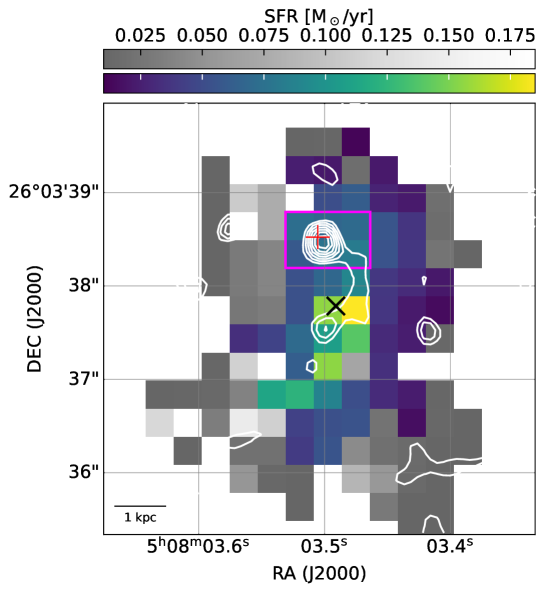
![Figure 1: Top Panel: VLA image at 15 GHz of the host galaxy of FRB 20201124A from this work. Black contours indicate 3, 4, 5, 7, 9 $\times\sigma$ levels. The white contours are from the 6 GHz VLA image by [ 13 ] at similar resolution. The red contours are from the previous 22 GHz VLA image by [ 12 ]](https://ar5iv.labs.arxiv.org/html/2312.15296/assets/x1.png)
实验结果
研究问题
- RQ1FRB 20201124A 的持久射电发射是否与其谱特性与磁场特性一致,支持星云起源?
- RQ2FRB 20201124A 中 PRS 的观测射电光度与法拉第旋转测量值(RM)是否符合同步辐射星云的预测 RM–光度关系?
- RQ3为何 FRB 20201124A 中的 PRS 比先前探测到的 PRS 更低光度、更低 RM?这对周围介质意味着什么?
- RQ4FRB 环境中缺乏可探测的恒星形成或尘埃发射,是否可排除 PRS 的恒星形成起源?
- RQ5探测到具有倒谱的 PRS 对中心引擎与年轻磁星的存在意味着什么?
主要发现
- 在 15 GHz 处探测到一个紧凑、未分辨的持久射电源(PRS),通量密度为 20.0 ± 3.5 μJy,与 FRB 位置一致,显著亮于 3–4 kpc 尺度的弥散发射。
- PRS 在 6–22 GHz 频段表现出倒谱射电谱($ F_{\nu} \propto \nu^{1} $),与热辐射或星形成相关发射不一致,支持其非热起源。
- PRS 的法拉第旋转测量值(RM)约为 100–200 rad/m²,处于低 RM、低光度区域,将观测到的 RM–光度关系拓展至此前未探索的参数空间。
- NOEMA 在 236 GHz 和 250 GHz 的上限分别为 ≤130 μJy 和 ≤160 μJy,排除了显著的冷尘埃发射,表明 FRB 区域恒星形成活动极微弱。
- GTC/MEGARA 数据显示固有 E(B-V) 消光较低,且无显著 Hα 发射,进一步排除了 PRS 的恒星形成起源。
- 由于其通量密度较低(≈10 μJy/beam),PRS 在此前的 VLBI 观测中未被探测到,低于约 10 μJy/beam 的噪声阈值,凸显了开展更深度、高分辨率巡天的必要性。
更好的研究,从现在开始
从阅读论文到最终审阅,大幅缩短您的研究时间。
无需绑定信用卡
本解读由 AI 生成,并经人工编辑审核。