
[论文解读] A new measurement of the expansion history of the Universe at z=1.26 with cosmic chronometers in VANDELS
本研究利用宇宙时钟法对来自VANDELS巡天的39个大质量、无星系的星系进行分析,首次在红移z ≈ 1.26处实现了宇宙学参数测量。通过全谱拟合技术在不施加宇宙学先验条件的情况下获得可靠的恒星年龄,研究得出H(z=1.26) = 135 ± 65 km s⁻¹ Mpc⁻¹,证明了宇宙时钟方法在z > 1红移范围内的可行性,并凸显其在未来大型巡天任务(如Euclid)中的潜力。
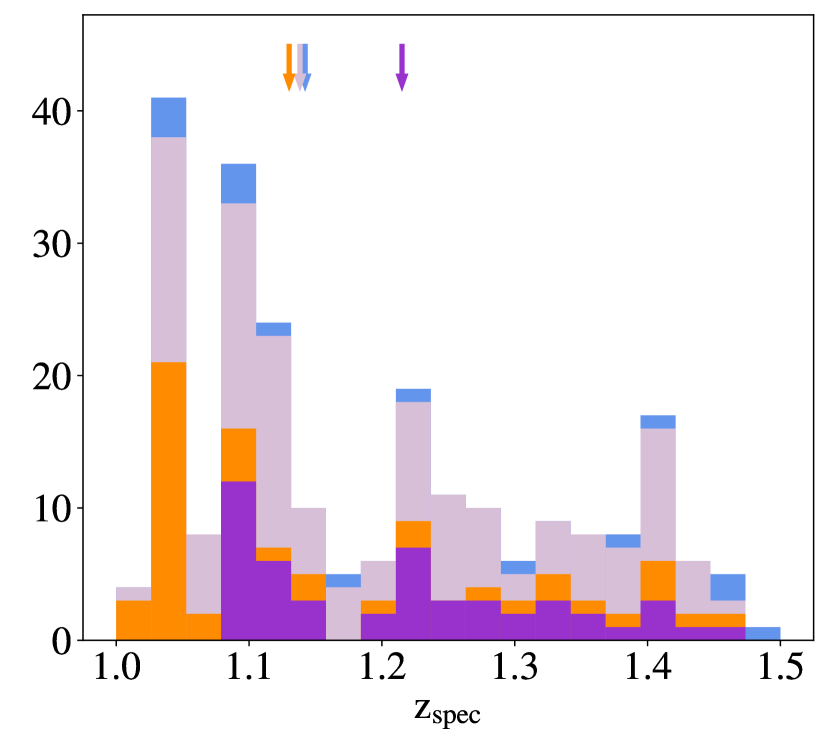
We derive a new constraint on the expansion history of the Universe by applying the cosmic chronometers method, studying the age evolution of high-redshift galaxies with a full-spectral-fitting approach. We select a sample of 39 massive ($log(M/M_\odot)>10.8$) and passive ($log(sSFR/yr^{-1})<-11$) galaxies from the data release 4 of the VANDELS survey at $1=0.28\pm0.02$ Gyr), low dust extinction ($=0.43\pm0.02$ mag), and sub-solar metallicities ($=0.44\pm0.01$). The ages show a decreasing trend with redshift compatible with a standard cosmological model, even if no cosmological constraint is assumed in the fit, and a clear mass-downsizing pattern. Testing the impact of the star formation history on the results, we find only a maximum 2\% fluctuation in age and metallicity. By fitting the median age-redshift relation with a flat $Λ$CDM model and assuming a Gaussian prior on $Ω_{M,0}= 0.3\pm0.02$ from late-Universe probes, we obtain $H_0=67_{-15}^{+14}\:km\:s^{-1}\:Mpc^{-1}$. In the end, we derive a new estimate of the Hubble parameter with the cosmic chronometers method, $H(z=1.26)=135\pm65\:km\:s^{-1}\:Mpc^{-1}$ including statistical and systematic errors. While the error budget is currently dominated by the scarcity of the sample, this work proves the potential strength of the cosmic chronometers approach up to $z>1$, especially in view of incoming large spectroscopic surveys like Euclid. (abridged)
研究动机与目标
- 利用宇宙时钟法在高红移(z ≈ 1.26)处测量哈勃参数,且不依赖于宇宙学假设。
- 检验在高红移无星系中通过全谱拟合获得的恒星年龄估计的稳健性。
- 利用光谱特征与物理参数约束,研究在z ≈ 1.26处大质量无星系中是否存在质量下移现象。
- 评估年龄与哈勃参数估计对不同恒星形成历史模型及样本选择标准的敏感性。
- 展示利用深度、高质量光谱数据将宇宙时钟法扩展至z ≈ 1以上的可行性。
提出的方法
- 研究者利用光度与光谱联合判据,在1 < z < 1.5红移范围内从VANDELS巡天中筛选出39个大质量(log(M*/M☉) ≥ 10.8)、无星(log(sSFR/yr⁻¹) ≤ -11)星系,以最小化恒星形成星系的污染。
- 通过BAGPIPES代码进行全谱拟合,联合分析光谱与光度数据,独立推导恒星种群参数(包括年龄、金属丰度、尘埃消光与恒星形成 timescale),且在年龄上不施加宇宙学先验。
- 通过将样本按红移与质量分箱,计算中位数年龄,再将该中位数年龄-红移关系拟合至平坦ΛCDM模型,并施加ΩM,0 = 0.30 ± 0.02的高斯先验以打破参数退化。
- 将宇宙时钟法应用于中位数年龄-红移关系,利用微分年龄公式H(z) = -1/(1+z) × dz/dt,直接估算z ≈ 1.26处的H(z)。
- 通过比较不同恒星形成历史模型(延迟τ模型与双幂律模型)下的年龄估计,验证结果稳健性,结果显示在物理合理约束下,年龄与金属丰度的中位数差异低于2%。
- 通过改变分箱方案并采用更复杂的恒星形成历史模型,评估H(z)的系统误差,结果表明统计误差主导最终误差预算。

实验结果
研究问题
- RQ1能否利用高红移无星系中的宇宙时钟法可靠地测量z ≈ 1.26处的哈勃参数?
- RQ2通过全谱拟合获得的恒星年龄是否表现出与宇宙学假设无关的红移演化一致性?
- RQ3在z ≈ 1.26处,大质量无星系中是否存在质量下移现象的证据,表现为光谱特征与年龄估计的差异?
- RQ4哈勃参数与年龄估计对恒星形成历史模型的选择有多敏感?
- RQ5样本选择、分箱方式与恒星形成历史建模带来的系统误差在多大程度上影响最终H(z)测量结果?
主要发现
- 39个大质量无星系样本表现出清晰的年龄随红移演化,恒星年龄随宇宙时间推移而减小,证实了该群体随时间变老的预期。
- 样本的中位数恒星年龄为1.7⁺¹.⁵₋₀.⁹ Gyr,中位数恒星形成timescale为⟨τ⟩ = 0.28 ± 0.02 Gyr,尘埃消光较低(⟨AV,dust⟩ = 0.43 ± 0.02 mag),金属丰度为亚太阳水平(⟨Z/Z☉⟩ = 0.44 ± 0.01),与其它高红移无星系一致。
- 更高质量星系(⟨log(M*/M☉)⟩ = 11.4)比低质量星系(⟨log(M*/M☉)⟩ = 11.15)年长约0.8 Gyr,为z ≈ 1.26处的质量下移现象提供了有力证据。
- 在物理约束参数下,不同恒星形成历史模型(延迟τ与双幂律)的年龄与金属丰度估计差异极小,中位数差异低于2%。
- 在z ≈ 1.26处测得的哈勃参数为H(z=1.26) = 135 ± 65 km s⁻¹ Mpc⁻¹,统计误差主导误差预算。
- 由中位数年龄-红移拟合得出的H₀ = 67⁺¹⁴₋₁⁵ km s⁻¹ Mpc⁻¹与晚期宇宙观测结果一致,支持宇宙时钟法在未来的高红移宇宙学研究中的潜力。
更好的研究,从现在开始
从阅读论文到最终审阅,大幅缩短您的研究时间。
无需绑定信用卡
本解读由 AI 生成,并经人工编辑审核。