
[论文解读] A non-linear solution to the $S_8$ tension II: Analysis of DES Year 3 cosmic shear
本文利用DES第三年宇宙剪影数据研究$S_8$张力问题,提出在波数$k \sim 0.2h\,{\rm Mpc}^{-1}$处的非线性物质功率谱抑制可调和弱引力透镜测量与Planck的$\Lambda{\rm CDM}$宇宙学之间的矛盾。所需抑制程度虽低于以往基于KiDS的研究结果,但仍超过流体动力学模拟的预测,暗示可能需要非标准物理机制,如修改的暗物质或增强的重子反馈。
Weak galaxy lensing surveys have consistently reported low values of the $S_8$ parameter compared to the $ extit{Planck}\ Λ m{CDM}$ cosmology. Amon & Efstathiou (2022) used KiDS-1000 cosmic shear measurements to propose that this tension can be reconciled if the matter fluctuation spectrum is suppressed more strongly on non-linear scales than assumed in state-of-the-art hydrodynamical simulations. In this paper, we investigate cosmic shear data from the Dark Energy Survey (DES) Year 3. The non-linear suppression of the matter power spectrum required to resolve the $S_8$ tension between DES and the $ extit{Planck}\ Λ m{CDM}$ model is not as strong as inferred using KiDS data, but is still more extreme than predictions from recent numerical simulations. An alternative possibility is that non-standard dark matter contributes to the required suppression. We investigate the redshift and scale dependence of the suppression of the matter power spectrum. If our proposed explanation of the $S_8$ tension is correct, the required suppression must extend into the mildly non-linear regime to wavenumbers $k\sim 0.2 h { m Mpc}^{-1}$. In addition, all measures of $S_8$ using linear scales should agree with the $ extit{Planck}\ Λ m{CDM}$ cosmology, an expectation that will be testable to high precision in the near future.
研究动机与目标
- 检验非线性物质功率谱抑制是否可调和DES第三年宇宙剪影与Planck $\Lambda{\rm CDM}$宇宙学之间的$S_8$张力。
- 评估所需抑制程度是否与当前流体动力学模拟一致,或是否指向非标准暗物质等新物理。
- 研究抑制的红移与尺度依赖性,尤其关注至$k \sim 0.2h\,{\rm Mpc}^{-1}$的弱非线性区域。
- 评估若非线性抑制假说成立,所有大尺度$S_8$测量是否应与Planck $\Lambda{\rm CDM}$一致。
- 提出可检验的预测:若该解决方案成立,未来高精度大尺度测量(如CMB引力透镜-星系互相关)应与$\Lambda{\rm CDM}$一致。
提出的方法
- 采用物质功率谱的唯象学模型:$P_{\rm m}(k,z) = P^{\rm L}_{\rm m}(k,z) + A_{\rm mod}[P^{\rm NL}_{\rm m}(k,z) - P^{\rm L}_{\rm m}(k,z)]$,其中$A_{\rm mod}$调节非线性功率的抑制程度。
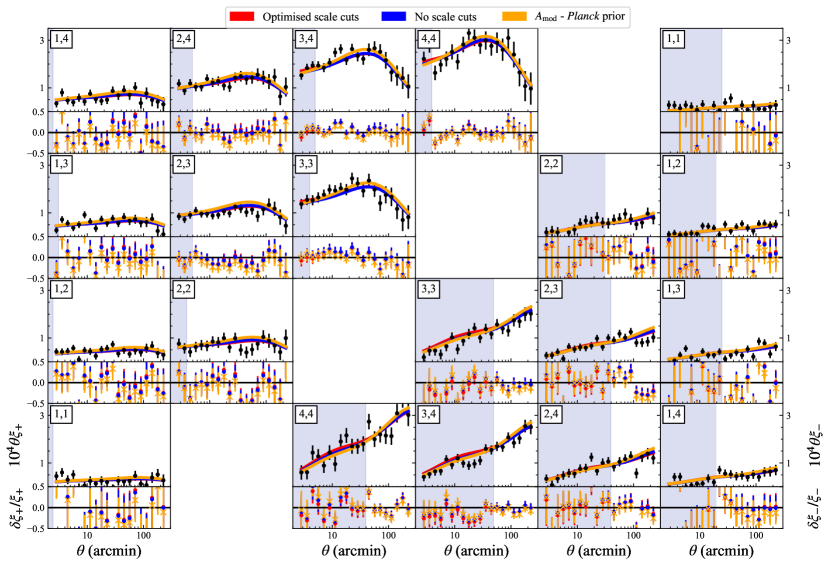
- 将该模型应用于DES第三年数据的宇宙剪影两两点相关函数,通过在宇宙学参数上积分,拟合$A_{\rm mod}$。
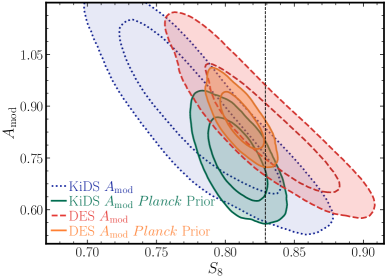
- 通过$\chi^2$和贝叶斯证据比较拟合质量与$S_8$约束,评估与Planck $\Lambda{\rm CDM}$模型的张力减小程度。
- 分析抑制的红移与波数依赖性,重点关注至$k \sim 0.2h\,{\rm Mpc}^{-1}$的弱非线性区域。
- 评估该模型与独立大尺度$S_8$测量(如CMB引力透镜-星系互相关与红移空间畸变)的一致性。
- 通过与先前基于KiDS的分析对比,并考虑未来观测约束,评估结果对系统误差的鲁棒性。
实验结果
研究问题
- RQ1非线性物质功率谱抑制能否调和DES第三年宇宙剪影数据中的$S_8$张力?
- RQ2所需抑制幅度($A_{\rm mod}$)与最先进流体动力学模拟的预测相比如何?
- RQ3抑制是否具有尺度与红移依赖性,且是否延伸至弱非线性区域($k \sim 0.2h\,{\rm Mpc}^{-1}$)?
- RQ4若非线性抑制假说成立,所有大尺度$S_8$测量是否应与Planck $\Lambda{\rm CDM}$宇宙学一致?
- RQ5何种物理机制(如重子反馈或非标准暗物质)可能产生所需抑制?
主要发现
- 为调和DES第三年数据中的$S_8$张力,所需非线性物质功率谱抑制程度低于KiDS-1000的推断结果,$A_{\rm mod} \approx 0.75$(相较论文I中的$\approx 0.69$)。
- 尽管程度较轻,该抑制仍超过近期流体动力学模拟的预测,暗示可能需要超出标准重子反馈的物理机制。
- 抑制必须延伸至弱非线性区域,且在波数$k \sim 0.2h\,{\rm Mpc}^{-1}$附近产生显著影响,方能与数据一致。
- 若非线性抑制假说成立,所有以大尺度为主导的$S_8$测量(如CMB引力透镜-星系互相关与红移空间畸变)必须与Planck $\Lambda{\rm CDM}$模型一致。
- 该假说仅在未来的高精度大尺度测量确认与$\Lambda{\rm CDM}$一致时才成立;任何偏差都将排除该解决方案。
- DES结果强化了未来弱引力透镜巡天需在全尺度上重建物质功率谱的必要性,以区分非线性物理效应与晚期$\Lambda{\rm CDM}$偏差。
更好的研究,从现在开始
从阅读论文到最终审阅,大幅缩短您的研究时间。
无需绑定信用卡
本解读由 AI 生成,并经人工编辑审核。