
[论文解读] A panorama of new-physics explanations to the MiniBooNE excess
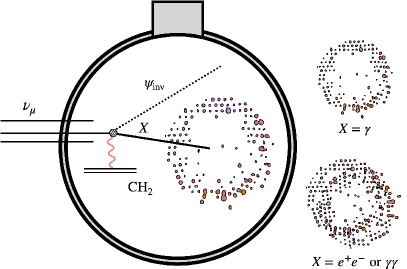
本文對暗中微子模型進行了全面分析,作為解決MiniBooNE低能 excess 的一種方案,提出在中微子-核子散射中產生的短壽命重中性輕子(HNLs)會在探測器內衰變為 e⁺e⁻ 末態。作者首次在 3+1 和 3+2 HNL 模型框架下對 MiniBooNE 能譜進行了全局擬合,表明暗中微子場景可解釋該 excess,且可被未來實驗直接檢測。
The MiniBooNE low-energy excess stands as an unexplained anomaly in short-baseline neutrino oscillation experiments. It has been shown that it can be explained in the context of dark sector models. Here, we provide an overview of the possible new-physics solutions based on electron, photon, and dilepton final states. We systematically discuss the various production mechanisms for dark particles in neutrino-nucleus scattering. Our main result is a comprehensive fit to the MiniBooNE energy spectrum in the parameter space of dark neutrino models, where short-lived heavy neutral leptons are produced in neutrino interactions and decay to $e^+e^-$ pairs inside the detector. For the first time, other experiments will be able to directly confirm or rule out dark neutrino interpretations of the MiniBooNE low-energy excess.
研究动机与目标
- 探討具有短壽命重中性輕子(HNLs)的暗中微子模型是否能解釋在 200–600 MeV 之間電子樣式事例中未被解釋的 MiniBooNE 低能 excess(LEE)。
- 系統性地評估中微子-核子散射中暗粒子的各種新物理產生機制,包括電子、光子和雙輕子末態。
- 在 3+1 和 3+2 HNL 模型的參數空間中對 MiniBooNE 能譜進行全局擬合,考慮動力學與探測器效應。
- 識別可被未來短基線實驗探測的可觀測信號,如 e⁺e⁻ 射線的非對稱動量分布與角分布。
- 為未來實驗確認或排除 LEE 的暗中微子解釋提供基準。
提出的方法
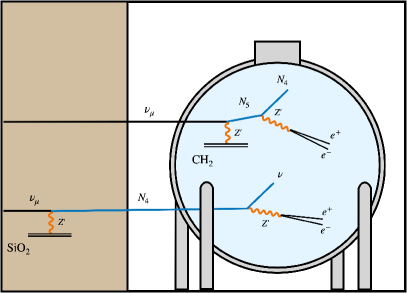
- 建立一個 phenomenological 暗中微子模型,其中 HNL 通過中微子-核子的中性流相互作用產生,並在 MiniBooNE 探測器內衰變為 e⁺e⁻ 末態。
- 使用 DarkNews 蒒蒙特卡洛模擬框架,模擬中微子-核子散射、HNL 產生以及後續衰變為 e⁺e⁻ 末態的過程,並考慮真實的探測器響應。
- 採用基於 χ²-似然擬合的統計程序,將模擬的事例能譜與 MiniBooNE 數據進行比較,包含系統不確定性。
- 系統性地改變 HNL 質量(m₄, m₅)、媒介子質量(m_Z′)、混合角(|U_D4|)與耦合強度(ε),以探索完整的參數空間。
- 分析動力學分佈(如射線角度、分離角度、能量非對稱性與總能量)在參數空間中的變化,以識別獨特的信號。
- 與先前的擬合結果(例如,參考文獻 [36])進行比較,以驗證方法論,並確保在 m_Z′ = 30 MeV 條件下 3+1 模型的一致性。
实验结果
研究问题
- RQ1具有衰變至 e⁺e⁻ 末態的 HNL 的暗中微子模型是否能在不引入惰性中微子振盪的情況下解釋 MiniBooNE 的低能 excess?
- RQ2在中微子-核子散射中,哪些是導致 MiniBooNE 中電子樣式信號的暗粒子主要產生機制?
- RQ3在 3+1 和 3+2 模型中,HNL 的實體與非實體衰變在動力學觀測量(如射線角度、能量非對稱性與總能量)上有何差異?
- RQ4HNL 參數空間的哪些區域會在 MiniBooNE 中產生最易辨識的信號?與現有的全局擬合結果相比如何?
- RQ5該模型的預測是否可被未來的短基線實驗(如 SBN 計畫)直接檢測?
主要发现
- 3+1 和 3+2 暗中微子模型對 MiniBooNE 能譜有良好的擬合效果,當 |U_D4| 設為 1 時,3+1 模型與先前結果一致。
- 實體 HNL 衰變產生更向前的 e⁺e⁻ 射線,因其動量更高;而非實體衰變則導致更廣泛的角分布與更大的分離角度。
- 最大射線分離角度出現在 m₅ ≈ 700 MeV 時,此處能量非對稱性也因誤重建的非對稱事件而達到最大。
- 在實體衰變區域附近,總射線能量顯著增強,特別是在較重 HNL 與較大混合角的情況下,最優參數區域的峰值能量超過 500 MeV。
- 在 3+2 模型中,當 m_Z′ ≈ 1.25 GeV 時,實體衰變區域顯示出明確的動力學行為差異,較高的 m₅ 會導致更能量高且分離更遠的射線。
- 該模型預測了獨特且可測量的動力學模式,特別是在射線角分離與能量非對稱性方面,可被未來實驗(如 SBN 計畫)直接檢測。
更好的研究,从现在开始
从阅读论文到最终审阅,大幅缩短您的研究时间。
无需绑定信用卡
本解读由 AI 生成,并经人工编辑审核。