
[论文解读] A physics and data co-driven surrogate modeling approach for temperature field prediction on irregular geometric domain
本文提出了一种物理与数据协同驱动的代理模型,用于在不规则几何域上实现快速且精确的温度场预测。通过使用边界拟合坐标将不规则几何体映射到规则计算平面,并结合基于物理的网格生成代理模型与多层次降阶数据驱动热力代理模型,该方法在小样本数据下实现了高精度预测,且训练时间显著短于标准卷积神经网络(CNN)如U-Net和FNO。
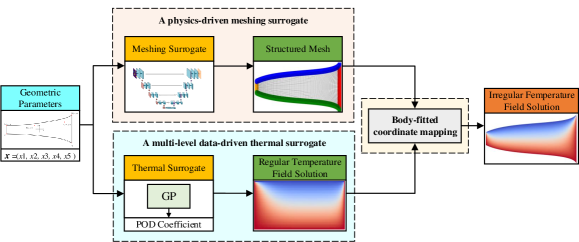
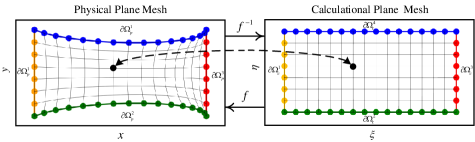
In the whole aircraft structural optimization loop, thermal analysis plays a very important role. But it faces a severe computational burden when directly applying traditional numerical analysis tools, especially when each optimization involves repetitive parameter modification and thermal analysis followed. Recently, with the fast development of deep learning, several Convolutional Neural Network (CNN) surrogate models have been introduced to overcome this obstacle. However, for temperature field prediction on irregular geometric domains (TFP-IGD), CNN can hardly be competent since most of them stem from processing for regular images. To alleviate this difficulty, we propose a novel physics and data co-driven surrogate modeling method. First, after adapting the Bezier curve in geometric parameterization, a body-fitted coordinate mapping is introduced to generate coordinate transforms between the irregular physical plane and regular computational plane. Second, a physics-driven CNN surrogate with partial differential equation (PDE) residuals as a loss function is utilized for fast meshing (meshing surrogate); then, we present a data-driven surrogate model based on the multi-level reduced-order method, aiming to learn solutions of temperature field in the above regular computational plane (thermal surrogate). Finally, combining the grid position information provided by the meshing surrogate with the scalar temperature field information provided by the thermal surrogate (combined model), we reach an end-to-end surrogate model from geometric parameters to temperature field prediction on an irregular geometric domain. Numerical results demonstrate that our method can significantly improve accuracy prediction on a smaller dataset while reducing the training time when compared with other CNN methods.
研究动机与目标
- 为解决传统PDE求解器在飞机结构优化热分析中计算成本过高的问题。
- 克服标准CNN在处理不规则几何域时因依赖规则网格而带来的局限性。
- 开发一种结合物理PDE约束与数据驱动学习的代理模型,以提升泛化能力与效率。
- 在保持复杂几何体温度场预测高精度的同时,减少训练时间与数据需求。
提出的方法
- 使用Bézier曲线对不规则几何体进行参数化,以实现一致的几何表示。
- 应用边界拟合坐标映射,将不规则物理域转换为规则计算平面。
- 开发一种基于物理的卷积神经网络(CNN)代理模型,利用PDE残差损失生成高质量网格。
- 基于本征正交分解(POD)构建多层次降阶模型(ROM),用于在规则化域中预测温度场。
- 将网格生成代理模型(提供网格位置)与热力代理模型(提供标量温度值)整合为端到端模型,用于不规则域预测。
- 使用小样本数据集对联合模型进行训练,结合物理定律与数据以提升泛化能力并减少过拟合。
实验结果
研究问题
- RQ1在标准CNN因网格不规则而失效的不规则几何域上,协同驱动代理模型是否能有效预测温度场?
- RQ2将基于PDE的物理约束与数据驱动学习相结合,如何在有限训练数据下提升预测精度?
- RQ3多层次降阶建模策略在多大程度上降低了训练复杂度并提升了温度场预测的泛化能力?
- RQ4在小样本数据集上,与最先进的基于CNN的代理模型(如U-Net和FNO)相比,所提方法在预测精度与训练效率方面表现如何?
- RQ5所提出的框架能否扩展至具有任意边界条件的三维或更复杂的热力问题?
主要发现
- 所提出的多层次模型实现了0.0123的平均绝对误差(MAE)与0.0299的平均相对误差(MRE),显著优于单层次模型(MAE: 0.0185, MRE: 0.0448)。
- 即使在小样本数据集下,多层次模型仍保持低误差与高精度,且随着数据规模增加,性能下降可忽略不计。
- 所提模型的训练时间约为2分钟,约为U-Net与FNO模型(约20分钟)收敛时间的十分之一。
- U-Net与FNO模型对数据集大小高度敏感,在小样本数据上性能显著下降,而所提模型保持稳定且准确。
- 网格生成代理模型生成了高质量网格且误差极低,验证了基于物理的方法在网格生成中的有效性。
- 联合模型实现了从几何参数到不规则域温度场的端到端预测,展现出在实时设计优化中的强大潜力。
更好的研究,从现在开始
从阅读论文到最终审阅,大幅缩短您的研究时间。
无需绑定信用卡
本解读由 AI 生成,并经人工编辑审核。