
[论文解读] A physics-informed deep neural network for surrogate modeling in classical elasto-plasticity
本文提出一种物理信息深度神经网络——弹性-塑性神经网络(EPNN),将经典弹塑性力学的基本原理(如应变的可加分解和非线性增量弹性)直接嵌入其网络结构中。EPNN在使用基于剪胀的本构模型生成的合成数据对砂土进行预测时,表现出更优的泛化能力和数据效率,优于标准的全连接神经网络(ANN),在预测未见的应变控制加载路径方面表现更优。
In this work, we present a deep neural network architecture that can efficiently approximate classical elasto-plastic constitutive relations. The network is enriched with crucial physics aspects of classical elasto-plasticity, including additive decomposition of strains into elastic and plastic parts, and nonlinear incremental elasticity. This leads to a Physics-Informed Neural Network (PINN) surrogate model named here as Elasto-Plastic Neural Network (EPNN). Detailed analyses show that embedding these physics into the architecture of the neural network facilitates a more efficient training of the network with less training data, while also enhancing the extrapolation capability for loading regimes outside the training data. The architecture of EPNN is model and material-independent, i.e. it can be adapted to a wide range of elasto-plastic material types, including geomaterials and metals; and experimental data can potentially be directly used in training the network. To demonstrate the robustness of the proposed architecture, we adapt its general framework to the elasto-plastic behavior of sands. We use synthetic data generated from material point simulations based on a relatively advanced dilatancy-based constitutive model for granular materials to train the neural network. The superiority of EPNN over regular neural network architectures is explored through predicting unseen strain-controlled loading paths for sands with different initial densities.
研究动机与目标
- 开发一种将核心物理原理直接嵌入神经网络架构的弹塑性材料代理本构模型。
- 提升模型在训练数据之外的泛化与外推能力,尤其针对未见的加载路径。
- 构建一种与模型和材料无关的框架,适用于多种弹塑性材料,包括岩土材料和金属。
- 实现实验数据的直接端到端训练,同时保持物理一致性与数值稳定性。
- 通过增量形式实现与标准有限元代码的无缝集成。
提出的方法
- EPNN的网络结构通过结构约束强制实现总应变的弹性与塑性部分的可加分解。
- 通过基于物理的应力更新规则,将非线性增量弹性嵌入网络的前向传播过程中。
- 采用包含数据保真项与物理一致性项的损失函数进行训练,确保满足本构定律。
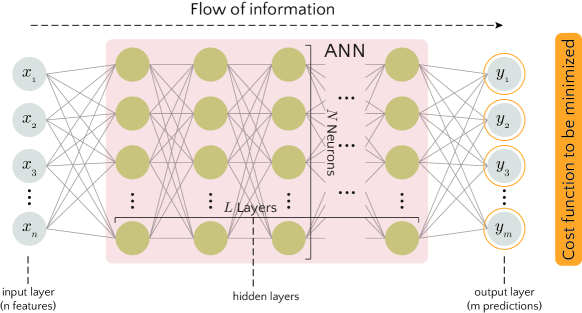
- 采用双分支子网络结构分别计算弹性与塑性应变贡献,其中塑性应变分支通过隐式方式满足屈服准则与流动法则。
- 利用基于剪胀本构模型的材料点模拟生成的合成数据,在多种应变控制加载路径下训练网络。
- 该框架支持任意单调加载路径,包括具有不同α比的轴对称三轴路径,从而实现对训练数据之外路径的泛化能力。
实验结果
研究问题
- RQ1是否可通过将弹塑性力学核心物理定律嵌入深度神经网络架构,实现相比标准全连接神经网络(ANN)在更少训练数据下的更优泛化能力?
- RQ2将增量弹性与应变分解整合进网络结构,对未见加载路径的预测精度与外推能力有何影响?
- RQ3EPNN架构在不重新训练或修改网络结构的前提下,可在多大程度上推广至不同弹塑性材料?
- RQ4是否可直接在实验数据上对EPNN进行端到端训练,同时保持物理一致性与数值稳定性?
- RQ5通过增量探测进行数据增强对提升EPNN预测能力有何影响?
主要发现
- EPNN在多种应变控制加载路径(包括α = -1000、-2.5 和 -1.75 的轴对称三轴路径)下均实现了高度精确的应力预测,其结果与数值积分得到的真实值高度一致。
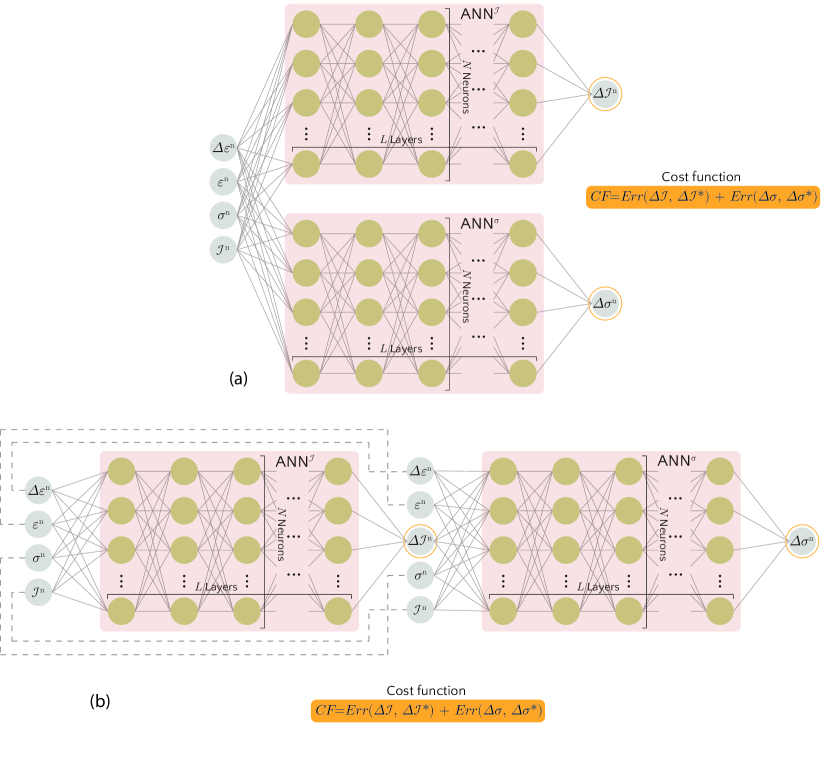
- 与标准的并行与串行全连接神经网络架构相比,EPNN在未见加载路径上的外推能力显著更优,尤其在训练数据中未包含的路径上表现突出。
- 由于嵌入了物理约束,该模型在更少的训练数据下即可实现收敛并保持稳定性。
- 由于采用增量形式与一致的应力更新机制,该架构与标准有限元代码完全兼容。
- 当训练数据质量提高时,网络性能随之提升,特别是当通过增量探测数据对张量响应区域进行探索后,性能进一步增强。
- 未来通过在塑性应变子网络中引入额外物理机制(如塑性势函数与显式流动法则)有望进一步提升模型性能。
更好的研究,从现在开始
从阅读论文到最终审阅,大幅缩短您的研究时间。
无需绑定信用卡
本解读由 AI 生成,并经人工编辑审核。