
[论文解读] A planetary system with gas giants and super-Earths around the nearby M dwarf GJ 676A. Optimizing data analysis techniques for the detection of multi-planetary systems
本研究采用先进的数据分析技术对M型矮星GJ 676A的HARPS径向速度数据进行了重新分析——使用HARPS-TERRA进行精确的RV测量,并结合改进的周期图法与贝叶斯MCMC方法进行信号探测,确认了一颗已知气态巨行星的存在,并发现了四个行星候选体,包括两颗超级-Earth和一颗质量巨大的外侧行星,使其成为首个质量与轨道周期范围与太阳系相当的M型矮星系。
Several M dwarfs are targets of systematical monitoring in searches for Doppler signals caused by low-mass exoplanet companions. As a result, an emerging population of high-multiplicity planetary systems around low-mass stars are being detected as well. We optimize classic data analysis methods and develop new ones to enhance sensitivity towards low-amplitude planets in high-multiplicity systems. We apply these methods to the public HARPS observations of GJ 676A, a nearby M dwarf with one reported gas giant companion. We re-derived Doppler measurements using the template matching method (HARPS-TERRA). We used refined versions of periodograms to assess the presence of additional low-mass companions. We analyse the same dataset with Bayesian tools and compared the performance of both approaches. We confirm the reported massive gas giant candidate and a long period trend, whose curvature is now well detected. We also find very secure evidence of two new candidates in close-in orbits and masses in the super-Earth mass regime. Despite the increased sensitivity of the new periodogram tools, we find that Bayesian methods are more sensitive in the early detection of candidate signals. While hardware development is important, development of data analysis techniques can help to reveal new results from existing data sets with significantly fewer resources. This new system holds the record of minimum-mass range (from Msin i = 4.5 M_Earth to 5 M_Jup) and period range (from 3.6 days to more than 10 years). Although all the planet candidates are substantially more massive, it is the first exoplanetary system with a general architecture similar to our solar system. GJ 676A can be happily added to the family of high-multiplicity planetary systems around M dwarfs.
研究动机与目标
- 通过改进的数据分析技术,提升在M型矮星周围多行星系统中探测低质量行星的灵敏度。
- 检验HARPS-TERRA软件在超越标准互相关函数方法的径向速度精度提升方面的有效性。
- 比较贝叶斯MCMC方法与基于周期图的方法在探测具有参数相关性的低振幅行星信号时的表现。
- 研究GJ 676A周围行星系统的动力学结构与稳定性,特别关注长周期与低质量伴星。
- 通过开发成本效益高的数据分析工具,实现对现有数据的高效利用,其性能可与基于硬件的精度提升相媲美。
提出的方法
- 应用HARPS-TERRA(一种最小二乘模板匹配方法)从GJ 676A的公开HARPS光谱中推导出高精度径向速度测量值,优于标准互相关函数(CCF)方法。
- 开发了一种递归周期图方法,以在强多行星参数相关性背景下增强对低振幅信号的探测灵敏度。
- 计算了经验虚假警报概率(FAPs),以评估周期图框架中检测到信号的统计显著性。
- 采用贝叶斯MCMC采样对轨道参数的后验分布进行全面建模,从而实现对多颗行星的稳健探测与表征。
- 结合经典方法(带FAP的周期图)与贝叶斯方法(MCMC)以验证信号探测结果,提升结果置信度。
- 利用25次以上的新增HARPS观测数据延长基线,检测到长期趋势中的弯曲特征,表明存在一颗质量巨大的外侧行星。
实验结果
研究问题
- RQ1像HARPS-TERRA和改进周期图这样的先进数据分析技术,能否显著提升在现有径向速度数据集中探测低质量行星的能力?
- RQ2在具有参数相关性的多行星系统中,贝叶斯MCMC方法与经典周期图方法在探测低振幅信号方面表现如何比较?
- RQ3GJ 676A周围行星系统的动力学结构是怎样的?所探测到的信号是否与稳定、多行星构型一致?
- RQ4能否有把握地将径向速度趋势中的弯曲特征归因于一颗质量巨大的外侧行星?其轨道周期的估计值是多少?
- RQ5新探测到的行星候选体(尤其是靠近的超级-Earth)是否适合进行光变曲线后续观测,如凌星观测?
主要发现
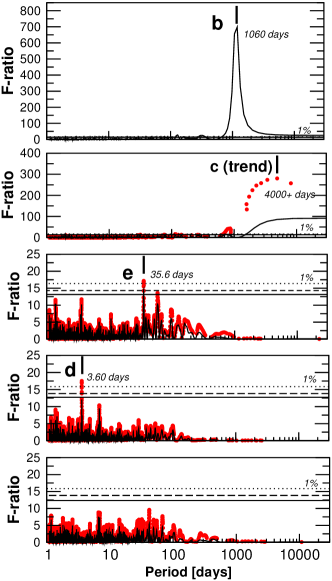
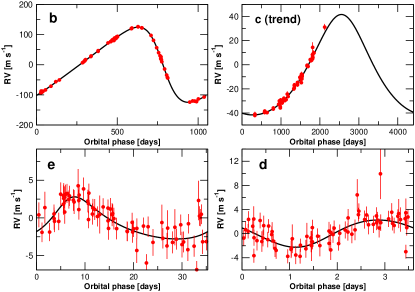
- 本研究确认了先前报道的巨型气态行星候选体(GJ 676Ab),并在径向速度中检测到长期趋势,表明存在一颗质量巨大的外侧行星,其周期暂估为4000天或更长。
- 新发现的两颗超级-Earth候选体(GJ 676Ad 和 GJ 676Ac)被可靠探测到,其最小质量分别为~4.5 M⊕,轨道周期分别为~3.6天和~15.5天。
- 贝叶斯MCMC分析提供了支持四颗行星的解,参数区间约束良好;而基于周期图的方法在获得25次额外测量后也确认了相同信号。
- 该系统在已知系外行星系统中展现出最宽的最小质量范围(4.5 M⊕ 至 5 Mjup)与轨道周期范围(3.6天至>10年),接近太阳系的多样性。
- 靠近的超级-Earth候选体GJ 676Ad具有约5%的凌星概率,使其成为光变曲线后续观测以确认其性质的优先目标。
- 贝叶斯与经典方法的结合显著提升了检测结果的置信度,其中贝叶斯方法在探测低振幅信号方面表现出更优灵敏度,并显著降低了误报风险。
更好的研究,从现在开始
从论文设计到论文写作,大幅缩短您的研究时间。
无需绑定信用卡
本解读由 AI 生成,并经人工编辑审核。