
[论文解读] A Portable Parton-Level Event Generator for the High-Luminosity LHC
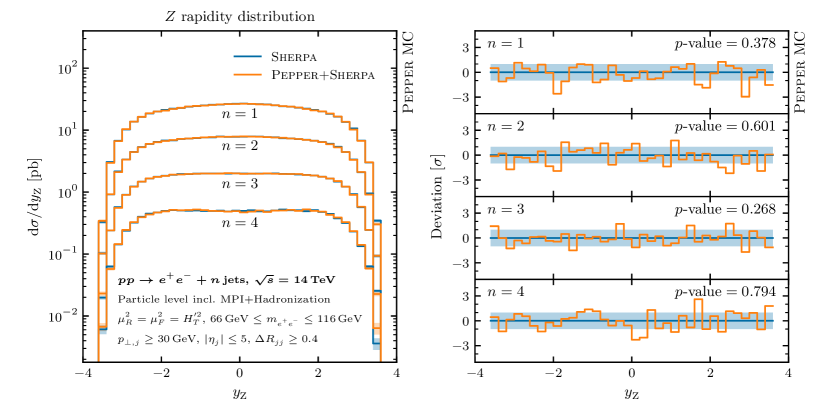
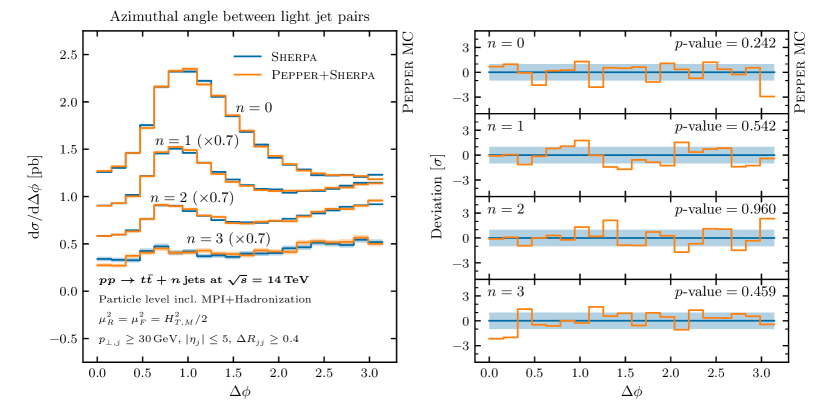
本文提出 Pepper,一个针对高亮度 LHC 的便携式、硬件无关的部分子级事件生成器,专为现代计算架构(包括 CPU、GPU 和加速器)优化。在 H100 GPU 上,对于产生顶夸克对并伴随四胶子的事件,其性能最高可达每小时 29 亿个未加权事件,相较于传统框架在性能和可持续性方面均有显著提升,同时保持与现有仿真流水线的完全兼容。
Profiling results for top pair plus jets production with Pepper v1.1.1 Contents This includes data/output for the following GPU accelerated unweighted event generation runs: A run over a few seconds to produce pepper-internal timing results (`*timers.csv` files) The same run, but with `nvprof` (`*.nvprof` files) A run with a single event batch, with `ncu --import-source on --set full` (`*.ncu-rep` files) The simulated process is top pair production with n jets, with n = 0...4, at 13 TeV. The configuration files (`pepper.ini`) are included. Also the `pepper_cache` directories are included. All results are for the "main" pepper variant (which uses Kokkos to utilise the GPU) and for the "native" pepper variant (which uses CUDA directly). Software stack and CPU/GPU hardware details The software/hardware used for the profiling are as follows: GPU Driver: NVIDIA-SMI: 550.100, Driver Version: 550.100, CUDA Version: 12.4 GPU: Tesla V100S-PCIE-32GB Cuda compilation tools: release 11.6, V11.6.124 Kokkos 4.3.01 gcc (GCC) 11.4.1 20231218 (Red Hat 11.4.1-3) Intel(R) Xeon(R) Silver 4214R CPU @ 2.40GHz Note that the event generation includes write-out of event files. The LHEH5 files are written to local SSD storage. The event files are not included in this dataset. Additional run parameters TTBar number of batches batch size rate (main variant) rate (native variant) +0j 20 1,179,648 1.4e10 2.0e10 +1j 20 1,179,648 1.5e10 2.4e10 +2j 20 1,179,648 * 2 1.3e10 2.7e10 +3j 20 1,179,648 / 2 6.4e9 1.4e10 +4j 20 1,179,648 2.2e9 2.2e9 The number of batches has been chosen such that the most important sub processes are samples and such that the overall runtime is at least a few seconds. The batch size has been chosen by scanning over factors of two and picking the best-performing batch size with the native variant. The event rate is the number given in the Pepper output. It does not include the closing time of the generated HDF5 file, which can be significant for the two lowest multiplicities. This can be checked by inspecting the corresponding relative and absolute timing results in the `*timing.csv` files included in the dataset.
研究动机与目标
- 为解决高亮度 LHC 仿真中部分子级事件生成日益增长的计算与生态负担。
- 实现在包括 GPU 和加速器在内的多种现代硬件上高效、可移植且可扩展的事件生成。
- 通过提升性能与资源利用率,降低蒙特卡洛模拟的碳足迹。
- 提供一个可投入生产的开源框架,与现有对撞机理论物理仿真流水线完全兼容。
- 通过算法与硬件感知的优化,克服高胶子多重性下低未加权效率导致的性能瓶颈。
提出的方法
- 该框架采用 C++ 与 CUDA 实现便携、模块化的架构,抽象硬件特定细节,实现跨平台部署。
- 采用自适应相空间积分,结合解析解与受神经网络启发的采样方法,提升效率。
- 矩阵元通过 Berends–Giele 递归计算,结合优化的自旋态求和与主导色投影。
- 事件生成在多个核心与设备间实现并行,输出流水线可配置,以最小化 I/O 瓶颈。
- 系统支持动态负载均衡,并与 Chili 相空间生成器集成,实现高精度采样。
- 采用轻量级事件数据布局,并支持异步 I/O,实现计算与存储的解耦。
实验结果
研究问题
- RQ1单一、便携的事件生成器是否能在包括 CPU 和 GPU 在内的多种硬件平台上,对高胶子多重性的 LHC 过程实现高性能?
- RQ2与 Comix 等传统工具相比,新框架在事件生成速率与资源效率方面表现如何?
- RQ3硬件无关设计在高能物理仿真中在可移植性与可持续性方面提升程度如何?
- RQ4现代事件生成中的主要性能瓶颈是什么?在异构架构上如何缓解?
- RQ5该框架能否在包含最多五个额外胶子的进程中(如 $t\bar{t}+4j$ 或 $Z+5j$)保持高未加权效率?
主要发现
- 在 NVIDIA H100 GPU 上,Pepper 对 $pp \to t\bar{t}+4j$ 事件的生成速度最高可达每小时 29 亿个未加权事件,相比仅使用 CPU 的基线提升 2.5 倍。
- 对于 $pp \to e^+e^-+5j$ 事件,Pepper 在 H100 上每小时可生成 13,000 个事件,而 CPU 仅能生成 380 个,实现 34 倍加速。
- 在 2× Skylake8180 CPU 上,Pepper 的事件生成速率相比 Comix 最高提升 35%,即使 Comix 运行在非默认的优化模式下。
- 在 GPU 上,由于单线程 I/O,事件输出成为低多重性过程的主要瓶颈,表明需要多核 I/O 分离机制。
- 该框架在多节点环境下表现出良好可扩展性,在 CPU 集群与 Fermilab 的 Wilson 集群等 GPU 加速系统上均表现强劲。
- 运行时性能分析显示,在 CPU 上矩阵元计算占主导,而在 GPU 上 I/O 占主导,凸显未来版本需优化 I/O 流水线。
更好的研究,从现在开始
从阅读论文到最终审阅,大幅缩短您的研究时间。
无需绑定信用卡
本解读由 AI 生成,并经人工编辑审核。